
Why Good Documentation Matters in a Tax Audit and Investigation
Tax Audit & Compliance
Introduction: Your Records Should Tell the Story of Your Business
Imagine receiving a BIR notice asking your business to explain a particular sale, purchase, expense, or tax treatment.
You know the transaction happened. It appears in your accounting records. Your tax return has already been filed.
But can you show what actually happened?
Can you locate the invoice, contract, proof of payment, delivery record, computation, and other documents that support the transaction?
Can you explain how the amount was recorded in your books and how it was treated in your tax return?
These questions illustrate why documentation matters.
Good documentation is not simply about keeping papers. It is about preserving the evidence that explains your business transactions.
During a tax audit or investigation, records may be needed to help establish what happened, why it happened, how it was recorded, and how it was reported for tax purposes.
A business that organizes its records as transactions occur is generally in a better position to explain its tax reporting than one that tries to reconstruct everything only after receiving an inquiry.
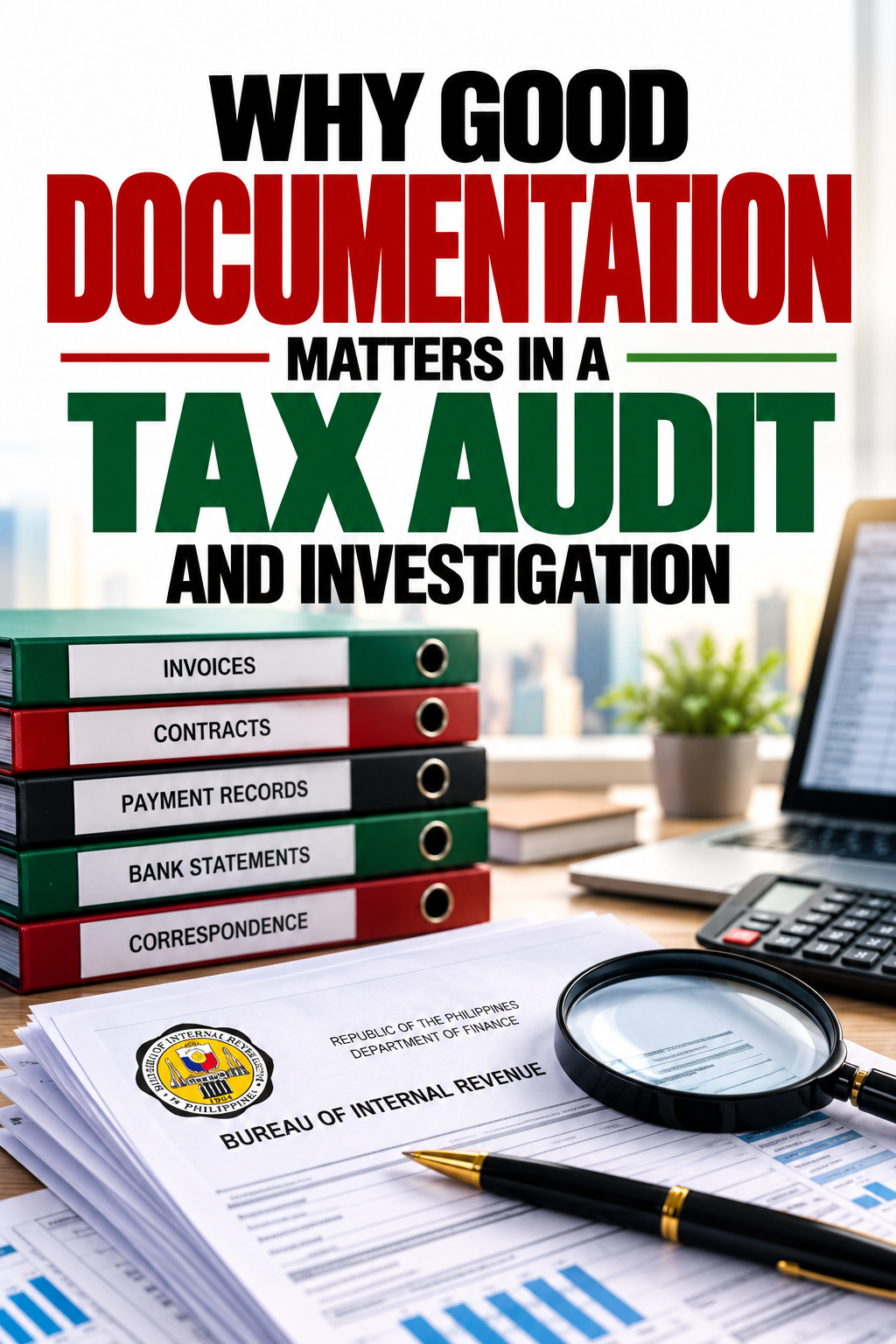
1. Documentation Connects Transactions to the Numbers in Your Books
Every accounting entry should have a business explanation.
For example, your books may show:
Sales revenue of ₱800,000;
Purchases of ₱250,000;
Professional fees of ₱120,000;
Rent expense of ₱60,000; or
Equipment purchased for ₱300,000.
The figures are only the starting point.
A reviewer may need to understand:
What transaction occurred?
Who were the parties?
What goods or services were involved?
When did the transaction happen?
How was the amount computed?
What document supports the transaction?
How was the transaction recorded?
How was it treated for tax purposes?
The supporting documents help connect the accounting entry to the underlying transaction.
The more clearly a transaction can be traced from its source documents to the books and tax returns, the easier it is to explain.
2. A Tax Return Is Not the Same as Supporting Evidence
Filing a tax return is an important compliance responsibility. But the return itself does not necessarily explain every transaction included in it.
Consider a business that claimed an expense in its income tax return.
The return may show the total amount claimed, while the accounting records show the individual entries. The supporting documents help explain the nature and business purpose of those entries.
Depending on the transaction, relevant records may include:
Sales or purchase invoices;
Contracts and agreements;
Purchase orders;
Delivery receipts or other delivery records;
Proof of payment;
Bank statements;
Payroll records;
Withholding tax records and certificates;
Expense reports;
Computation schedules;
Correspondence relating to the transaction; and
Other documents relevant to the facts.
The specific records needed depend on the nature of the transaction and the tax treatment involved.
The practical lesson is this:
Do not rely on the tax return alone to explain a transaction. Keep the records that support what was reported.
3. Good Documentation Helps Support Tax Deductions and Claims
Businesses may incur expenses in earning income. However, recording an expense does not automatically establish that it qualifies for a particular tax treatment.
The business should be able to explain the expense and retain the records relevant to its claim.
For example, suppose a company records ₱400,000 as professional fees.
Useful questions include:
Who provided the service?
What service was performed?
Was there an engagement letter or contract?
Is there an invoice or other relevant supporting document?
How was the fee computed?
Was payment made?
Was withholding tax applicable?
Was the transaction recorded in the appropriate period?
The documents required will depend on the circumstances and the applicable tax rules.
The key point is that a bookkeeping entry is not a substitute for the evidence supporting the transaction.
4. Invoices Are Important—but They May Not Be the Only Relevant Record
Invoices are important records of business transactions.
Under the Ease of Paying Taxes Act and its implementing rules, the invoice is the primary document for documenting sales of goods and services, subject to the applicable requirements. BIR regulations also distinguish invoices from supplementary documents used as sources of accounting entries.
Depending on the circumstances, other documents may help establish:
What was ordered;
What was delivered or performed;
Whether the service was completed;
How the price was determined;
Whether payment was made;
Whether the transaction was modified; or
How the amount was recorded.
For example, a service invoice may identify the service provider and amount charged. An engagement letter, service report, correspondence, and proof of payment may provide additional context about the transaction.
Keep the invoice and the other records that help explain the transaction.
5. Documentation Helps Reconcile Your Books and Tax Returns
A business may maintain several sets of records:
BOOKS OF ACCOUNTS The transactions recorded by the business.
TAX RETURNS The amounts reported to the BIR.
SUPPORTING DOCUMENTS The records that explain and support the transactions.
These records should be capable of being reconciled where applicable.
For example:
Sales recorded in the books should be explainable in relation to the sales reported for tax purposes.
Expenses recorded in the books should be supported by relevant records.
Withholding tax amounts should be traceable to the underlying payments and reporting.
Payroll records should be consistent with the related accounting and tax records.
Asset purchases should be traceable to the relevant documents and accounting treatment.
Differences may have legitimate explanations. However, unexplained differences can create questions that take time and effort to resolve.
A periodic reconciliation helps identify issues while the people involved still remember the transactions and the documents are easier to retrieve.
6. Documentation Is Especially Important When Transactions Are Unusual
Routine transactions are often easier to explain because the business follows a regular process.
Unusual or significant transactions may require more attention.
Examples include:
Large or one-time purchases;
Transactions with related parties;
Major repairs or improvements;
Loans and advances;
Write-offs;
Business restructuring;
Unusual discounts or adjustments;
Transactions involving several contracts or stages; and
Transactions with significant tax consequences.
For these transactions, the business should consider keeping a clear record of the commercial purpose, approvals, calculations, and supporting documents.
A useful question to ask is:
If the person who handled this transaction leaves the company, will someone else be able to understand what happened from the records?
If the answer is no, the documentation may need improvement.
7. Keep Records Organized Before a BIR Inquiry
Trying to collect documents only after receiving a notice can be stressful.
The business may need to locate records from different departments, employees, suppliers, customers, or service providers.
Some documents may be stored in email. Others may be in accounting software, shared folders, filing cabinets, or the personal files of employees.
A simple but consistent filing system can make a significant difference.
For each transaction, consider organizing records by:
Tax year or accounting period;
Transaction date;
Customer or supplier;
Transaction type;
Invoice or document number; and
Relevant account or tax category.
The exact system may vary depending on the size and nature of the business.
What matters is that the records are complete, secure, readable, and retrievable.
8. Understand Your Recordkeeping and Preservation Responsibilities
Philippine tax rules require taxpayers to preserve books of accounts and other accounting records.
The Ease of Paying Taxes Act amended Section 235 of the National Internal Revenue Code to provide for a five-year preservation period, reckoned from the day following the deadline for filing the return—or, if filed after the deadline, from the date the return was filed—for the taxable year when the last entry was made in the books.
A practical records policy should identify:
Which records must be retained;
Where they are stored;
Who is responsible for maintaining them;
How electronic records are backed up;
How records can be retrieved; and
When records may be reviewed for authorized disposal.
If a tax audit, investigation, assessment, or other proceeding is pending, seek professional advice before destroying records that may be relevant.
9. Electronic Records Need Proper Management, Too
Many businesses now store invoices, accounting reports, contracts, bank records, and other documents electronically.
Electronic storage can make records easier to organize and retrieve—but only if the system is maintained properly.
Consider whether your business has:
A consistent folder structure;
Clear file names;
Access controls;
Regular backups;
A process for retaining important emails and attachments;
A way to retrieve documents by transaction or period; and
A process for checking that stored files remain readable.
BIR rules address the maintenance and availability of electronic records. Taxpayers should ensure that records required for determining tax liability can be made available when properly requested.
The goal is not just to save files. The goal is to maintain usable records.
10. What Should You Do When You Receive a BIR Notice?
If your business receives a BIR notice or communication, do not ignore it or assume that every notice means the same thing.
Read the document carefully and identify:
The issuing office;
The taxpayer or tax period involved;
The subject of the notice;
The records or information requested;
The applicable response date or deadline; and
The next action required.
If the matter involves a tax audit or investigation, the business should coordinate with its authorized representative or qualified tax professional.
A Letter of Authority is relevant to the authority of revenue officers to examine a taxpayer’s books and records. The Supreme Court has discussed the importance of proper authority in tax examinations, including in Commissioner of Internal Revenue v. McDonald’s Philippines Realty Corp.
Act promptly, preserve relevant records, and obtain professional guidance when needed.
11. A Practical Documentation Checklist for Business Owners
Use this checklist to review your business’s documentation practices.
Sales and Revenue
Purchases and Expenses
Payroll and Withholding
Books and Tax Returns
Recordkeeping System
12. Documentation Is a Business Process—not a Last-Minute Task
Documentation should be part of the way a business operates.
It should happen when:
A sale is made;
A purchase is approved;
A service is performed;
An employee is paid;
A contract is signed;
An asset is acquired;
A payment is made; or
An accounting entry is recorded.
When documentation is left until year-end—or until a BIR inquiry arrives—important details may already be difficult to recover.
A better approach is to establish clear responsibilities and procedures so that documents are created, collected, reviewed, and stored as transactions occur.
This helps the business maintain more reliable records and makes future review more manageable.
The Bottom Line
Good documentation helps your business explain what happened—not merely show what was recorded.
A tax return reports information. The books organize the transactions. Supporting documents help establish the facts behind those numbers.
When these records are complete, organized, and consistent, the business is better prepared to explain its transactions and respond to questions.
The important question is not only:
“Did we record the transaction?”
It is also:
“Can we explain and support the transaction with reliable records?”
That is why documentation should be built into your business processes from the beginning—not assembled only when a tax inquiry arrives.
Need Help Reviewing Your Tax Documentation?
Your business may already have invoices, accounting records, contracts, and tax returns. The next step is to determine whether these records work together as a reliable documentation system.
If you need professional guidance on tax compliance, documentation, bookkeeping, or preparing for a tax audit or investigation, you may discuss your specific circumstances with us.
BOOK A CONSULTATION →
Disclaimer
This article is provided for educational and conceptual purposes only and does not constitute tax, legal, accounting, or other professional advice. Tax rules and administrative requirements may change, and their application depends on the taxpayer’s particular facts and circumstances. Consult a qualified professional regarding your specific situation.
LEARN • STRENGTHEN • COMPLY
Trainings, Seminars & Webinars
Practical learning for business owners, professionals and teams.


- services@easantoscpa.com
- +63 916 587 1528
- Topaz Building, Kamias Road, Quezon City
- Office visit: By Appointment only.
- Strictly NO Walk-In
- Affiliate: ptabcpsolutions.com
Disclaimer: Posts are provided for educational and conceptual purposes only. They do not constitute professional advice. You are advised to consult a qualified professional regarding your specific circumstances.