
What Your Books Should Tell You About Your Business
Bookkeeping and Business Systems
Your accounting records should do more than help you prepare tax returns. When properly maintained and reviewed, they can help you understand where your business stands, identify issues early, and make more informed decisions.
Below is a full draft for your WordPress blog, followed by the homepage card text.
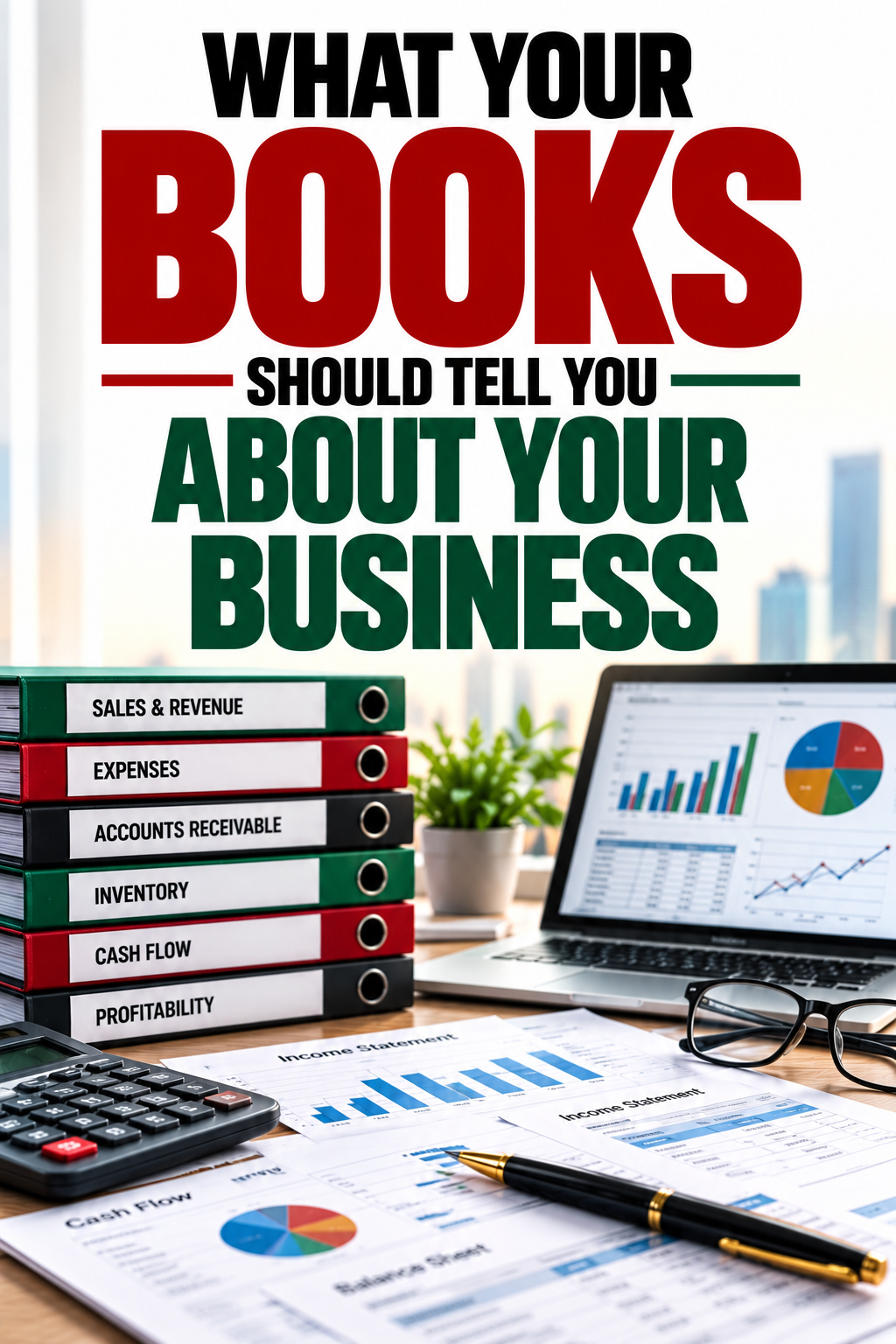
Introduction: Your Books Are More Than a Compliance Requirement
Many business owners think of bookkeeping as a task they need to complete for tax filing.
They collect invoices, record expenses, prepare reports, and submit information to their accountant or bookkeeper. Once the tax return is filed, they may not look at the numbers again until the next deadline.
But your books can tell you much more than how much tax you may need to pay.
When records are complete, updated, and properly reviewed, they can help you understand:
Whether your business is earning a profit;
Where your money is going;
Whether customers are paying on time;
Whether your expenses are increasing;
Whether you have enough cash to meet upcoming obligations;
Which products or services contribute to your results; and
Whether your business is growing sustainably.
Your books should help you understand your business—not just report what happened.
In the Philippines, businesses required to keep books of accounts must maintain appropriate records of their transactions. Those records can also serve as a practical source of information for managing the business.
Let’s look at what your books should help you see.
1. Are You Actually Earning a Profit?
One of the first questions a business owner should ask is:
“Are we making money?”
Your sales may be increasing. Your business may have more customers. You may even have more cash coming into the bank.
But none of those facts, by themselves, proves that the business is profitable.
To understand profitability, you need to compare your income with the costs and expenses incurred in generating it.
For example, consider this simplified monthly result:
Item | Amount |
|---|---|
Sales | ₱800,000 |
Cost of goods sold | ₱450,000 |
Gross profit | ₱350,000 |
Operating expenses | ₱260,000 |
Operating profit before other items | ₱90,000 |
In this example, the business generated ₱800,000 in sales, but the amount remaining after the listed costs and expenses was much smaller.
This is why looking only at sales can be misleading.
Your books should help you understand:
How much revenue you generated;
What it cost to provide your goods or services;
How much remained after direct costs;
How much you spent to operate; and
Whether the business earned a profit for the period.
What to review
Review your income statement or profit-and-loss report regularly. Compare the results with prior months, the same period last year, and your business targets.
A single month may not tell the whole story. Look for patterns over time.
2. Where Is Your Money Going?
A business can generate substantial revenue and still struggle financially if its costs and expenses are not controlled.
Your books should help you identify where money is being spent.
Common expense categories may include:
Salaries and wages;
Rent;
Utilities;
Transportation and delivery;
Professional fees;
Supplies;
Repairs and maintenance;
Advertising and marketing;
Software subscriptions; and
Interest and financing costs.
The important question is not simply whether an expense exists. It is whether the expense is reasonable for the business, properly recorded, and contributing to operations or growth.
For example, if your sales remain relatively stable but your operating expenses increase every month, your profit may gradually decline.
A useful review includes:
Comparing expenses with previous periods;
Identifying unusually large or unexpected amounts;
Checking recurring subscriptions and service costs;
Reviewing expenses that increased faster than sales; and
Confirming that significant expenses have proper supporting records.
Your books should help you spot changes before they become bigger problems.
3. Are Your Customers Paying You on Time?
If your business sells on credit, your sales report may show that you earned revenue even though the customer has not yet paid.
That means your business may have recorded a sale but still be waiting for the cash.
Your accounts receivable records should help you identify:
Who owes the business;
How much each customer owes;
When the amount became due;
Which invoices are overdue; and
How long balances have remained unpaid.
A useful tool is an accounts receivable aging report, which groups unpaid customer balances according to how long they have been outstanding.
For example:
Customer | Current | 1–30 Days Overdue | 31–60 Days Overdue | Over 60 Days |
|---|---|---|---|---|
Customer A | ₱40,000 | — | — | — |
Customer B | — | ₱25,000 | — | — |
Customer C | — | — | ₱18,000 | — |
Customer D | — | — | — | ₱35,000 |
This type of report can help you decide which customers need follow-up and whether your collection procedures need improvement.
Why it matters
Late collections can affect your ability to pay suppliers, employees, rent, taxes, and other obligations.
A profitable sale is not the same as cash already received.
4. Do You Have Enough Cash to Meet Your Obligations?
Profit and cash are related, but they are not the same.
A business may report a profit and still experience cash shortages.
This can happen when:
Customers have not yet paid;
Inventory has been purchased but not sold;
The business has made large equipment purchases;
Loan principal payments are due;
Taxes or other obligations are coming up; or
Cash is tied up in deposits, advances, or other assets.
Your cash records should help you understand the money available and the payments expected.
Review:
Bank balances;
Cash on hand;
Expected customer collections;
Supplier payments;
Payroll dates;
Loan payments;
Tax payment deadlines; and
Other upcoming commitments.
A simple cash-flow forecast can help you estimate whether expected cash receipts will be enough to cover planned payments.
A practical question
“If our customers paid only what they currently owe, would we have enough cash to meet the next month’s obligations?”
The answer can help you decide whether to follow up on collections, adjust spending, or plan financing.
5. Are You Managing Your Inventory Properly?
For businesses that sell goods, inventory is often one of the most important assets.
Your inventory records should help you understand:
What items are available;
How much inventory is on hand;
Which products sell quickly;
Which products move slowly;
Which items may be damaged or obsolete; and
Whether recorded quantities agree with actual stock.
Inventory that stays on the shelves for too long may tie up money that could otherwise be used for operations.
On the other hand, insufficient inventory may result in missed sales or delays in serving customers.
Compare inventory records with physical counts at appropriate intervals. Investigate differences rather than simply adjusting the numbers without understanding what caused them.
Your records should help answer:
“Are we buying the right quantities, and are we turning our inventory into sales?”
6. Which Products or Services Are Contributing to Your Results?
Total sales can hide important differences between products, services, customers, or business locations.
For example, one service may generate substantial revenue but also require significant labor and other costs. Another service may generate lower revenue but contribute more toward covering the business’s operating expenses.
If your accounting system and records allow it, review results by:
Product or service;
Branch or location;
Business unit;
Customer group; or
Project.
This may help you identify which areas are growing, which require attention, and where additional resources may be needed.
However, avoid making decisions based only on revenue. Consider the relevant direct costs, shared expenses, capacity, and business objectives.
Your books should help you understand not only how much you sell, but also what contributes to your results.
7. Are Your Business Expenses and Personal Expenses Properly Separated?
For sole proprietors and small businesses, owners may sometimes use the same bank account or payment method for business and personal transactions.
This can make it harder to understand the business’s actual financial performance.
It may also complicate the classification and documentation of transactions.
A more reliable process is to:
Use separate business and personal accounts where appropriate;
Clearly identify owner contributions and withdrawals;
Keep records of business payments made personally by the owner;
Avoid recording personal expenses as business expenses; and
Review unusual transactions with your accountant or bookkeeper.
The goal is to maintain records that clearly distinguish business activity from personal activity.
This makes it easier to understand the business’s income, expenses, assets, liabilities, and cash position.
8. Are Your Books Consistent With Your Tax Reporting?
Your books should not exist separately from your tax compliance process.
The accounting records provide information used to prepare and support tax reporting, while tax returns report amounts according to the applicable tax rules.
Differences may arise for legitimate reasons. For example, accounting treatment and tax treatment may differ for particular items.
The important point is that those differences should be understood and properly explained.
Review whether:
Recorded sales can be reconciled with reported sales;
Expenses are properly classified and supported;
Withholding tax records can be traced to the relevant transactions;
Tax adjustments are documented;
Filing and payment confirmations are retained; and
Books and tax returns are reviewed for inconsistencies.
Philippine tax rules require taxpayers to maintain books and supporting accounting records. The BIR’s rules also address preservation of these records, including source documents supporting book entries.
The specific treatment depends on the transaction and applicable rules.
9. Are Your Records Complete and Reliable?
Reports are only as useful as the information behind them.
If transactions are missing, duplicated, incorrectly classified, or recorded in the wrong period, your reports may give you an inaccurate picture of the business.
Your bookkeeping process should include regular checks for:
Missing invoices or receipts;
Duplicate entries;
Unusual balances;
Unreconciled bank transactions;
Customer balances that do not agree with records;
Supplier balances that require confirmation;
Inventory differences;
Unusual journal entries; and
Transactions recorded in the wrong period.
Bank reconciliation is especially useful because it compares the business’s cash records with the bank’s records and helps identify differences that need investigation.
Other accounts may also require reconciliation, depending on the business.
Don’t wait until year-end
Reviewing records regularly makes it easier to identify errors while the transactions are still recent and supporting documents are easier to locate.
10. Are You Keeping Records That Can Be Retrieved When Needed?
A business may have documents but still struggle to use them if they are scattered across email accounts, personal computers, paper folders, and different employees’ files.
A practical recordkeeping system should make it possible to retrieve documents by date, transaction, customer, supplier, or accounting period.
Consider whether your business has:
A consistent folder structure;
Clear file names;
A process for collecting source documents;
Access controls for confidential information;
Backups for electronic records;
A way to retrieve records when an employee is unavailable; and
A policy for preserving records.
The BIR’s rules provide for the preservation of books of accounts and other accounting records, including supporting documents. The applicable retention period and requirements should be checked against current rules and the taxpayer’s circumstances.
11. How Often Should You Review Your Books?
The appropriate review schedule depends on the size, complexity, and transaction volume of your business.
A practical starting point may look like this:
Weekly
Check cash balances and collections;
Review urgent supplier payments;
Record transactions and collect supporting documents;
Follow up on overdue customer accounts.
Monthly
Review the income statement;
Review cash flow and upcoming obligations;
Reconcile bank accounts;
Review accounts receivable and payable;
Check inventory, if applicable;
Compare results with prior months or business targets.
Quarterly
Review trends in revenue, expenses, and profitability;
Review tax compliance and reporting matters;
Check whether business processes are working as intended;
Discuss significant changes with your accountant or adviser.
Annually
Review the full-year financial results;
Assess whether the business met its targets;
Identify recurring issues;
Plan improvements for the next year; and
Coordinate year-end accounting and tax requirements.
These are general management suggestions, not a substitute for any specific statutory filing or accounting deadline.
12. Questions Every Business Owner Should Ask About Their Books
When reviewing your records, ask:
Are we earning a profit?
Which costs and expenses are increasing?
Are customers paying on time?
Do we have enough cash for upcoming obligations?
Is inventory moving as expected?
Which products or services are contributing to our results?
Are business and personal transactions properly separated?
Are our books consistent with our tax reporting?
Are our records complete and supported?
Can we retrieve important documents when needed?
If you cannot answer these questions from your current reports, it may be time to improve your bookkeeping process or the way you review financial information.
The Bottom Line: Your Books Should Help You Make Better Decisions
Bookkeeping is not just about recording transactions after they happen.
It is about creating reliable information that helps you understand the business.
Your books should help you see whether you are earning a profit, where your money is going, whether customers are paying, how your cash is being used, and whether your records support your tax reporting.
You do not need to be an accountant to ask meaningful questions about your business.
But you do need records that are accurate, organized, updated, and explained in a way you can understand.
Don’t just ask, “Are our books updated?”
Ask:
“What are our books telling us about the health of our business—and what should we do next?”
Need Help Understanding Your Business Records?
Your accounting records may contain useful information that is not being reviewed regularly.
If you need help improving your bookkeeping process, reviewing your records, or understanding how your financial information supports business decisions and tax compliance, you may discuss your specific circumstances with us.
BOOK A CONSULTATION →
Disclaimer
This article is provided for educational and conceptual purposes only and does not constitute tax, legal, accounting, or other professional advice. Tax rules and administrative requirements may change, and their application depends on the taxpayer’s particular facts and circumstances. Consult a qualified professional regarding your specific situation.
LEARN • STRENGTHEN • COMPLY
Trainings, Seminars & Webinars
Practical learning for business owners, professionals and teams.

- services@easantoscpa.com
- +63 916 587 1528
- Topaz Building, Kamias Road, Quezon City
- Office visit: By Appointment only.
- Strictly NO Walk-In
- Affiliate: ptabcpsolutions.com
Disclaimer: Posts are provided for educational and conceptual purposes only. They do not constitute professional advice. You are advised to consult a qualified professional regarding your specific circumstances.