
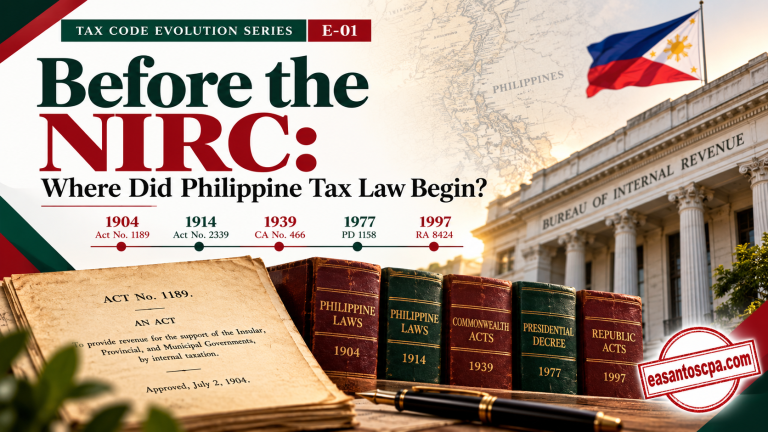
BEFORE THE NIRC: WHERE DID PHILIPPINE TAX LAW BEGIN?
Tax Code Evolution Series
When we talk about Philippine tax law today, we usually start with the National Internal Revenue Code (NIRC).
We look at the applicable section.
We check the latest Revenue Regulation.
We search for the latest BIR issuance.
We look at what the courts have said.
But there is a question that is often overlooked:
Where did Philippine internal-revenue law actually begin?
The answer is not the 1997 NIRC.
In fact, it is not even the 1977 NIRC.
To understand today’s Philippine tax system, we need to go back to one of the most important early milestones in the development of our internal-revenue system:
Act No. 1189 of 1904 — the Internal Revenue Law of 1904.
But first, an important clarification:
Act No. 1189 was not the first tax law in Philippine history.
Taxation existed long before 1904.
What made Act No. 1189 historically significant was not that it introduced taxation to the Philippines, but that it established an important statutory and institutional framework for internal revenue under the early civil government. Section 2 established the Bureau of Internal Revenue, headed by the Collector of Internal Revenue, while Section 3 placed the assessment and collection of the taxes and excises imposed by the law under the Collector’s general superintendence.
In other words, the law did not merely identify sources of government revenue. It also established an institution and administrative machinery for administering those taxes.
BEFORE THERE WAS A BIR, THERE WAS ALREADY TAXATION
The Philippines had systems of taxation and revenue collection long before the modern BIR existed.
During earlier periods of Philippine history, governments imposed various forms of tribute, taxes, fees and other revenue exactions.
What changed over time was the development of a more organized system for:
- imposing taxes;
- assessing tax liabilities;
- collecting taxes;
- maintaining records;
- regulating taxpayers;
- enforcing tax laws; and
- resolving tax disputes.
In other words:
Taxation existed before the modern tax administration system.
The development of Philippine tax law was therefore not simply about creating taxes.
It was also about creating the legal and administrative machinery needed to administer those taxes.
THE INTERNAL REVENUE LAW OF 1904
On July 2, 1904, Act No. 1189 was enacted.
Its full title was:
“An Act to Provide Revenue for the Support of the Insular, Provincial, and Municipal Governments, by Internal Taxation.”
The law itself referred to it as the Internal Revenue Law of 1904.
Act No. 1189 was enacted on July 2, 1904 and took effect on August 1, 1904.
One of its most important provisions was Section 2, which established:
“A Bureau of Internal Revenue”
The law also created the position of Collector of Internal Revenue and placed the Bureau under the Department of Finance and Justice.
Section 3 placed the assessment and collection of the taxes and excises imposed by the law under the general superintendence of the Collector of Internal Revenue.
This was a significant development.
The law was not simply saying:
“Here are the taxes.”
It was also saying:
“Here is the government institution that will administer them.”
That principle remains fundamental to Philippine taxation today.
TAX LAW HAS ALWAYS BEEN MORE THAN TAX RATES
One of the most interesting things about Act No. 1189 is that it did not merely establish taxes.
It also dealt with the administration and enforcement of taxation.
The law contained provisions concerning matters such as:
- assessment;
- collection;
- registration;
- revenue officers;
- inspection;
- records;
- seizures;
- enforcement;
- penalties;
- tax liens; and
- collection of delinquent taxes.
The law even authorized the Collector, in certain circumstances, to determine the amount of tax based on the best evidence obtainable when a required report was not submitted or when there was reason to believe that a report was false, incomplete or erroneous.
Think about how familiar some of these concepts sound to a taxpayer today.
Assessment.
Records.
Evidence.
Delinquent taxes.
Enforcement.
These concepts did not suddenly appear in the modern NIRC.
These were not entirely new concerns created by the modern NIRC. Important elements of tax administration and enforcement can already be found in the early internal-revenue laws.
RECORDS AND DOCUMENTS WERE ALREADY PART OF TAX ADMINISTRATION
Today, taxpayers are accustomed to hearing about:
- books of accounts;
- invoices;
- receipts;
- supporting documents;
- tax returns; and
- records.
It may be tempting to think that documentary compliance is a modern BIR requirement.
It is not.
The early internal-revenue laws already recognized the importance of records and documentary evidence in administering taxation.
The Internal Revenue Law of 1914, Act No. 2339, made this even clearer. Section 5 authorized regulations necessary to carry the law into effect, while Section 6 specifically contemplated rules concerning the manner in which proper books, records, invoices and other papers were to be kept and entries made by persons subject to tax.
This is an early illustration of something taxpayers still encounter today:
Tax compliance requires both a legal obligation and documentary evidence of compliance.
This gives us an important lesson:
Tax administration has always depended on evidence.
The technology has changed.
The forms have changed.
The terminology has changed.
But the fundamental question remains:
Can the taxpayer’s records support what the taxpayer is reporting to the government?
WHAT TAXES DID THE 1904 LAW COVER?
Act No. 1189 already dealt with a variety of internal-revenue sources.
Act No. 1189 already covered a wide range of internal-revenue sources, including license taxes, specific taxes on various products, taxes on banks and insurance companies, stamp taxes, cedula personal tax, forestry products, certain mining concessions, and taxes on business, manufacture and occupation.
So even in the early development of the modern internal-revenue system, Philippine taxation was already a multi-tax system.
There was no single tax that applied to everyone in the same way.
Different taxpayers, activities and transactions could trigger different tax obligations.
That characteristic remains true today.
TAXPAYER DISPUTES WERE ALSO PART OF THE SYSTEM
Another important feature of the early internal-revenue laws is that they did not simply give government the power to collect.
They also contained provisions dealing with disputes and recovery.
Act No. 1189 included provisions concerning matters such as:
- payment under protest;
- recovery of taxes;
- refunds;
- compromise;
- forfeiture;
- tax liens;
- distraint;
- levy; and
- collection of delinquent taxes.
That tells us something important about the nature of Philippine taxation:
Tax administration has never been simply “BIR imposes, taxpayer pays.”
From an early stage, the system involved a relationship between:
Taxation → Assessment → Collection → Dispute → Remedy → Enforcement
As the years passed, each of these areas would become increasingly detailed.
BUT ACT NO. 1189 DID NOT REMAIN THE LAW FOREVER
And this is where the evolution of the Tax Code becomes important.
Act No. 1189 was eventually replaced.
On February 27, 1914, Act No. 2339 was enacted.
Its title was:
“An Act Revising and Consolidating the Laws Relative to Internal Revenue.”
Notice the words:
REVISing and CONSOLIDATING
Those words tell us something important about tax law.
Tax laws evolve.
A law is enacted.
Then:
- amendments are made;
- new taxes are created;
- administrative problems arise;
- economic conditions change;
- government policies change;
- courts interpret provisions; and
- eventually, legislation may be revised or consolidated.
Act No. 2339 repealed Act No. 1189 and its amendatory laws, subject to specified exceptions.
The process of evolution had already begun.
THE FIRST BIG LESSON OF TAX CODE EVOLUTION
This is perhaps the most important thing to take away from this article:
The Philippine Tax Code did not appear overnight.
Today’s NIRC is the product of a long process of:
Enactment
↓
Amendment
↓
Implementation
↓
Interpretation
↓
Revision and Consolidation
↓
Further Amendment
That process continues even today.
This is why a taxpayer should be careful when someone says:
“The Tax Code says…”
The next question should be:
“Which version?”
WHY THE HISTORY OF A TAX PROVISION CAN MATTER
Suppose you encounter a tax provision in today’s NIRC.
You might think the research process is simply:
Find the section → read the section → apply the section.
Sometimes that is enough.
But not always.
A provision may have:
- originated under an earlier law;
- been amended several times;
- been renumbered during a later codification;
- been implemented by regulations;
- been interpreted by the Supreme Court or CTA; and
- later been amended again.
That means the history of a provision can sometimes help explain its present form and meaning.
Philippine Supreme Court decisions have themselves traced the lineage of tax provisions through earlier statutes and later codifications.
So when we study the Tax Code, we should not look at it as a static document.
We should look at it as a living body of law.
FROM ACT NO. 1189 TO THE NIRC
The story did not end with Act No. 2339.
The internal-revenue system continued to evolve.
The major milestones would eventually include:
1904 — Act No. 1189
Internal Revenue Law of 1904
↓
1914 — Act No. 2339
Revision and consolidation of internal-revenue laws
↓
1939 — Commonwealth Act No. 466
National Internal Revenue Code
↓
1977 — Presidential Decree No. 1158
National Internal Revenue Code of 1977
↓
1997 — Republic Act No. 8424
Tax Reform Act of 1997, further amending and restructuring the NIRC
↓
Subsequent major amendments
TRAIN → CREATE → EOPT → Digital Services VAT → CREATE MORE → CMEPA → continuing amendments and administrative issuances
This is why the phrase:
“NIRC, as amended”
is so important.
The NIRC we deal with today is not frozen in 1997.
It has continued to change.
WHY THIS MATTERS TO TODAY’S TAXPAYER
You may be wondering:
“Why should I care about a tax law from 1904?”
You probably do not need to memorize the taxes imposed in 1904.
The value of understanding tax history is something else.
It teaches us how to approach Philippine tax law.
When you encounter a tax rule, do not always ask only:
“What does the Tax Code say?”
Also ask:
Where did this rule come from?
What law created it?
Was it amended?
What regulation implemented it?
Did the courts interpret it?
Was it later changed?
What is the rule that actually applies today?
That is the beginning of serious Philippine tax-law research: not merely finding a tax provision, but understanding where it came from, how it evolved, and whether it remains the rule that applies today.
LEGAL BASIS
Act No. 1189 — Internal Revenue Law of 1904
Enacted July 2, 1904Enacted July 2, 1904; effective August 1, 1904. It established the Bureau of Internal Revenue and the office of the Collector of Internal Revenue and provided the statutory framework for the assessment and collection of internal-revenue taxes.
Act No. 2339 — Internal Revenue Law of 1914
Enacted February 27, 1914. It revised and consolidated the laws relating to internal revenue and repealed Act No. 1189 and its amendatory laws, subject to specified exceptions. It also contained provisions concerning BIR administration, regulations, books, records, invoices, remedies and tax collection.
Jurisprudence
The historical importance of Act No. 1189 is also reflected in Supreme Court jurisprudence.
In G.R. No. 43142, the Supreme Court identified Act No. 1189, enacted on July 2, 1904 and effective August 1, 1904, as the original Internal Revenue Law. The Court discussed its purpose of replacing the earlier Spanish industrial-tax system and traced the development of the relevant tax provision through later legislation.
The case illustrates an important principle in tax-law research:
A tax provision may have a legislative history that extends across several statutes and codifications.
That history can sometimes help explain how a provision developed and how later versions should be understood.
Another useful illustration appears in Commissioner of Internal Revenue v. Philippine Health Care Providers, Inc., G.R. No. 167330 (September 18, 2009). In tracing the history of a documentary stamp tax provision, the Supreme Court followed its lineage from Act No. 1189, to Act No. 2339, through the Administrative Codes, Commonwealth Act No. 466, and eventually Presidential Decree No. 1158
This demonstrates why the history of a tax provision can matter: the provision found in a later Tax Code may be part of a legislative chain extending across several earlier statutes.
THE TAKEAWAY
The Philippine Tax Code did not begin with the NIRC.
The NIRC is the product of a much longer legal evolution.
And that evolution began long before the tax laws that today’s taxpayers recognize.
Act No. 1189 in 1904 helped establish the institutional foundation of the modern internal-revenue system.
From there came revisions, consolidations, codifications, amendments, regulations and jurisprudence.
So the next time you encounter a tax rule, remember:
A tax rule has a history.
And sometimes, to understand the rule that applies today, you first have to understand where it came from.
Related Philippine Tax Code Evolution Articles
E-01 — Before the NIRC: Where Did Philippine Tax Law Begin?
E-02 — From Act No. 1189 to Act No. 2339: How Philippine Internal Revenue Law Started to Evolve
E-03 — The Commonwealth Tax Code: How CA 466 Became the National Internal Revenue Code
Editorial Note
Current as of October 5, 2026.
This article is part of the Tax Code Evolution Series of easantoscpa.com Articles & Insights.
The purpose of this series is to help taxpayers understand where Philippine tax rules came from, how they evolved, and why today’s tax rules must be read together with their amendments, implementing issuances and jurisprudence.
Taxpayer Literacy is a Must!
Need Help With a Tax or Compliance Concern?
Understanding your obligations is the first step. Building the right compliance system is the next.
If your business needs professional guidance regarding BIR compliance, bookkeeping, documentation, tax concerns, or compliance review, you may discuss your specific circumstances with us.
BOOK A CONSULTATION →
Disclaimer
This article is provided for educational and conceptual purposes only and does not constitute tax, legal, accounting, or other professional advice. Tax rules and administrative requirements may change, and their application depends on the taxpayer’s particular facts and circumstances. Consult a qualified professional regarding your specific situation.
LEARN • STRENGTHEN • COMPLY
Trainings, Seminars & Webinars
Practical learning for business owners, professionals and teams.


- services@easantoscpa.com
- +63 916 587 1528
- Topaz Building, Kamias Road, Quezon City
- Office visit: By Appointment only.
- Strictly NO Walk-In
- Affiliate: ptabcpsolutions.com
Disclaimer: Posts are provided for educational and conceptual purposes only. They do not constitute professional advice. You are advised to consult a qualified professional regarding your specific circumstances.