
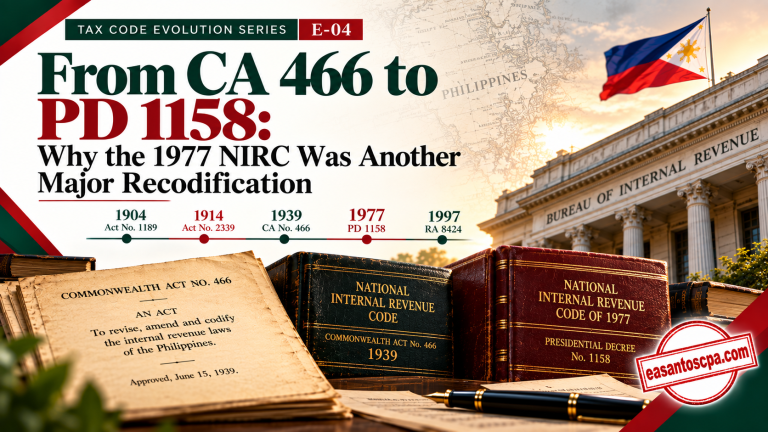
FROM CA 466 TO PD 1158: WHY THE 1977 NIRC WAS ANOTHER MAJOR RECODIFICATION
Tax Code Evolution Series (E-04)
In the previous article, we saw how Commonwealth Act No. 466 became the first codification of the Philippine internal revenue laws in 1939.
But codification did not freeze the tax system.
For almost four decades, CA 466 was repeatedly amended.
New taxes were introduced.
Existing taxes were changed.
Administrative rules evolved.
New economic activities emerged.
And by the 1970s, the government again faced a familiar problem:
There were already so many amendments and revenue laws that another consolidation and codification became necessary.
That led to Presidential Decree No. 1158.
And this is where the National Internal Revenue Code of 1977 entered Philippine tax history.
1. Why Was Another Tax Code Necessary?
When CA 466 was enacted in 1939, it was intended to revise, amend and codify the internal revenue laws.
But a Tax Code does not operate in isolation.
After 1939, Congress enacted numerous amendments to CA 466.
Later, during the 1970s, additional Presidential Decrees modified the tax system.
Eventually, the 1939 Code contained provisions that had become obsolete or had already been modified by later legislation.
PD 1158 itself expressly recognized this problem.
Its preamble stated that the existing NIRC was the product of the first codification in 1939, but that numerous tax laws enacted since then needed to be consolidated and codified. It also stated that integration and harmonization were necessary for taxpayer guidance and efficient tax administration.
So the 1977 NIRC was not created because the 1939 Code had simply become “old.”
It was created because the body of tax law surrounding and amending the Code had become increasingly complex.
2. Enter Presidential Decree No. 1158
On June 3, 1977, Presidential Decree No. 1158 was issued.
Its title was:
“A Decree to Consolidate and Codify All the Internal Revenue Laws of the Philippines.”
That title tells us almost everything about its purpose.
It was another major effort to bring the country’s accumulated internal-revenue laws into one consolidated Code.
Section 1 provided that the internal revenue laws contained in the existing NIRC and in various laws and Presidential Decrees would be consolidated and codified into a single tax code, to be known as the:
National Internal Revenue Code of 1977.
3. Notice the Difference Between 1939 and 1977
Compare the titles:
1939 — Commonwealth Act No. 466
“An Act to Revise, Amend and Codify the Internal Revenue Laws of the Philippines.”
1977 — Presidential Decree No. 1158
“A Decree to Consolidate and Codify All the Internal Revenue Laws of the Philippines.”
The wording reflects the historical situation.
By 1977, there was already a National Internal Revenue Code.
The challenge was to consolidate the existing Code together with the numerous subsequent amendments and revenue laws into another coherent Code.
In other words:
The 1977 NIRC was not taxation starting from zero.
It was a recodification of an already-evolving tax system.
4. What Does “Recodification” Mean?
Think about a taxpayer’s records.
Imagine having:
- the original document;
- several amendments;
- supplemental documents;
- replacement pages;
- additional schedules; and
- later corrections.
Eventually, reading everything together becomes difficult.
One solution is to reorganize the material into a consolidated version.
That is essentially what recodification does to legislation.
It brings together the operative rules while accounting for amendments and changes.
This is why the history of a tax provision can sometimes look like:
1939 section
↓
1977 section
↓
1980 amendment
↓
1981 amendment
↓
1986 amendment
↓
1988 amendment
↓
1997 amendment
and so on.
The provision may survive while its section number, location or wording changes.
5. The 1977 Code Did Not Erase Legislative History
This is a critical point.
PD 1158 consolidated the laws into the NIRC of 1977, but Section 2 expressly dealt with the effectivity of the various laws and decrees that had previously amended the 1939 Code.
The new Code was to take effect immediately, without prejudice to the effectivity dates of the various laws and decrees that had amended the 1939 NIRC and the new revenue laws consolidated into the 1977 Code.
That is important.
It means that when studying a provision, you cannot always stop at:
“PD 1158 says this.”
You may have to ask:
- Was this provision originally from CA 466?
- Was it amended before PD 1158?
- Was a later effectivity date provided?
- Did the provision operate differently during a transition period?
- Was the provision subsequently amended?
Effectivity matters.
And in tax law, the date on which a rule became operative can determine which rule applies to a particular transaction or taxable period.
6. PD 1158-A Shows How the Consolidation Was Done
There is another interesting piece of the 1977 story.
On the same date, Presidential Decree No. 1158-A amended certain provisions of the 1939 NIRC specifically for incorporation into the consolidation and codification under PD 1158.
That tells us something important.
The 1977 exercise was not simply:
“Copy the old Code and give it a new date.”
There was legislative work involved in determining how existing provisions would be incorporated into the new Code.
7. Section Numbers Could Change
This is one of the most useful lessons for modern tax research.
A provision’s section number is not necessarily permanent.
One excellent example involves the refund provision.
Under the 1939 NIRC, Section 306 dealt with recovery of taxes erroneously or illegally collected.
When the Tax Code was recodified in 1977, that provision became Section 292, while its substance was retained. The Supreme Court expressly discussed this legislative history in Commissioner of Internal Revenue v. Carrier Air Conditioning Philippines, Inc., G.R. No. 226592.
So:
1939
Section 306
↓
1977
Section 292
Same general subject.
Different section number.
Substantive continuity.
That is precisely why old jurisprudence cannot be dismissed simply because the section number cited by the Court is different from today’s section number.
8. Another Example: A Provision Can Move Several Times
The Supreme Court has also documented an even more dramatic example involving a provision concerning tax refunds and related matters.
In People v. Sandiganbayan, the Court’s legislative-history discussion traced the provision through several changes:
NIRC of 1977 — Section 229
↓
PD 1705 — Section 16(d)
↓
PD 1773 — Section 319-A
↓
PD 1994 — Section 270
↓
EO 273 — Section 229
↓
RA 8424 — Section 228
The Court used this history to explain how the provision eventually arrived at its current location under the 1997 Tax Code.
This is an excellent illustration of why:
Section-number searching alone is not enough for serious tax research.
9. The NIRC of 1977 Was Already a Living Code
Another misconception is that once PD 1158 was issued, the new Code remained stable for decades.
It did not.
The NIRC of 1977 itself was subsequently amended.
For example:
- PD 1705 amended provisions in 1980;
- PD 1773 made further changes in 1981;
- PD 1994 made substantial amendments in 1985;
- Executive Order No. 273 introduced major VAT-related changes effective in 1988; and
- other laws and decrees continued modifying the Code.
The Supreme Court has repeatedly referred to these legislative changes when explaining the history of particular tax provisions.
So again, the pattern continued:
Code → amendment → amendment → restructuring → amendment → another major reform.
10. Even CA 466 Provisions Could Survive Into the 1977 Code
The relationship between the two Codes is particularly interesting.
In G.R. No. L-54108, the Supreme Court noted that a provision under the old National Internal Revenue Code, Commonwealth Act No. 466, was reproduced in PD 1158, the NIRC of 1977.
This is another reminder:
A provision appearing in the 1977 Code may have roots in the 1939 Code.
Therefore, if a modern tax dispute involves an old statutory concept, it can sometimes be useful to trace the provision backward.
11. Why Does This Matter to Today’s Taxpayer?
Because today’s taxpayer may encounter an old BIR ruling, an old Supreme Court decision, an old tax opinion, or an old tax provision.
Someone might say:
“That case is old. It refers to the 1977 NIRC.”
That does not automatically mean the case has no value.
The proper question is:
What happened to the provision after the case was decided?
Was it:
- retained?
- amended?
- repealed?
- renumbered?
- transferred?
- substantially changed?
The reverse is also true.
You cannot assume that an old case remains controlling merely because the section number looks familiar.
The substance and the amendments must be examined.
12. This Is Why “NIRC, as Amended” Matters
You will frequently encounter the expression:
“National Internal Revenue Code, as amended.”
That phrase is not decorative.
It reflects the actual nature of Philippine tax legislation.
The Code has repeatedly been:
- amended;
- supplemented;
- renumbered;
- reorganized;
- recodified; and
- modified by later legislation.
Even RA 8424, the Tax Reform Act of 1997, did not describe itself as creating an entirely unrelated tax system.
Section 3 expressly stated that PD 1158, as amended by PD 1994 and EO 273, otherwise known as the National Internal Revenue Code, was further amended.
That wording is historically significant.
The 1997 NIRC grew out of the 1977 NIRC.
And the 1977 NIRC grew out of the earlier codification under CA 466.
13. The Tax Code Is a Continuum
Now look at the larger picture:
1904
Act No. 1189
Early statutory framework for internal revenue
↓
1914
Act No. 2339
Revision and consolidation
↓
1939
CA 466
First codification of the internal revenue laws
↓
1977
PD 1158
Consolidation and codification of the accumulated internal revenue laws
↓
1997
RA 8424
Further amendment and restructuring
↓
2017
TRAIN — RA 10963
↓
2021
CREATE — RA 11534
↓
2024
EOPT — RA 11976
Digital Services VAT — RA 12023
CREATE MORE — RA 12066
↓
2025
CMEPA — RA 12214
↓
2026
Continuing amendments, regulations, BIR issuances and jurisprudence
The current NIRC therefore has a legal ancestry.
It is not simply a book published in 1997.
14. A Taxpayer’s Question Should Include the Taxable Period
This history gives us a very practical lesson.
Suppose a taxpayer asks:
“What was the tax rule for this transaction?”
That question may be incomplete.
A better question is:
“What was the tax rule applicable to this taxpayer, transaction and taxable period?”
Why?
Because the applicable rule can change over time.
A transaction in:
1977
may be governed by a different provision from the same type of transaction in:
1985
which may differ again from:
1988
and again from:
1997
and again from:
2024
and again from:
2026.
Tax law has a time dimension.
15. The Big Lesson From the 1977 NIRC
The story of PD 1158 teaches us something larger than the history of one Tax Code.
It teaches us how Philippine tax law should be read.
Do not look only at the current section.
Look at its:
origin
↓
amendments
↓
effectivity
↓
transitional provisions
↓
administrative implementation
↓
jurisprudence
↓
current version
That is how you avoid confusing:
the rule that once existed
with
the rule that actually applies today.
What This Means for Modern Tax Research
When researching a tax provision, don’t stop when you find the first answer.
Ask:
Where did this provision come from?
What law amended it?
Was it renumbered?
When did the amendment take effect?
Did a later law change it again?
Did the Supreme Court interpret its legislative history?
What is the current operative provision?
That is why tax-law history is not merely for lawyers writing textbooks.
It can matter to taxpayers, accountants, tax practitioners, auditors and researchers who need to determine which rule actually governs a particular transaction or taxable period.
LEGAL BASIS
Presidential Decree No. 1158 — June 3, 1977
“A Decree to Consolidate and Codify All the Internal Revenue Laws of the Philippines.”
Section 1 consolidated and codified the internal revenue laws embodied in the existing NIRC and various laws and Presidential Decrees into the National Internal Revenue Code of 1977.
Section 2 addressed immediate effectivity while preserving the effectivity dates of prior amendatory laws and decrees.
Presidential Decree No. 1158-A
Amended certain provisions of the 1939 NIRC for incorporation into the consolidation and codification under PD 1158.
Commonwealth Act No. 466
The 1939 National Internal Revenue Code—the earlier codification upon which the 1977 recodification built.
Republic Act No. 8424
The Tax Reform Act of 1997 expressly further amended PD 1158, as amended by PD 1994 and EO 273.
Jurisprudence
Commissioner of Internal Revenue v. Carrier Air Conditioning Philippines, Inc.
G.R. No. 226592
The Supreme Court explained that Section 306 of the 1939 Code was renumbered as Section 292 in the 1977 recodification while retaining its substance.
People v. Sandiganbayan
G.R. Nos. 201398-99
The Court traced the legislative history of a provision through multiple renumberings and amendments—from the 1977 NIRC through later Presidential Decrees and EO 273, ultimately to its amendment by RA 8424.
Manila Electric Company v. Vera
G.R. No. L-29987, October 22, 1975
Illustrates the operation and interpretation of provisions under the 1939 NIRC, as amended, before the 1977 recodification.
TAXPAYER TAKEAWAY
A Tax Code can be recodified without erasing its legislative history.
A provision may move from one section number to another while retaining substantially the same substance.
It may also be amended, transferred, repealed or replaced.
That is why the section number alone does not tell the whole legal story.
And this brings us to an important distinction:
The law that created the rule is not necessarily the law that contains the rule today.
The next article takes us to the major reform that eventually produced the modern NIRC:
E-05 — FROM THE 1980s–1990s TAX REFORMS TO RA 8424: HOW THE MODERN NIRC EMERGED
We will trace the reforms that came between the 1977 NIRC and the Tax Reform Act of 1997, including the major development of the VAT system and the laws that ultimately shaped RA 8424.
Taxpayer Literacy is a Must!
Related Philippine Tax Code Evolution Articles
E-01 — Before the NIRC: Where Did Philippine Tax Law Begin?
E-02 — From Act No. 1189 to Act No. 2339: How Philippine Internal Revenue Law Started to Evolve
E-03 — The Commonwealth Tax Code: How CA 466 Became the National Internal Revenue Code
Editorial Note
Current as of October 5, 2026.
This article is part of the Tax Code Evolution Series of easantoscpa.com Articles & Insights.
The purpose of this series is to help taxpayers understand where Philippine tax rules came from, how they evolved, and why today’s tax rules must be read together with their amendments, implementing issuances and jurisprudence.
Taxpayer Literacy is a Must!
Need Help With a Tax or Compliance Concern?
Understanding your obligations is the first step. Building the right compliance system is the next.
If your business needs professional guidance regarding BIR compliance, bookkeeping, documentation, tax concerns, or compliance review, you may discuss your specific circumstances with us.
BOOK A CONSULTATION →
Disclaimer
This article is provided for educational and conceptual purposes only and does not constitute tax, legal, accounting, or other professional advice. Tax rules and administrative requirements may change, and their application depends on the taxpayer’s particular facts and circumstances. Consult a qualified professional regarding your specific situation.
LEARN • STRENGTHEN • COMPLY
Trainings, Seminars & Webinars
Practical learning for business owners, professionals and teams.


- services@easantoscpa.com
- +63 916 587 1528
- Topaz Building, Kamias Road, Quezon City
- Office visit: By Appointment only.
- Strictly NO Walk-In
- Affiliate: ptabcpsolutions.com
Disclaimer: Posts are provided for educational and conceptual purposes only. They do not constitute professional advice. You are advised to consult a qualified professional regarding your specific circumstances.