
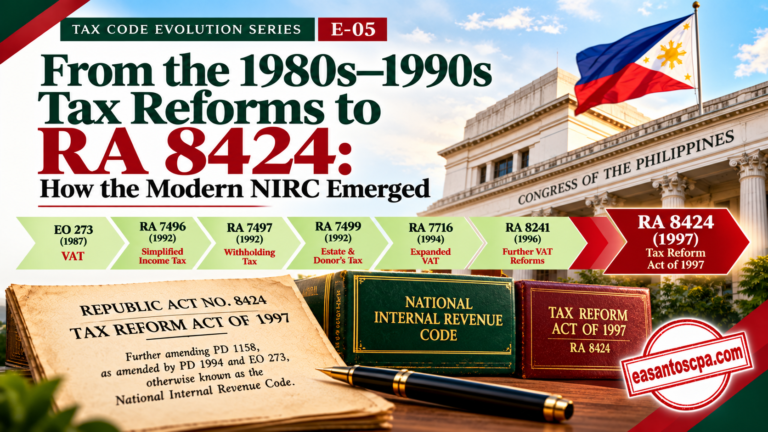
[E-05] FROM THE 1980s–1990s TAX REFORMS TO RA 8424: HOW THE MODERN NIRC EMERGED
Tax Code Evolution Series No. 5
In the previous article, we saw how PD 1158 created the National Internal Revenue Code of 1977 through another major consolidation and codification of Philippine internal revenue laws.
But the 1977 NIRC did not remain unchanged.
The next two decades brought major reforms involving:
- income taxation;
- withholding taxes;
- estate and donor’s taxes;
- value-added tax;
- tax administration; and
- the structure of the internal revenue system itself.
Eventually, these developments culminated in Republic Act No. 8424, the Tax Reform Act of 1997.
And this is an important point in understanding today’s NIRC:
RA 8424 did not appear out of nowhere. It was the product of the tax reforms that came before it.
The 1980s: Tax Reform Was Becoming a Structural Question
By the 1980s, the Philippine tax system was dealing with a familiar problem:
How do you raise sufficient revenue while making the tax system more rational, equitable and administratively workable?
This was not simply a question of increasing tax rates.
It involved the structure of taxation itself.
One of the most important developments was the introduction of the value-added tax (VAT).
And VAT would eventually become one of the defining features of the modern Philippine tax system.
EO 273: The Philippines Adopted VAT
On July 25, 1987, President Corazon C. Aquino issued Executive Order No. 273, entitled:
“Adopting a Value-Added Tax, Amending for this Purpose Certain Provisions of the National Internal Revenue Code, and for Other Purposes.”
The stated policy was to rationalize the taxation of goods and services by adopting a multi-stage VAT to replace the tax on original and subsequent sales and certain percentage taxes.
EO 273 described VAT as part of the 1986 Tax Reform Program intended to:
- simplify tax administration;
- make the tax system more equitable; and
- strengthen and improve tax administration and compliance.
This was a major structural change.
VAT Was Not Simply “Another Tax”
The significance of VAT is easier to understand when we look at its structure.
EO 273 imposed VAT on:
- sales of goods;
- importation of goods; and
- sale of services.
It also introduced the concepts of:
Input Tax
VAT paid by a VAT-registered person on qualifying purchases or importations.
Output Tax
VAT due on taxable sales or services.
Input Tax Credit
The mechanism through which allowable input tax could be credited against output tax.
The initial VAT rate under EO 273 was 10%.
This was more than a rate change.
It introduced a fundamentally different way of looking at consumption taxation.
VAT Also Changed Compliance
VAT required taxpayers to maintain a relationship between:
purchases
→
input tax
→
sales
→
output tax
→
VAT payable or excess input tax.
That meant tax administration increasingly depended on:
- invoices and receipts;
- books and records;
- sales records;
- purchase records;
- tax returns;
- supporting documents; and
- reconciliation.
In other words:
VAT strengthened the connection between transactions, documentation, accounting and taxation.
That connection remains central to Philippine tax compliance today.
EO 273 Also Reorganized the NIRC
There is another reason EO 273 is important to the Tax Code Evolution Series.
It did not merely insert a VAT provision into the existing Code.
It renumbered and rearranged provisions of the NIRC.
EO 273 established a new structure that included:
- Title I — Organization and Function of Bureau
- Title II — Tax on Income
- Title III — Tax on Transfer of Property
- Title IV — Value-Added Tax
- Title V — Other Percentage Taxes
- Title VI — Excise Taxes
- Title VII — Documentary Stamp Tax
- Title VIII — Remedies
- Title IX — Compliance Requirements
- Title X — Statutory Offenses and Penalties
- and other titles.
This is historically important.
It shows once again that the section numbers and organization of the NIRC can change as tax legislation evolves.
That is one reason historical tracing matters.
The 1990s Brought More Targeted Tax Reforms
The reform process did not stop with VAT.
In 1992, Congress enacted several laws amending specific areas of the NIRC.
Three are particularly useful for understanding the period.
RA 7496 — Simplified Net Income Taxation
Republic Act No. 7496, approved May 15, 1992, adopted the:
Simplified Net Income Taxation Scheme (SNITS)
for self-employed individuals and professionals.
It amended Sections 21 and 29 of the NIRC.
The law expressly covered self-employed persons and professionals, including examples such as:
- manufacturers;
- traders;
- market vendors;
- owners of eateries;
- farmers;
- service shops;
- lawyers;
- doctors;
- dentists; and
- CPAs.
It also introduced a simplified approach to determining taxable income for covered taxpayers and allowed, for taxpayers whose costs were difficult to determine, a maximum 40% deduction from gross receipts for business or professional expenses.
The important historical lesson is not the old 40% rule itself.
It is this:
The Tax Code was being modified to address the practical compliance problems of particular classes of taxpayers.
RA 7497: Withholding Tax on Compensation
The same period also saw Republic Act No. 7497, approved May 15, 1992.
Its title tells us its focus:
Finality of the Withholding Tax on Purely Compensation Income
The law sought to simplify compliance and administration of the withholding-tax system for purely compensation income.
It required employers to deduct and withhold the appropriate amount of tax from employee compensation and introduced rules concerning year-end adjustments.
This is another important development.
Tax administration was increasingly being designed around mechanisms that would allow tax to be collected before or at the time income was received, rather than waiting for the taxpayer’s annual filing.
That is the basic logic behind withholding taxation.
RA 7499: Estate and Donor’s Taxes Were Also Reworked
Also on May 15, 1992, Congress enacted Republic Act No. 7499, restructuring the estate and donor’s taxes.
It amended provisions concerning:
- estate tax;
- estate-tax filing;
- donor’s tax;
- tax rates; and
- gifts to strangers.
Again, the lesson is broader than the individual provisions.
During the 1990s, the government was not making one giant amendment to the Tax Code.
It was making targeted reforms to different components of the tax system.
Then VAT Was Restructured Again
The VAT system introduced through EO 273 was subsequently modified.
A particularly important reform was:
Republic Act No. 7716
approved on May 5, 1994.
Its title was:
“An Act Restructuring the Value-Added Tax (VAT) System, Widening Its Tax Base and Enhancing Its Administration…”
The title itself is revealing.
VAT was no longer simply being introduced.
It was being restructured, expanded and strengthened administratively.
RA 7716 Expanded the VAT Base
RA 7716 amended Section 99 of the NIRC to cover persons who, in the course of trade or business:
- sell;
- barter;
- exchange;
- lease goods or properties;
- render services; or
- import goods.
It also clarified the concept of “in the course of trade or business.”
The VAT system was therefore becoming broader in its application.
And this illustrates another recurring theme in Philippine tax history:
Tax reform is often not simply about changing the tax rate.
It can also involve:
- expanding the tax base;
- changing exemptions;
- redefining taxable transactions;
- improving collection;
- changing registration rules; and
- improving administrative enforcement.
RA 8241 Continued the VAT Evolution
Two years later, Republic Act No. 8241 was enacted on December 20, 1996.
It amended RA 7716 and other relevant NIRC provisions.
Among other things, it further modified:
- VAT coverage;
- percentage taxes;
- withholding of VAT;
- registration;
- international carriers; and
- the timing for bringing certain services into the VAT system.
RA 8241 also provided that certain services would enter VAT coverage beginning January 1, 1998, showing how effectivity and transitional provisions can be an important part of tax reform.
This matters because a tax rule can exist in a statute but become applicable only at a later date.
Enactment date is not always the same as operative date.
That is a fundamental tax-research lesson.
By the 1990s, the Tax Code Had Become a Moving Target
Let’s step back.
Between the 1977 NIRC and 1997, we had:
PD 1158
1977 NIRC
↓
EO 273
VAT and major restructuring
↓
RA 7496
Simplified taxation for self-employed and professionals
↓
RA 7497
Withholding tax reform
↓
RA 7499
Estate and donor’s tax restructuring
↓
RA 7716
Expanded VAT
↓
RA 8241
Further VAT restructuring
↓
RA 8424
Tax Reform Act of 1997
The important point is obvious:
RA 8424 was the culmination of an extended reform process.
Then Came the Tax Reform Act of 1997
On December 11, 1997, Congress enacted:
Republic Act No. 8424
Its short title:
“Tax Reform Act of 1997.”
Section 3 is particularly important to the historical story.
It expressly stated that:
Presidential Decree No. 1158, as amended by, among others, Presidential Decree No. 1994 and Executive Order No. 273, otherwise known as the National Internal Revenue Code, is hereby further amended.
That sentence tells us something fundamental.
RA 8424 did not create the Philippine Tax Code from scratch.
It further amended the existing NIRC.
And that existing NIRC was itself the product of previous codifications and amendments.
Why RA 8424 Became So Important
RA 8424 significantly reorganized and amended the Philippine internal revenue system.
It became the principal statutory foundation that taxpayers and practitioners would come to identify as the:
1997 National Internal Revenue Code
But historically, it is more accurate to think of it as:
PD 1158, as amended, further amended and reorganized by RA 8424.
That distinction is not merely technical.
It explains why older legislation and jurisprudence can continue to matter.
The modern Code inherited concepts, structures and provisions from its predecessors—sometimes with modifications, sometimes through renumbering, and sometimes through substantial change.
The Constitution Also Matters
The evolution of the Tax Code cannot be separated completely from the 1987 Constitution.
Article VI, Section 28 provides:
“The rule of taxation shall be uniform and equitable.”
It also directs Congress to evolve a progressive system of taxation.
These constitutional principles provide the broader framework within which tax legislation operates.
So when Congress enacted tax reforms during the 1980s and 1990s, the tax system was being developed not only in response to revenue requirements but also within constitutional principles governing taxation.
What Changed Between 1977 and 1997?
It is tempting to think of the period simply as:
1977 NIRC → 1997 NIRC
But the actual history was much richer.
During those two decades, the tax system developed:
A more sophisticated consumption-tax system
through VAT.
More targeted income-tax mechanisms
for particular taxpayer groups.
Stronger withholding mechanisms
for compensation income.
Revised transfer taxes
through estate and donor’s tax reforms.
Broader VAT coverage
through RA 7716 and RA 8241.
Greater emphasis on administration
through changes in registration, collection and compliance mechanisms.
In other words:
The tax system was becoming increasingly interconnected.
VAT Changed the Meaning of “Tax Compliance”
Consider a VAT-registered business.
It could no longer look only at:
“How much tax do I owe?”
It increasingly had to ask:
- What are my taxable sales?
- What are my exempt sales?
- What are my zero-rated sales?
- What is my output VAT?
- What input VAT can I claim?
- Is the input tax properly supported?
- Are my invoices compliant?
- Are my books consistent with my VAT returns?
- Are my VAT returns consistent with my sales records?
This is an important historical development because it helped establish the modern reality that:
Tax compliance is a system of connected records and transactions.
This Also Explains Why Documentation Became More Important
VAT is based on transactions.
Transactions generate documents.
Documents support books.
Books support returns.
Returns establish reported tax positions.
And those reported positions may later be examined by the BIR.
That creates a chain:
TRANSACTION
↓
DOCUMENT
↓
BOOKS
↓
RETURN
↓
TAX LIABILITY
The modern taxpayer may recognize this immediately.
But the foundation for this interconnected compliance environment was strengthened substantially during the VAT reforms of the 1980s and 1990s.
The Tax Code Was Becoming More Than a Collection of Tax Rates
By 1997, the NIRC was not simply a schedule of tax rates.
It was a comprehensive legal framework covering:
- taxation;
- administration;
- registration;
- returns;
- payment;
- withholding;
- documentation;
- remedies;
- assessment;
- collection;
- offenses;
- penalties; and
- enforcement.
That is why RA 8424 was such an important milestone.
It represented a major reorganization of an already sophisticated tax system.
The Historical Lesson
Look at the progression one more time:
1904
Act No. 1189
↓
1914
Act No. 2339
↓
1939
CA 466
↓
1977
PD 1158
↓
1987
EO 273 — VAT
↓
1992
RA 7496 / RA 7497 / RA 7499
↓
1994
RA 7716 — Expanded VAT
↓
1996
RA 8241 — Further VAT reforms
↓
1997
RA 8424 — Tax Reform Act of 1997
The modern NIRC therefore has a long legislative ancestry.
What This Means for Today’s Taxpayer
When you encounter a provision in the current NIRC, do not automatically assume:
“This rule started in 1997.”
It may have roots in:
- the 1977 NIRC;
- the 1939 Code;
- earlier internal revenue laws;
- an executive order;
- an earlier Republic Act; or
- an entirely different statutory framework.
And when an old tax case cites a different section number, don’t immediately assume it is irrelevant.
The provision may have been:
renumbered
reorganized
amended
or
carried forward into a later Code.
But there is an equally important warning:
Historical continuity does not automatically mean that the old rule remains current.
You still have to determine what later laws did to it.
The Research Question That Matters
This is why serious Philippine tax research eventually comes down to one question:
What is the current operative rule?
Not merely:
“What did the law say?”
Not merely:
“What does this old case say?”
And not merely:
“What does the BIR website say?”
But:
What rule governs this taxpayer, this transaction, this taxable period, under the law currently in force?
That question is the bridge between Tax Code history and actual tax research.
LEGAL BASIS
1987 Constitution — Article VI, Section 28
Provides that the rule of taxation shall be uniform and equitable, and directs Congress to evolve a progressive system of taxation.
Executive Order No. 273 — July 25, 1987
Adopted a multi-stage value-added tax, amended the NIRC, reorganized and renumbered provisions, and provided the structural foundation for the VAT system that followed.
Republic Act No. 7496 — May 15, 1992
Adopted the Simplified Net Income Taxation Scheme for self-employed persons and professionals and amended Sections 21 and 29 of the NIRC.
Republic Act No. 7497 — May 15, 1992
Reformed the final withholding tax system on purely compensation income.
Republic Act No. 7499 — May 15, 1992
Restructured estate and donor’s taxes.
Republic Act No. 7716 — May 5, 1994
Restructured the VAT system, widened its tax base and enhanced VAT administration.
Republic Act No. 8241 — December 20, 1996
Further amended RA 7716 and relevant NIRC provisions concerning VAT and other taxes. It provided, among other things, for the effectivity of VAT on specified services beginning January 1, 1998.
Republic Act No. 8424 — December 11, 1997
The Tax Reform Act of 1997, which further amended PD 1158, as amended by subsequent legislation including PD 1994 and EO 273.
Jurisprudence
The historical evolution of the NIRC is also reflected in Supreme Court decisions that trace provisions across successive Codes and amendments.
This is important because legislative history can explain why a provision has a particular section number, wording or legal treatment today.
The jurisprudence discussed in the preceding E-series articles—particularly cases tracing provisions from CA 466 through PD 1158 and later amendments—illustrates this continuing legislative lineage.
TAXPAYER TAKEAWAY
RA 8424 did not suddenly create the Philippine Tax Code.
It was the product of decades of tax-law development.
VAT, withholding tax reforms, income-tax reforms and transfer-tax reforms all contributed to the tax system that existed when the Tax Reform Act of 1997 was enacted.
To understand today’s NIRC, you sometimes need to understand the reforms that came before it.
And now we arrive at the pivotal point in the evolution series:
E-06 — THE 1997 NIRC: HOW THE MODERN PHILIPPINE TAX CODE IS STRUCTURED
This next article will stop looking primarily at how we got here and examine what RA 8424 actually created as a modern Tax Code structure—its Titles, organization, BIR powers, remedies, compliance requirements, offenses and penalties.
Taxpayer Literacy is a Must!
Related Philippine Tax Code Evolution Articles
[E-01] Before the NIRC: Where Did Philippine Tax Law Begin?
[E-02] From Act No. 1189 to Act No. 2339: How Philippine Internal Revenue Law Started To Evolve
[E-03] The Commonwealth Tax Code: How CA 466 Became the National Internal Revenue Code
[E-04] From CA 466 To PD 1158: Why the 1977 NIRC Was Another Recodification
[E-05] From The 1980s-1990s Tax Reforms To RA 8424: How the Modern NIRC Emerged
Editorial Note
Current as of October 31, 2026.
This article is part of the Tax Code Evolution Series of easantoscpa.com Articles & Insights.
The purpose of this series is to help taxpayers understand where Philippine tax rules came from, how they evolved, and why today’s tax rules must be read together with their amendments, implementing issuances and jurisprudence.
Taxpayer Literacy is a Must!
Need Help With a Tax or Compliance Concern?
Understanding your obligations is the first step. Building the right compliance system is the next.
If your business needs professional guidance regarding BIR compliance, bookkeeping, documentation, tax concerns, or compliance review, you may discuss your specific circumstances with us.
BOOK A CONSULTATION →
Disclaimer
This article is provided for educational and conceptual purposes only and does not constitute tax, legal, accounting, or other professional advice. Tax rules and administrative requirements may change, and their application depends on the taxpayer’s particular facts and circumstances. Consult a qualified professional regarding your specific situation.
LEARN • STRENGTHEN • COMPLY
Trainings, Seminars & Webinars
Practical learning for business owners, professionals and teams.


- services@easantoscpa.com
- +63 916 587 1528
- Topaz Building, Kamias Road, Quezon City
- Office visit: By Appointment only.
- Strictly NO Walk-In
- Affiliate: ptabcpsolutions.com
Disclaimer: Posts are provided for educational and conceptual purposes only. They do not constitute professional advice. You are advised to consult a qualified professional regarding your specific circumstances.