
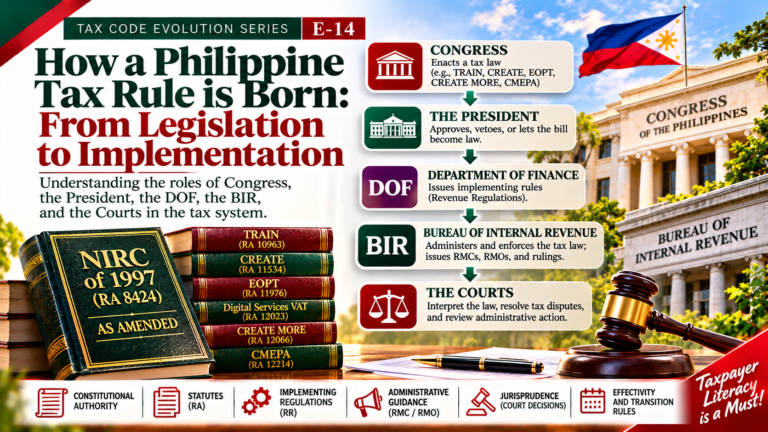
[E-14] HOW A PHILIPPINE TAX RULE IS BORN: FROM LEGISLATION TO IMPLEMENTATION
Tax Code Evolution Series No. 14
Understanding the Roles of Congress, the President, the Department of Finance, the BIR, and the Courts
Part I — Tax Code Evolution | easantoscpa.com
Last reviewed: October 31, 2026
When the BIR announces a new tax rule, who actually created it?
A taxpayer reads an announcement about a new tax requirement.
It may concern invoicing, withholding tax, VAT, recordkeeping, filing procedures, or the documentation required to support a transaction.
The announcement refers to a Revenue Regulation, Revenue Memorandum Circular, or Revenue Memorandum Order.
Naturally, the taxpayer may conclude:
“Bagong batas na naman ng BIR.”
But is every BIR issuance a new tax law?
Not necessarily.
A tax obligation may originate from an Act of Congress. A Revenue Regulation may implement that law. A Revenue Memorandum Circular may clarify its interpretation. A Revenue Memorandum Order may prescribe administrative procedures. Later, a court may determine whether the law or its implementation was properly interpreted and applied.
These are different legal functions.
Understanding the distinction is important because taxpayers must know not only what a tax rule requires, but also where the requirement came from and what legal authority supports it.
This article explains how Philippine tax rules are created, implemented, interpreted, and tested under the law.
Taxation begins with constitutional authority
The Philippine government’s power to tax is an inherent attribute of sovereignty. Its exercise, however, is subject to constitutional limitations.
The 1987 Constitution establishes important principles governing the enactment and administration of taxes.
Article VI, Section 28(1) provides that the rule of taxation shall be uniform and equitable and that Congress shall evolve a progressive system of taxation.
Article VI, Section 24 requires revenue bills to originate exclusively in the House of Representatives, although the Senate may propose or concur with amendments.
Article VI, Section 28(4) provides that no law granting a tax exemption shall be passed without the concurrence of a majority of all the Members of Congress.
These provisions demonstrate that taxation is not simply a matter of administrative discretion.
Congress exercises legislative taxing authority within the limits established by the Constitution.
For taxpayers, this means that the legal basis for a tax obligation cannot be determined merely from the existence of an announcement or administrative instruction.
Congress: where national tax legislation is enacted
When the government proposes to introduce a national tax, revise a tax rate, amend an exemption, or change a statutory obligation, legislation may be required.
A tax reform proposal proceeds through the legislative process prescribed by the Constitution and the rules of Congress.
SIMPLIFIED LEGISLATIVE PATH
Bill introduced — A legislative proposal is filed in Congress.
Committee consideration — The proposal is examined and may be amended.
House and Senate action — Both chambers must agree on the legislative text.
Presidential action — The enrolled bill is submitted to the President.
Enactment and publication — The law becomes effective according to constitutional and statutory requirements.
Consider the reforms discussed in the earlier articles of this series.
TRAIN was enacted through RA 10963. EOPT was enacted through RA 11976. CREATE MORE was enacted through RA 12066. CMEPA was enacted through RA 12214.
Each is legislation—not merely a BIR circular.
Their amendments to the NIRC derive their legal force from the legislative process.
Legal basis: 1987 Constitution, Article VI, Sections 24, 26, 27, and 28.
The President: approval, veto, and execution of tax laws
Under Article VI, Section 27 of the Constitution, a bill passed by Congress is presented to the President.
The President may approve it, veto it, or allow it to become law without signature under the conditions specified by the Constitution.
The President also possesses a constitutionally defined item-veto power over particular items in appropriation, revenue, or tariff bills.
After enactment, the executive branch is responsible for faithful execution of the law.
This does not mean that the President or an administrative agency may freely replace the tax policy chosen by Congress.
The Constitution permits certain delegations, such as the authority under Article VI, Section 28(2) concerning specified tariff-related rates within legislatively prescribed limits.
Such delegations must be distinguished from an unrestricted power to legislate new taxes.
The principle: Legislative taxing authority and executive implementation are related, but they are not the same power.
The Department of Finance: implementing the law through Revenue Regulations
After Congress enacts a tax law, the law may require administrative rules for its implementation.
Section 244 of the NIRC provides that the Secretary of Finance, upon recommendation of the Commissioner of Internal Revenue, shall promulgate the rules and regulations needed for effective enforcement of the Code.
Section 245 further identifies matters that may be covered by such regulations.
Revenue Regulations (RRs) therefore serve an important function.
A statute may establish a tax obligation while leaving certain administrative details to implementing regulations.
For example, an amendment concerning invoicing may require further rules addressing the prescribed information, permitted forms, or transitional arrangements.
However, the power to implement a law is not an unlimited power to rewrite it.
In Commissioner of Internal Revenue v. Fortune Tobacco Corporation, the Supreme Court explained that administrative regulations must conform to the law and cannot enlarge, alter, or restrict its provisions.
The distinction is essential:
A Revenue Regulation may implement statutory requirements, but it cannot lawfully impose a tax that the statute does not authorize.
The BIR: interpretation, administration, and enforcement
The Bureau of Internal Revenue administers and enforces national internal revenue tax laws.
Under Section 4 of the NIRC, the Commissioner of Internal Revenue has the exclusive and original jurisdiction to interpret the provisions of the Code, subject to review by the Secretary of Finance.
The Commissioner also exercises statutory authority concerning disputed assessments, refunds, penalties, and other tax matters, subject to the applicable review and appeal mechanisms.
The BIR communicates and implements its policies through several types of issuances.
Issuance | General purpose |
|---|---|
Revenue Regulation (RR) | Implements tax laws through rules promulgated by the Secretary of Finance |
Revenue Memorandum Circular (RMC) | Publishes or clarifies interpretations, policies, and relevant issuances |
Revenue Memorandum Order (RMO) | Prescribes administrative directives, procedures, and operational instructions |
Revenue Memorandum Ruling (RMR) | Provides formal interpretations on issues of general significance |
BIR Ruling | Addresses a particular request or set of facts under applicable law |
The Supreme Court discussed these distinctions in Philippine Stock Exchange, Inc. v. Secretary of Finance, G.R. No. 213860, July 5, 2022.
The classification of an issuance is important, but its title alone does not determine its validity.
Its actual substance, legal authority, and effect must also be considered.
Publication and effectivity: when does a rule become enforceable?
A law may already have been approved, but that does not automatically answer when its requirements become enforceable.
Article 2 of the Civil Code, as amended by Executive Order No. 200, establishes the general rule on publication and effectivity.
A statute may prescribe a particular effective date, but the applicable publication requirements must still be satisfied.
The landmark decision in Tañada v. Tuvera, G.R. No. L-63915, December 29, 1986, established the importance of publication as a condition for the effectivity of laws and administrative rules intended to enforce or implement existing laws.
The Court distinguished such rules from merely interpretative or internal administrative instructions, which do not necessarily require publication in the same manner.
This distinction matters when taxpayers encounter a newly issued regulation.
The following dates should not be confused:
The date a law was approved;
The date it was published;
The date it became effective;
The date implementing regulations were issued; and
Any specific compliance or transitional deadline.
They may be different dates.
What happens when a BIR issuance appears inconsistent with the law?
Consider a hypothetical situation.
Congress enacts a law establishing a particular tax treatment. A subsequent administrative issuance appears to impose an additional substantive requirement that is not authorized by the statute.
The question is not simply whether the BIR issued the requirement.
The question is whether the issuance falls within the authority granted by law.
Philippine jurisprudence provides guidance.
Commissioner of Internal Revenue v. Fortune Tobacco Corporation
G.R. Nos. 167274–75, July 21, 2008
The Supreme Court reaffirmed that administrative regulations must remain consistent with the governing statute.
It also emphasized that tax burdens cannot be extended beyond what the law clearly imposes.
Commissioner of Internal Revenue v. San Roque Power Corporation
G.R. No. 187485 and companion cases, October 8, 2013 (Resolution)
The Court examined the respective interpretative and rulemaking powers of the Commissioner and the Secretary of Finance.
It explained that the Commissioner cannot amend or reverse a Revenue Regulation merely by issuing a ruling.
Philippine Stock Exchange, Inc. v. Secretary of Finance
G.R. No. 213860, July 5, 2022
The Supreme Court discussed the different forms of BIR issuances and their relationship to statutory rulemaking and interpretation.
These decisions demonstrate that the legality of an administrative tax requirement depends on more than the authority of the office issuing it.
The substance of the requirement must remain within the applicable statutory and constitutional limits.
This does not mean taxpayers should disregard an issuance merely because they disagree with it. A challenge must be evaluated under the proper legal procedures, relevant deadlines, and applicable jurisprudence.
The courts: interpreting tax laws and reviewing administrative action
The judiciary performs a distinct role in the Philippine tax system.
Courts do not ordinarily create tax legislation. They resolve actual controversies and interpret the Constitution, statutes, regulations, and administrative acts within their jurisdiction.
The Court of Tax Appeals has specialized jurisdiction over matters specified by Republic Act No. 1125, as amended by RA 9282 and RA 9503.
The Supreme Court exercises its constitutional judicial power and determines questions properly brought before it, including whether administrative action exceeds legal authority.
A judicial decision may clarify the meaning of a tax provision, determine the validity of a regulation, or explain the legal consequences of particular facts.
Such interpretation becomes important when similar legal issues arise.
However, judicial decisions must also be read carefully.
A ruling interpreting an earlier statutory provision may require reassessment after Congress amends that provision.
The law interpreted by a court and the law subsequently amended by Congress must be distinguished.
A Philippine example: the evolution of invoicing rules
The Ease of Paying Taxes Act, RA 11976, amended important NIRC provisions affecting invoicing and tax administration.
The BIR subsequently issued implementing regulations and administrative guidance.
This illustrates how a statutory reform may be followed by several stages of implementation.
Congress
RA 11976 amended the relevant provisions of the NIRC.
Department of Finance / BIR
Revenue Regulations implemented the statutory changes, including rules affecting invoicing.
BIR administrative guidance
Circulars and other issuances clarified particular compliance matters and transitions.
Judicial review, when a justiciable controversy arises
The appropriate court may determine how the governing law applies or whether an administrative issuance is legally valid.
The important lesson is that the issuance of an implementing regulation does not end the development of the legal framework.
Later clarifications, amendments, and judicial decisions may affect how particular requirements are understood and applied.
Why this matters to business owners and taxpayers
A taxpayer may encounter several documents relating to the same tax obligation.
One document may be the statute. Another may be the implementing regulation. A third may be a BIR circular clarifying the regulation.
These documents should not be treated as though they perform identical functions.
Understanding their relationship helps taxpayers recognize why a familiar procedure may change even when the underlying tax remains the same.
It also explains why an announcement, a press release, or an informal interpretation should not automatically be treated as the complete legal rule.
The underlying statute, the applicable implementing issuance, the relevant effective dates, and controlling jurisprudence may all matter.
Taxpayer literacy includes understanding not only one’s obligations but also the legal authority through which those obligations arise.
Legal basis and jurisprudence
Authority | Subject |
|---|---|
1987 Constitution, Article III, Section 1 | Due process and equal protection |
1987 Constitution, Article VI, Sections 24–28 | Legislative process and taxation |
1987 Constitution, Article VIII, Section 1 | Judicial power |
Civil Code, Article 2, as amended by EO 200 | Publication and effectivity |
NIRC Section 4 | Powers of the Commissioner |
NIRC Sections 244–245 | Rulemaking authority |
RA 1125, as amended | Court of Tax Appeals jurisdiction |
Tañada v. Tuvera | Publication and effectivity |
CIR v. Fortune Tobacco | Limits of administrative regulations |
CIR v. San Roque Power | Rulemaking and interpretative authority |
Philippine Stock Exchange v. Secretary of Finance | Types and authority of BIR issuances |
Primary sources
The lesson of E-14
A Philippine tax rule does not necessarily begin with a BIR announcement.
Its legal foundation may begin with the Constitution and an Act of Congress. Its implementation may involve the Department of Finance and the BIR. Its meaning and validity may later be examined by the courts.
These institutions have different functions, and their actions have different legal effects.
For taxpayers, the central question should therefore go beyond:
“Ano ang bagong requirement ng BIR?”
It should also include:
“Ano ang legal basis nito, kailan ito naging applicable, at paano ito nauugnay sa mismong batas?”
Understanding that distinction is an important part of responsible tax compliance.
Taxpayer Literacy is a Must!
This article is intended for general Philippine tax education. It is not a legal opinion on the validity of any particular administrative issuance or a substitute for professional advice concerning a specific dispute.
Related Philippine Tax Code Evolution Articles
[E-01] Before the NIRC: Where Did Philippine Tax Law Begin?
[E-02] From Act No. 1189 to Act No. 2339: How Philippine Internal Revenue Law Started To Evolve
[E-03] The Commonwealth Tax Code: How CA 466 Became the National Internal Revenue Code
[E-04] From CA 466 To PD 1158: Why the 1977 NIRC Was Another Recodification
[E-05] From The 1980s-1990s Tax Reforms To RA 8424: How the Modern NIRC Emerged
[E-06] The 1997 NIRC: How the Modern Philippine Tax Code Is Structured
[E-07] Train: Why RA 10963 Changed The 1997 NIRC
[E-08] Create: How RA 11534 Reshaped Corporate Taxation And Tax Incentives
[E-09] EOPT: Why RA 11976 Changed How Taxpayers Comply
[E-10] Digital Services VAT: How RA 12023 Brought Digital Services Into The Philippine Vat System
[E-11] Create More: Why RA 12066 Rewrote Parts Of The Create Framework
[E-12] CMEPA: How Ra 12214 Changed The Taxation Of Capital Markets And Financial Transactions
[E-13] The Current NIRC: How To Read The National Internal Revenue Code As Amended In 2026
[E-14] How A Philippine Tax Rule Is Born: From Legislation To Implementation
[E-15] How To Research Philippine Tax Law: Finding The Original Rule, Its Amendments, And The Current Legal Basis
Next:
[E-07]
HOW TO RESEARCH PHILIPPINE TAX LAW: FINDING THE ORIGINAL RULE, ITS AMENDMENTS, AND THE CURRENT LEGAL BASIS
The final foundational article will explain how to understand the relationship among the original Tax Code, subsequent statutes, Revenue Regulations, RMCs, RMOs, and jurisprudence—and why identifying the latest issuance alone does not necessarily establish the complete applicable rule.
Taxpayer Literacy is a Must!
Editorial Note
Current as of October 31, 2026.
This article is part of the Tax Code Evolution Series of easantoscpa.com Articles & Insights.
The purpose of this series is to help taxpayers understand where Philippine tax rules came from, how they evolved, and why today’s tax rules must be read together with their amendments, implementing issuances and jurisprudence.
Taxpayer Literacy is a Must!
Need Help With a Tax or Compliance Concern?
Understanding your obligations is the first step. Building the right compliance system is the next.
If your business needs professional guidance regarding BIR compliance, bookkeeping, documentation, tax concerns, or compliance review, you may discuss your specific circumstances with us.
BOOK A CONSULTATION →
Disclaimer
This article is provided for educational and conceptual purposes only and does not constitute tax, legal, accounting, or other professional advice. Tax rules and administrative requirements may change, and their application depends on the taxpayer’s particular facts and circumstances. Consult a qualified professional regarding your specific situation.
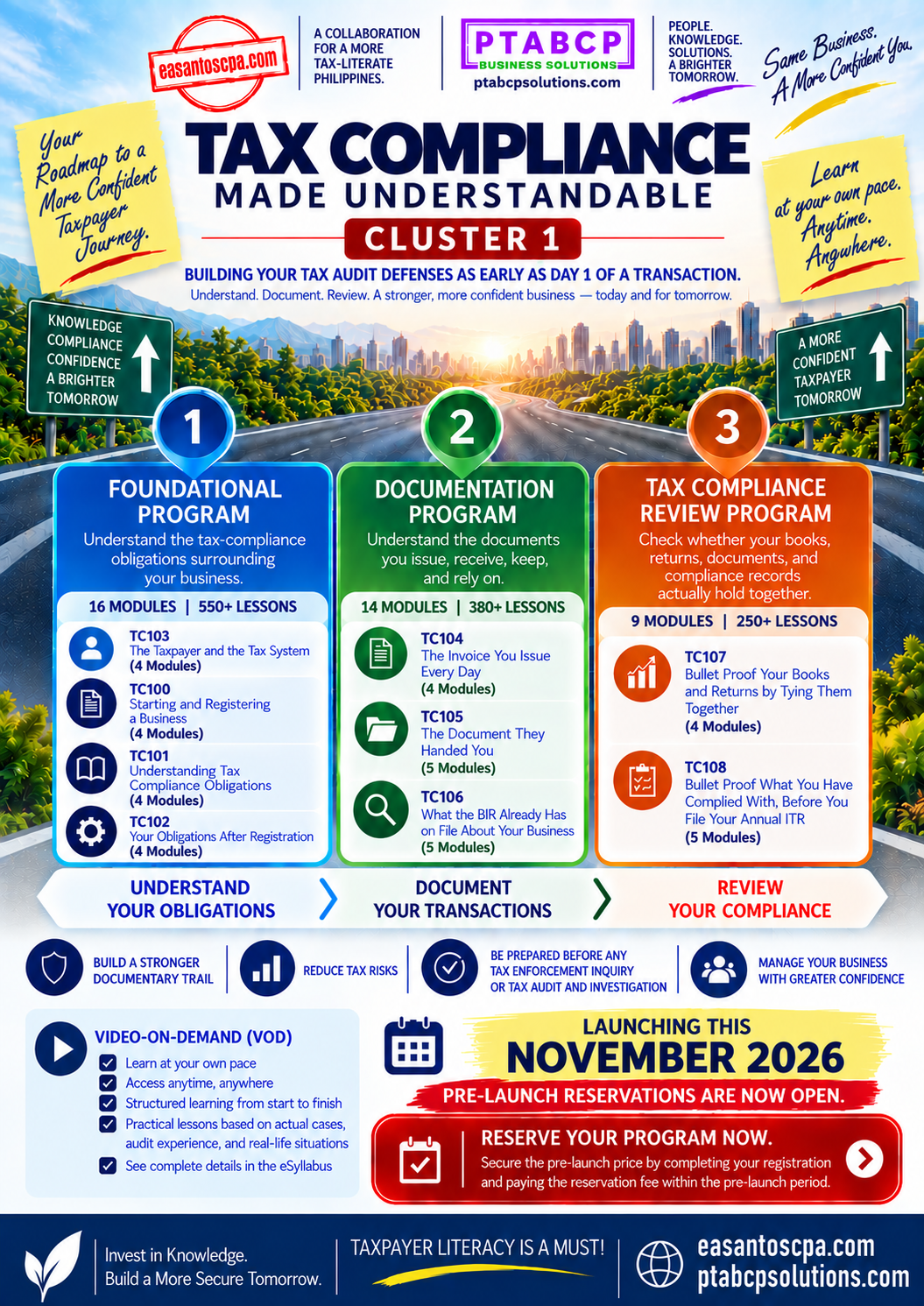
LEARN • STRENGTHEN • COMPLY
Trainings, Seminars & Webinars
Practical learning for business owners, professionals and teams.


- services@easantoscpa.com
- +63 916 587 1528
- Topaz Building, Kamias Road, Quezon City
- Office visit: By Appointment only.
- Strictly NO Walk-In
- Affiliate: ptabcpsolutions.com
Disclaimer: Posts are provided for educational and conceptual purposes only. They do not constitute professional advice. You are advised to consult a qualified professional regarding your specific circumstances.