
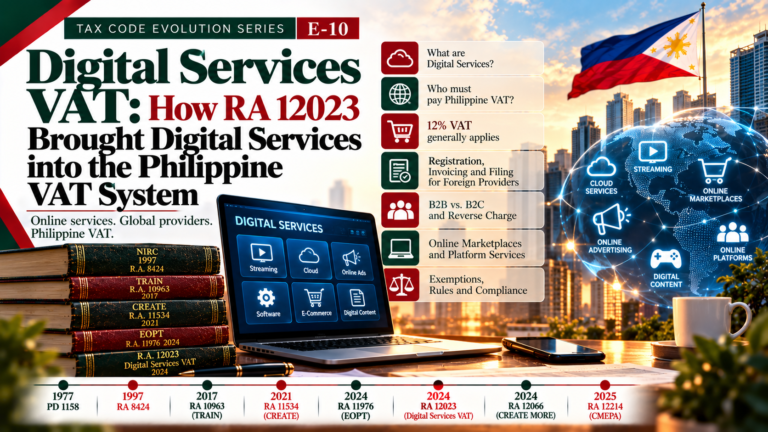
[E-10] DIGITAL SERVICES VAT: HOW RA 12023 BROUGHT DIGITAL SERVICES INTO THE PHILIPPINE VAT SYSTEM
Tax Code Evolution Series No. 10
You may never see the foreign digital company that provides your service. But if you consume that digital service in the Philippines, Philippine VAT may still follow the transaction.
A few years ago, the Philippine VAT system was largely designed around transactions that were easier to visualize:
- a store selling goods;
- a professional rendering services;
- a landlord leasing property;
- a restaurant serving customers;
- a manufacturer selling products.
Then commerce changed.
Today, a Filipino consumer can purchase:
- a streaming subscription;
- cloud storage;
- online advertising;
- a digital application;
- an online marketplace service;
- digital content;
- an online platform service;
from a provider that may have no physical office, employee, branch or other physical presence in the Philippines.
This created a fundamental tax-administration problem:
How does a country impose VAT on a digital service when the supplier may be physically outside the country?
The Philippine answer was Republic Act No. 12023, approved on October 2, 2024, which amended the 1997 NIRC to impose VAT on digital services.
And this is an important continuation of our Tax Code Evolution story.
EOPT changed how taxpayers comply.
RA 12023 changed what the VAT system could reach in the digital economy.
Where does RA 12023 fit in the evolution?
The Tax Code evolution now looks like this:
PD 1158 — 1977 NIRC
↓
RA 8424 — 1997 NIRC
↓
RA 10963 — TRAIN
↓
RA 11534 — CREATE
↓
RA 11976 — EOPT
↓
RA 12023 — Digital Services VAT
↓
RA 12066 — CREATE MORE
↓
RA 12214 — CMEPA
↓
Current NIRC, as amended
RA 12023 therefore did not create a separate digital tax code.
It amended the existing NIRC.
Specifically, it amended Sections 105, 108, 109, 110, 113, 114, 115, 128, 236 and 288, and inserted new Sections 108-A and 108-B.
This is another example of the principle we have seen throughout this series:
The NIRC remains the mother statute. Major tax reforms continue to modify it.
Why was a special digital-services law necessary?
The traditional VAT system already taxed services.
So one might ask:
“If services were already subject to VAT, why was another law necessary?”
Because the digital economy creates a different administrative and jurisdictional problem.
Consider a simple example.
A Philippine consumer subscribes to an online platform.
The service provider:
- is incorporated abroad;
- has no Philippine office;
- has no Philippine branch;
- provides the service through the internet;
- receives payment electronically; and
- delivers the service digitally.
Where is the service consumed?
And who is responsible for collecting the VAT?
RA 12023 addressed these questions by expressly bringing digital services into the statutory VAT framework.
RA 12023 expanded the statutory definition of taxable services
The amended Section 108 expressly includes:
the supply of digital services
within the VAT system.
This is significant because the law is no longer relying solely on older service categories written for a predominantly physical economy.
The NIRC now expressly recognizes digital services as part of the VAT architecture.
What exactly is a “digital service”?
New Section 108-A defines a digital service as a service:
- supplied over the internet or another electronic network;
- using information technology; and
- where the supply is essentially automated.
The law expressly includes examples such as:
- online search engines;
- online marketplaces or e-marketplaces;
- cloud services;
- online media and advertising;
- online platforms; and
- digital goods.
This is important because the law is not limited to one particular business model.
It is designed to capture different ways in which digital services are supplied.
Who is a Digital Service Provider?
The law defines a Digital Service Provider (DSP) as a resident or nonresident supplier of digital services to a consumer who uses digital services subject to VAT in the Philippines.
A Nonresident Digital Service Provider (NRDSP) is a DSP that has no physical presence in the Philippines.
That definition is central to the reform.
The Philippine tax system is no longer asking only:
“Does the foreign company have a Philippine office?”
It can instead ask:
“Are its digital services being consumed in the Philippines?”
That is a major conceptual shift.
The key concept: consumption in the Philippines
RA 12023 provides that digital services supplied by a nonresident DSP are considered performed or rendered in the Philippines if the digital services are consumed in the Philippines.
The implementing RR No. 3-2025 explains that digital services are generally considered consumed or used in the Philippines when the buyer is located in the Philippines.
The BIR may consider indicators such as:
- payment information;
- credit-card or bank information;
- residence information;
- billing address;
- mobile country code;
- IP address; and
- other reliable information establishing the buyer’s location.
If available information conflicts, the regulations provide for obtaining at least two pieces of non-conflicting evidence of where the service is consumed.
This is an important development.
The VAT system is increasingly concerned not only with:
Where is the supplier?
but also:
Where is the consumption?
This reflects the destination principle of VAT
The digital-services regime fits into the broader VAT concept of the destination principle.
The Supreme Court has explained that under the destination principle, goods and services are generally taxed in the jurisdiction where they are consumed.
This principle is not new.
What is new is applying the principle to transactions where:
- the supplier may be abroad;
- the customer may be in the Philippines;
- the service is delivered electronically; and
- there may be no physical movement of goods.
In other words:
RA 12023 did not invent the destination principle. It adapted Philippine VAT administration to the digital economy.
The tax rate is 12%
Under RA 12023 and the implementing regulations, digital services consumed in the Philippines are generally subject to 12% VAT.
RR No. 3-2025 states that VAT shall be levied, assessed and collected at 12% of gross sales derived by a DSP from its sale or exchange of services in the Philippines, pursuant to Section 108 of the NIRC.
So the law did not create a special lower VAT rate simply because the service is digital.
The fundamental VAT rate remains:
12%
subject to the applicable statutory exemptions and zero-rating rules.
Who is responsible for the VAT?
This is where RA 12023 becomes especially interesting.
Under Section 108-A, the digital service provider—whether resident or nonresident—is generally responsible for:
- assessing;
- collecting; and
- remitting
the VAT on digital services consumed in the Philippines, subject to the withholding rules applicable to VAT-registered consumers.
So the foreign digital provider is not necessarily outside the Philippine VAT system simply because it has no physical office here.
What happens when the digital provider is a foreign company?
A nonresident digital service provider can be required to register for Philippine VAT.
RA 12023 specifically amended Section 236 to provide a registration framework for nonresident DSPs and directed the BIR to establish a simplified automated registration system.
RR No. 3-2025 implemented this through the BIR’s VAT on Digital Services (VDS) Portal.
Importantly, the BIR regulations state that an NRDSP:
does not need a local representative in the Philippines simply to register for VAT.
However, it may appoint a Philippine-based third-party service provider—such as an accounting firm, law firm or consultancy—to receive notices, maintain records and assist with filing and reporting obligations.
That is a very different administrative model from the traditional concept of establishing a Philippine business presence.
The transition period mattered
RA 12023 did not make nonresident digital service providers immediately liable on the day the law was signed.
The statute provided for a transition period after the implementing rules took effect.
RR No. 3-2025 initially prescribed the registration and transition framework.
Then RR No. 14-2025 amended the transitory provision.
Under the amended rule:
- NRDSPs were given until June 1, 2025 to register or update registration; and
- they became subject to VAT beginning June 2, 2025.
This is another useful Tax Code Evolution lesson:
Always distinguish the law’s effectivity from the date a particular taxpayer obligation actually begins.
What if the customer is a VAT-registered business?
This is one of the more important features of the law.
RA 12023 created a reverse-charge mechanism under amended Section 114.
When a VAT-registered taxpayer purchases digital services from a nonresident DSP and the services are consumed in the Philippines, the Philippine VAT-registered purchaser is responsible for withholding and remitting the VAT under the statutory mechanism.
The law provides that the VAT-registered taxpayer must remit the VAT to the BIR within 10 days following the end of the month in which the withholding was made.
This creates an important distinction.
B2C
A Philippine consumer who is not VAT-registered may generally have the nonresident DSP collecting and remitting the VAT.
B2B
A VAT-registered Philippine business purchasing digital services from an NRDSP may have withholding/remittance responsibilities under the reverse-charge mechanism.
That means:
The same foreign digital service can create different compliance consequences depending on who the Philippine customer is.
And this was clarified by the BIR
The BIR later issued RMC No. 47-2025 to clarify the implementation of RR No. 3-2025.
One particularly important clarification was:
Nonresident DSPs are required to register even when their Philippine transactions are purely B2B.
The BIR also clarified that such NRDSPs must still file tax returns to report those B2B transactions.
This illustrates why taxpayers and digital businesses should not assume:
“B2B means no digital-services VAT compliance.”
The actual legal and administrative treatment must be examined.
The BIR created a special return for NRDSPs
To operationalize the system, the BIR issued RMC No. 52-2025, prescribing BIR Form No. 2550-DS, the VAT return specifically for nonresident digital service providers.
This is a good example of the hierarchy we have been following throughout the Tax Code Evolution Series:
RA 12023
creates the legal obligation.
↓
RR No. 3-2025
provides implementation rules.
↓
RR No. 14-2025
changes the transition period.
↓
RMC No. 47-2025
clarifies implementation.
↓
RMC No. 52-2025
creates the relevant VAT return.
↓
RMC No. 59-2026
provides further clarification.
That is how a tax rule becomes operational.
The digital invoice also had to change
The law amended Section 113.
A VAT-registered nonresident DSP must issue a digital sales or commercial invoice for each sale, barter or exchange of digital services.
For these invoices, the law specifies information such as:
- date of transaction;
- transaction reference number;
- identification of the consumer;
- brief description of the transaction; and
- total amount, indicating that the amount includes VAT.
If the transaction contains VAT-taxable, VAT-exempt and zero-rated components, the invoice must identify the applicable breakdown.
RR No. 3-2025 further provides that invoices issued by nonresident VAT-registered DSPs may be electronic and need not be registered with the BIR, subject to the regulatory requirements.
What counts as a digital service?
The law’s examples are deliberately broad.
Think about:
Online search
Search-engine services can fall within the digital-services framework.
Online marketplaces
Digital platforms connecting buyers and sellers may fall within the statutory definition.
Cloud services
Cloud-based services can be subject to the VAT rules.
Online media and advertising
Digital advertising services can be covered.
Online platforms
Platform-based services are expressly contemplated.
Digital goods
The statute expressly includes digital goods within the digital-service definition.
The important point is:
Digital does not mean tax-free.
But not every online transaction is automatically VATable
This is another important caution.
RA 12023 did not say:
“Everything that happens on the internet is subject to VAT.”
The transaction must still be examined under the NIRC.
For example, the law specifically amended Section 109 to address certain exempt transactions.
One express exemption covers qualifying educational services, including online courses, online seminars and online training rendered by duly accredited educational institutions and government educational institutions, subject to the statutory requirements.
Therefore, when analyzing an online transaction, the correct sequence is:
Is this a digital service?
↓
Is it consumed in the Philippines?
↓
Who is the provider?
↓
Who is the customer?
↓
Is the transaction subject to VAT or exempt?
↓
Who is responsible for collection or withholding?
↓
What registration/invoicing/reporting rules apply?
That is much better than simply asking:
“Is it online?”
Online education is a good example
Consider two businesses.
Business A
A duly accredited educational institution provides an online training program that falls within the statutory educational-service exemption.
Business B
A commercial platform sells an automated digital learning subscription that does not fall within the statutory exemption.
Both may describe their products as:
“online courses.”
But their VAT treatment may be different.
This is why the legal classification of the transaction matters more than its marketing description.
Online marketplace operators have an additional responsibility
RA 12023 created a particularly important rule for online marketplaces/e-marketplaces.
If a VAT-registered nonresident digital service provider operates an online marketplace or e-marketplace, it can also become responsible for VAT on transactions of nonresident sellers passing through its platform when it:
- controls key aspects of the supply; and
- either sets, directly or indirectly, the terms and conditions under which the goods are supplied, or is involved in ordering or delivery.
This is a major development.
The platform may no longer be viewed merely as a passive technological intermediary.
Depending on the statutory conditions, the platform itself can have VAT responsibilities connected to transactions conducted through it.
Why is this important for Philippine consumers?
Because digital VAT may now be embedded in the price of services consumers purchase.
For example, a subscription previously purchased from a foreign provider may now have Philippine VAT consequences because:
the digital service is consumed in the Philippines.
The consumer may therefore see VAT reflected in:
- subscription pricing;
- invoices;
- digital receipts/invoices;
- platform charges; or
- other transaction documentation.
VAT remains an indirect tax.
The Supreme Court has repeatedly explained that VAT may be shifted or passed on to the buyer or consumer.
Thus, although the legal liability may rest on the DSP or withholding taxpayer, the economic burden may ultimately be passed through to the consumer.
What about Philippine businesses buying foreign digital services?
This is where digital VAT becomes a bookkeeping and tax-compliance issue.
Imagine a Philippine company pays a foreign provider for:
- cloud software;
- online advertising;
- digital platform access;
- cloud storage;
- other digital services.
The business should not automatically record the payment as:
“Foreign expense — no Philippine VAT.”
It must first determine whether the service is covered by RA 12023 and whether the reverse-charge mechanism applies.
If the Philippine buyer is VAT-registered, Section 114(D) becomes particularly important.
This means digital services can affect:
- accounts payable;
- VAT accounting;
- withholding/remittance;
- tax returns;
- supporting documentation;
- invoices; and
- financial reporting.
Nonresident DSPs cannot claim ordinary Philippine input VAT
RA 12023 specifically provides that nonresident digital service providers are not allowed to claim creditable input tax under the amended Section 110.
This is an important structural difference.
A normal VAT system generally works through the input-output VAT mechanism.
The Supreme Court has described Philippine VAT as an invoice-based tax-credit system in which output VAT on sales is offset by allowable input VAT.
RA 12023 creates a special statutory treatment for NRDSPs.
So the digital-services regime should not simply be assumed to operate exactly like the ordinary domestic VAT regime in every respect.
Why does location become so important?
In a physical transaction, location is often easier to determine.
A customer walks into a Philippine store.
The store is physically here.
The transaction occurs here.
But imagine:
Philippine customer → Philippine bank/card → foreign platform → cloud server in another country → digital service consumed on a Philippine device.
Where did the transaction occur?
RA 12023 answers the VAT question largely through the concept of:
consumption in the Philippines.
RR No. 3-2025 therefore provides multiple indicators for determining the buyer’s location.
This is an example of tax law adapting to a transaction that does not fit neatly into traditional physical boundaries.
This is not simply a “foreign company tax”
An important distinction:
VAT on digital services is not the same thing as Philippine income taxation of a foreign corporation.
A nonresident DSP may have VAT obligations under RA 12023 because its digital services are consumed in the Philippines.
That does not automatically mean the foreign company has become a Philippine resident corporation or has a Philippine permanent establishment for every other tax purpose.
In fact, RR No. 3-2025 expressly states that appointing a Philippine third-party service provider for VAT-related administrative functions does not, by itself, classify the NRDSP as a nonresident foreign corporation doing business in the Philippines.
Therefore:
VAT presence and income-tax presence are not automatically the same legal question.
The BIR’s 2026 clarification shows that the system is still evolving
The digital VAT regime did not end with RA 12023.
The BIR issued RMC No. 59-2026 on June 2, 2026, further clarifying the implementation of RR No. 3-2025.
This is extremely important for this Tax Code Evolution Series.
The timeline is now:
October 2, 2024
RA 12023 enacted
↓
January 17, 2025
RR No. 3-2025 issued
↓
April 25, 2025
RR No. 14-2025 amended the transition rules
↓
May 7, 2025
RMC No. 47-2025 clarified implementation
↓
May 30, 2025
RMC No. 52-2025 prescribed BIR Form 2550-DS
↓
June 2, 2025
NRDSP VAT liability commenced under the amended transition rule
↓
June 2, 2026
RMC No. 59-2026 further clarified the framework.
This is exactly why:
“I read RA 12023” is not the same as “I know the current digital-VAT compliance rules.”
What does jurisprudence tell us?
As of this article’s review date, the major statutory and administrative framework specifically governing VAT on digital services comes from RA 12023 and its implementing BIR issuances.
The Supreme Court’s established VAT jurisprudence remains important for understanding the underlying principles.
Destination principle
The Court has explained that VAT follows the destination principle: goods and services are generally taxed where they are consumed.
That principle provides important conceptual support for taxing digital services consumed in the Philippines.
VAT is an indirect consumption tax
The Court has repeatedly recognized VAT as an indirect tax that may be shifted to the buyer or consumer.
This helps explain why the law can impose VAT on a transaction even though the economic burden may ultimately be passed on to the consumer.
Statutory tax privileges are strictly construed
The Supreme Court has repeatedly held that tax exemptions must be clearly granted by law and are strictly construed.
This remains relevant when determining whether a particular digital service qualifies for a statutory VAT exemption.
Important caution
These cases do not themselves interpret RA 12023.
They provide the broader VAT doctrines within which RA 12023 operates.
That distinction matters.
A simple real-life example
Imagine a Philippine company subscribes to a foreign cloud platform.
The provider:
- has no Philippine office;
- has no Philippine branch;
- provides the service online;
- charges the Philippine company electronically.
The company’s tax adviser should ask:
Step 1
Is the service a digital service under Section 108-A?
Step 2
Is it consumed in the Philippines?
Step 3
Is the foreign provider a nonresident DSP?
Step 4
Is the Philippine customer VAT-registered?
Step 5
Does the reverse-charge mechanism apply?
Step 6
What invoice/documentation is required?
Step 7
What VAT must be withheld and remitted?
Step 8
How should the transaction be reflected in the books and tax returns?
That is a proper tax analysis.
Not:
“It’s a foreign subscription, so there is no Philippine VAT.”
Another example: online advertising
A Philippine business purchases advertising services from a foreign digital platform.
The business may think:
“We’re just buying ads online.”
But from a tax perspective, the transaction can involve:
- a digital service;
- a nonresident DSP;
- Philippine consumption;
- VAT;
- invoice requirements;
- reverse charge;
- accounting;
- payment documentation; and
- reporting.
The fact that the advertisement appears on a phone screen rather than on a physical billboard does not make the transaction invisible to the tax system.
The deeper lesson: tax law follows economic activity
This is perhaps the most important lesson from RA 12023.
Tax laws are written at a particular point in history.
But business models change.
The Philippine tax system evolved from:
physical commerce
to
service commerce
to
electronic commerce
to
platform-based commerce
to
digital services delivered across borders.
The tax system therefore had to evolve as well.
RA 12023 represents one of those evolutionary steps.
But digital VAT is not the end of digital taxation
There is another important distinction.
VAT on digital services is only one part of the broader subject of:
Digital Taxation
Digital taxation can raise questions involving:
- VAT;
- income tax;
- withholding;
- permanent establishments;
- source rules;
- transfer pricing;
- cross-border transactions;
- online marketplaces;
- digital advertising;
- cloud services;
- intellectual property;
- data and technology;
- international tax agreements.
RA 12023 primarily addresses the VAT side.
The broader digital-taxation story therefore continues beyond this article.
That is why Digital Taxation remains one of our 36 Mother Tax Topics.
LEGAL BASIS
Constitutional foundation
The digital VAT framework operates within the constitutional taxation principles under:
- Article VI, Section 28(1) — taxation shall be uniform and equitable;
- Article III, Section 1 — due process and equal protection;
- the constitutional allocation of taxing authority to Congress.
Principal statute
Republic Act No. 12023
Approved: October 2, 2024
Title:
“An Act Amending Sections 105, 108, 109, 110, 113, 114, 115, 128, 236 and 288 and Adding New Sections 108-A and 108-B of the National Internal Revenue Code of 1997, as Amended.”
Among its major provisions are:
- digital services included in Section 108;
- new Section 108-A on liability of DSPs;
- new Section 108-B on NRDSP VAT;
- amendments to invoicing;
- reverse-charge mechanism;
- registration rules;
- digital-services exemptions; and
- allocation of part of incremental VAT revenue for creative industries.
Important implementing issuances
RR No. 3-2025
Issued January 17, 2025.
Provides the principal BIR implementation rules for VAT on digital services, including:
- registration;
- VAT liability;
- location/consumption;
- invoicing;
- filing;
- payment;
- compliance of resident and nonresident DSPs.
RR No. 14-2025
Issued April 25, 2025.
Amended the transitory provision and established June 2, 2025 as the start of VAT liability for covered NRDSPs after the registration transition.
RMC No. 47-2025
Issued May 7, 2025.
Clarified implementation of RR No. 3-2025, including B2B registration and filing obligations of NRDSPs.
RMC No. 52-2025
Issued May 30, 2025.
Prescribed BIR Form No. 2550-DS for NRDSP VAT reporting.
RMC No. 59-2026
Issued June 2, 2026.
Further clarified the implementation of the digital-services VAT framework.
Jurisprudence to remember
There may not yet be a Supreme Court decision squarely interpreting all the new provisions of RA 12023 as of this article’s review date.
But several established VAT doctrines remain highly relevant.
Destination Principle
Philippine VAT follows the principle that taxation generally attaches to consumption in the destination jurisdiction.
VAT as an indirect tax
VAT may be passed on to the buyer, transferee or lessee.
Tax exemptions must be clearly established
The Supreme Court repeatedly holds that tax exemptions are strictly construed and cannot simply be presumed.
These doctrines help explain the legal architecture of RA 12023, but they should not be mistaken for judicial interpretations of the new digital-services provisions themselves.
What should taxpayers remember?
If you remember only seven things about Digital Services VAT:
1. Digital services can be subject to Philippine VAT.
The fact that the supplier is online or foreign does not automatically remove Philippine VAT.
2. Consumption in the Philippines matters.
The location of the consumer is central to determining Philippine VAT exposure.
3. Nonresident DSPs can have Philippine VAT obligations.
Physical presence is not necessarily required for VAT registration and compliance.
4. B2B and B2C can produce different compliance mechanics.
A VAT-registered Philippine customer may have reverse-charge responsibilities.
5. Online marketplaces can have additional VAT responsibilities.
The law can make a qualifying platform responsible for VAT on transactions passing through it.
6. Not every online service is automatically taxable.
Statutory exemptions—including qualifying educational services—must still be examined.
7. The rules continue to evolve.
RA 12023 → RR 3-2025 → RR 14-2025 → RMC 47-2025 → RMC 52-2025 → RMC 59-2026.
That sequence is the real story.
The Tax Code Evolution Lesson
The evolution of Philippine VAT can now be seen more clearly.
1987
VAT entered the Philippine tax system through EO 273, later expanded and modified by subsequent legislation.
1997
RA 8424 reorganized the VAT provisions within the NIRC.
TRAIN
RA 10963 substantially changed VAT and other tax rules.
CREATE
RA 11534 modified VAT and incentive-related rules.
EOPT
RA 11976 changed invoicing, service recognition, refunds and VAT administration.
Digital Services VAT
RA 12023 expressly brought digital services into the VAT framework.
And now the tax system faces a new question:
What happens when the transaction is not only digital, but international?
That question takes us beyond VAT and into cross-border taxation.
Related Philippine Tax Code Evolution Articles
[E-01] Before the NIRC: Where Did Philippine Tax Law Begin?
[E-02] From Act No. 1189 to Act No. 2339: How Philippine Internal Revenue Law Started To Evolve
[E-03] The Commonwealth Tax Code: How CA 466 Became the National Internal Revenue Code
[E-04] From CA 466 To PD 1158: Why the 1977 NIRC Was Another Recodification
[E-05] From The 1980s-1990s Tax Reforms To RA 8424: How the Modern NIRC Emerged
[E-06] The 1997 NIRC: How the Modern Philippine Tax Code Is Structured
[E-07] Train: Why RA 10963 Changed The 1997 NIRC
[E-08] Create: How RA 11534 Reshaped Corporate Taxation And Tax Incentives
[E-09] EOPT: Why RA 11976 Changed How Taxpayers Comply
[E-10] Digital Services VAT: How RA 12023 Brought Digital Services Into The Philippine Vat System
[E-11] Create More: Why RA 12066 Rewrote Parts Of The Create Framework
[E-12] CMEPA: How Ra 12214 Changed The Taxation Of Capital Markets And Financial Transactions
[E-13] The Current NIRC: How To Read The National Internal Revenue Code As Amended In 2026
[E-14] How A Philippine Tax Rule Is Born: From Legislation To Implementation
[E-15] How To Research Philippine Tax Law: Finding The Original Rule, Its Amendments, And The Current Legal Basis
Next:
[E-11]
CREATE MORE: WHY RA 12066 REWROTE PARTS OF THE CREATE FRAMEWORK
We will examine how CREATE MORE modified the corporate-tax and tax-incentive framework that CREATE had only recently established—and why this is another reminder that:
A tax law can become obsolete as a compliance guide even while remaining essential as part of the legal history.
Taxpayer Literacy is a Must!
Editorial Note
Current as of October 31, 2026.
This article is part of the Tax Code Evolution Series of easantoscpa.com Articles & Insights.
The purpose of this series is to help taxpayers understand where Philippine tax rules came from, how they evolved, and why today’s tax rules must be read together with their amendments, implementing issuances and jurisprudence.
Taxpayer Literacy is a Must!
Need Help With a Tax or Compliance Concern?
Understanding your obligations is the first step. Building the right compliance system is the next.
If your business needs professional guidance regarding BIR compliance, bookkeeping, documentation, tax concerns, or compliance review, you may discuss your specific circumstances with us.
BOOK A CONSULTATION →
Disclaimer
This article is provided for educational and conceptual purposes only and does not constitute tax, legal, accounting, or other professional advice. Tax rules and administrative requirements may change, and their application depends on the taxpayer’s particular facts and circumstances. Consult a qualified professional regarding your specific situation.
LEARN • STRENGTHEN • COMPLY
Trainings, Seminars & Webinars
Practical learning for business owners, professionals and teams.


- services@easantoscpa.com
- +63 916 587 1528
- Topaz Building, Kamias Road, Quezon City
- Office visit: By Appointment only.
- Strictly NO Walk-In
- Affiliate: ptabcpsolutions.com
Disclaimer: Posts are provided for educational and conceptual purposes only. They do not constitute professional advice. You are advised to consult a qualified professional regarding your specific circumstances.