
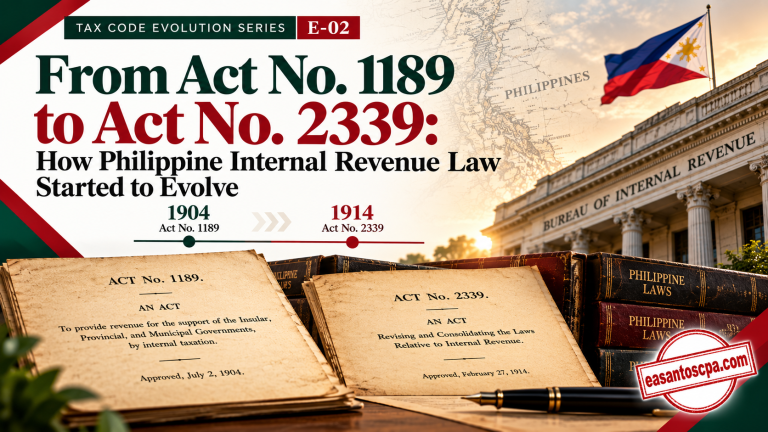
FROM ACT NO. 1189 TO ACT NO. 2339: HOW PHILIPPINE INTERNAL REVENUE LAW STARTED TO EVOLVE
Tax Code Evolution Series
If you think Philippine tax law began with one Tax Code and stayed essentially the same, history tells a different story.
The Philippine internal revenue system was already changing within its first decade.
After Act No. 1189 of 1904, the Internal Revenue Law continued to be amended as the government encountered new businesses, transactions, revenue sources, administrative requirements, and enforcement concerns.
That eventually led to Act No. 2339 of 1914—the law expressly enacted to revise and consolidate the laws relating to internal revenue.
And that transition gives us an important lesson about Philippine tax law today:
Tax law evolves because the economy, government, transactions, and compliance problems evolve.
1. Act No. 1189 Was Not the End of the Story
Act No. 1189, enacted on July 2, 1904, established the early statutory framework for internal taxation and created the Bureau of Internal Revenue.
But it did not remain untouched.
Even before the 1914 consolidation, the law was being amended.
For example, Act No. 2227, enacted in 1913, amended provisions of Act No. 1189 dealing with occupation licenses for professionals such as lawyers, physicians, dentists, engineers, surveyors and architects.
This is important because it shows something that remains true today:
A tax law can change because the government needs to refine how an existing tax rule operates.
The law does not necessarily have to wait for an entirely new Tax Code.
2. Then Came Act No. 2339
On February 27, 1914, the Philippine Legislature enacted Act No. 2339, entitled:
“An Act Revising and Consolidating the Laws Relative to Internal Revenue.”
It was called the Internal Revenue Law of 1914. Lawphil
Notice the words:
REVISING AND CONSOLIDATING
Those words are significant.
The government was no longer dealing simply with one original internal-revenue statute.
There were already amendments, additional provisions and developing tax rules that needed to be brought together.
Act No. 2339 therefore illustrates an important stage in tax-law development:
Original law → amendments → accumulated rules → revision and consolidation.
That pattern would appear again and again in Philippine tax history.
4. Tax Records Were Already Part of the System
Another surprisingly familiar feature is found in Section 6(j).
Act No. 2339 contemplated regulations governing the manner in which taxpayers would keep:
- books;
- records;
- invoices;
- other papers; and
- entries relating to revenue.
Section 8 likewise authorized the Collector to prescribe and provide various forms, certificates, records and invoice books used in administering the internal revenue laws. Lawphil
Think about that for a moment.
More than a century ago, Philippine internal revenue administration already recognized that tax compliance was not merely about paying the tax.
It also involved the records that support the tax.
That idea remains fundamental today.
5. Assessment Was Already an Administrative Function
Act No. 2339 also contained an early form of an assessment mechanism.
Under Section 18, when a required report was not submitted—or when there was reason to believe that the report was false, incomplete or erroneous—the Collector of Internal Revenue could assess the proper tax based on the best evidence obtainable. Lawphil
The terminology and legal framework have changed considerably over the decades.
But the basic administrative problem is familiar:
What happens when the taxpayer’s report does not adequately establish the tax liability?
That question did not begin with the modern NIRC.
It was already part of Philippine internal-revenue administration in 1914.
6. Taxpayer Remedies Were Already Recognized
Act No. 2339 also contained provisions addressing taxpayer disputes.
Section 140 provided a mechanism for a taxpayer who questioned the validity or amount of a tax to pay under protest and seek a decision from the Collector of Internal Revenue, subject to the statutory conditions and periods then applicable. Lawphil
The law also provided for:
- recovery of taxes paid under protest;
- contests involving forfeited property;
- compromises;
- refunds of erroneously or illegally collected taxes; and
- remission of certain taxes that appeared unjustly assessed or excessive. Lawphil
Again, the modern remedies system is much more developed.
But the historical lesson is clear:
Tax administration and taxpayer remedies developed together.
As government acquired greater power to assess and collect taxes, the law also developed mechanisms through which taxpayers could challenge tax impositions.
7. The Tax Base Was Already Becoming More Complex
Act No. 2339 recognized multiple sources of internal revenue.
Among them were:
- cedula taxes;
- documentary taxes;
- privilege taxes on business and occupation;
- specific taxes on manufactured products;
- taxes involving banks and insurance companies;
- forest-product charges;
- income tax collected under applicable laws;
- taxes on signs, signboards and billboards. Lawphil
And the system continued to expand.
For example, Act No. 2432, enacted later in 1914, amended Act No. 2339 by imposing increased and additional taxes and adding provisions including an ad valorem tax on mining output.
Then Act No. 2541 of 1915 again amended Act No. 2339, changing rates, creating new taxes and abolishing others.
So even the supposedly “consolidated” 1914 law did not remain static.
8. Consolidation Does Not Mean the Law Stops Changing
This is perhaps the most important lesson from the period.
Act No. 2339 was enacted precisely because the internal revenue laws needed revision and consolidation.
Yet shortly afterward, Act No. 2339 itself was amended.
That is not necessarily a defect in the tax system.
It is what happens when legislation interacts with a changing economy.
The cycle looks like this:
LAW
↓
AMENDMENTS
↓
NEW TAX RULES / NEW ADMINISTRATIVE NEEDS
↓
REVISION & CONSOLIDATION
↓
MORE AMENDMENTS
↓
ANOTHER CODIFICATION OR REFORM
That cycle would eventually lead to the Commonwealth Act No. 466 of 1939, the first major codification of the internal revenue laws under the National Internal Revenue Code.
And much later:
CA 466 → PD 1158 → RA 8424 → TRAIN → CREATE → EOPT → Digital Services VAT → CREATE MORE → CMEPA and other amendments.
9. The Supreme Court Has Actually Traced This Legislative Lineage
This is not merely a historical reconstruction.
The Supreme Court itself has traced the evolution of particular tax provisions across successive laws.
In Commissioner of Internal Revenue v. Philippine Health Care Providers, Inc., G.R. No. 167330, the Court traced a documentary stamp tax provision from Act No. 1189, to Act No. 2339, then through the Administrative Codes, Commonwealth Act No. 466, and eventually PD 1158. eLibrary
That case gives us a powerful research lesson:
A provision’s current location in the Tax Code may only be the latest point in a much longer legislative history.
The section number may change.
The Code may be recodified.
The wording may be amended.
But the legal history can sometimes reveal how the provision developed.
10. Why Should a Modern Taxpayer Care About 1914?
You might be thinking:
“Okay. Interesting history. But why should I care? That was more than 100 years ago.”
Because understanding tax evolution changes the way you read tax law.
When you encounter a provision today, you should not automatically assume:
“This is the rule because this is what the current Tax Code says.”
A better question is:
How did this rule get here?
Was it:
- part of the original NIRC?
- introduced by an amendment?
- carried forward from an older law?
- changed by a later statute?
- implemented by a regulation?
- clarified by a BIR issuance?
- interpreted by the courts?
- modified by a subsequent law?
That distinction becomes increasingly important as the Philippine tax system becomes more complex.
11. The Bigger Picture: Philippine Tax Law Is a Continuing Story
Look at the timeline:
1904
Act No. 1189
↓
1914
Act No. 2339
↓
1939
Commonwealth Act No. 466
↓
1977
PD 1158
↓
1997
RA 8424
↓
2017
TRAIN — RA 10963
↓
2021
CREATE — RA 11534
↓
2024
EOPT — RA 11976
Digital Services VAT — RA 12023
CREATE MORE — RA 12066
↓
2025
CMEPA — RA 12214
↓
2026
Continuing amendments, regulations, revenue issuances and jurisprudence
The names change.
The section numbers change.
The tax rates change.
The administrative mechanisms change.
But the underlying process remains:
Congress creates and changes tax law.
Administrative agencies implement it.
Taxpayers comply with it.
Disputes are resolved through the legal system.
And later laws may change the rules again.
What This Means for Today’s Taxpayer
A taxpayer should therefore be careful when someone says:
“Matagal nang ganyan ang tax rule.”
Maybe.
But “matagal nang ganyan” is not a legal authority.
The real questions are:
What law created the rule?
What law amended it?
When did the amendment become effective?
What regulation implemented it?
Were there transitional rules?
Did the courts interpret it?
Was it later amended or repealed?
And most importantly:
What is the rule that actually applies to this taxpayer, this transaction, and this taxable period?
That is where tax research begins to matter.
LEGAL BASIS
Act No. 1189 (1904)
The Internal Revenue Law of 1904. It established the Bureau of Internal Revenue and the early statutory framework for internal taxation.
Act No. 2339 (1914)
The Internal Revenue Law of 1914, expressly revising and consolidating the laws relating to internal revenue. It also contained provisions on BIR administration, regulations, records, invoices, assessment, remedies, collection and penalties.
Act No. 2432 (1914)
Amended Act No. 2339 by imposing increased and additional taxes and creating additional tax provisions.
Act No. 2541 (1915)
Further amended Act No. 2339 by changing rates, creating new taxes and abolishing others.
Commissioner of Internal Revenue v. Philippine Health Care Providers, Inc.
G.R. No. 167330 — The Supreme Court traced the legislative history of a documentary stamp tax provision across successive internal-revenue laws, illustrating how a tax provision can evolve through amendments and recodifications.
Jurisprudence
Commonwealth Act No. 466 (1939)
Revised, amended and codified the internal revenue laws and was expressly known as the National Internal Revenue Code.
TAXPAYER TAKEAWAY
A Tax Code is not born fully formed.
It develops through legislation, amendment, consolidation, administrative implementation and judicial interpretation.
Understanding today’s tax rule sometimes requires understanding where that rule came from.
Related Philippine Tax Code Evolution Articles
E-01 — Before the NIRC: Where Did Philippine Tax Law Begin?
E-02 — From Act No. 1189 to Act No. 2339: How Philippine Internal Revenue Law Started to Evolve
E-03 — The Commonwealth Tax Code: How CA 466 Became the National Internal Revenue Code
Editorial Note
Current as of October 5, 2026.
This article is part of the Tax Code Evolution Series of easantoscpa.com Articles & Insights.
The purpose of this series is to help taxpayers understand where Philippine tax rules came from, how they evolved, and why today’s tax rules must be read together with their amendments, implementing issuances and jurisprudence.
Taxpayer Literacy is a Must!
Need Help With a Tax or Compliance Concern?
Understanding your obligations is the first step. Building the right compliance system is the next.
If your business needs professional guidance regarding BIR compliance, bookkeeping, documentation, tax concerns, or compliance review, you may discuss your specific circumstances with us.
BOOK A CONSULTATION →
Disclaimer
This article is provided for educational and conceptual purposes only and does not constitute tax, legal, accounting, or other professional advice. Tax rules and administrative requirements may change, and their application depends on the taxpayer’s particular facts and circumstances. Consult a qualified professional regarding your specific situation.
LEARN • STRENGTHEN • COMPLY
Trainings, Seminars & Webinars
Practical learning for business owners, professionals and teams.


- services@easantoscpa.com
- +63 916 587 1528
- Topaz Building, Kamias Road, Quezon City
- Office visit: By Appointment only.
- Strictly NO Walk-In
- Affiliate: ptabcpsolutions.com
Disclaimer: Posts are provided for educational and conceptual purposes only. They do not constitute professional advice. You are advised to consult a qualified professional regarding your specific circumstances.