
TAX COMPLIANCE FOUNDATIONAL PROGRAM
TC-FOUNDATIONAL
YOUR TAX COMPLIANCE HAS A STARTING POINT.
Before You Can Document and Review Your Tax Compliance, Understand What You Chose, What You Owe, and What You Are Responsible For.
A practical, self-paced Video-On-Demand (VOD) program for business owners, taxpayers, and tax compliance personnel.
4 Courses | 16 Modules | 550+ Lessons
REGISTER NOW
1. PROGRAM OVERVIEW
You registered your business.
You chose a tax type—or someone helped you choose one.
You started operating.
You issued invoices, received payments, paid expenses, and filed tax returns.
But have you ever paused to ask:
Do I understand the tax type I am registered under?
Do I know what my registration requires me to do?
Do I understand which tax obligations apply to my business?
Do I know what I am signing when I submit a tax return or document?
Do I know which rates, thresholds, deadlines, and amounts apply to the year I am dealing with?
Tax compliance is not simply about filing returns and paying taxes.
It begins with understanding the obligations that apply to you—and the decisions, responsibilities, and records connected with those obligations.
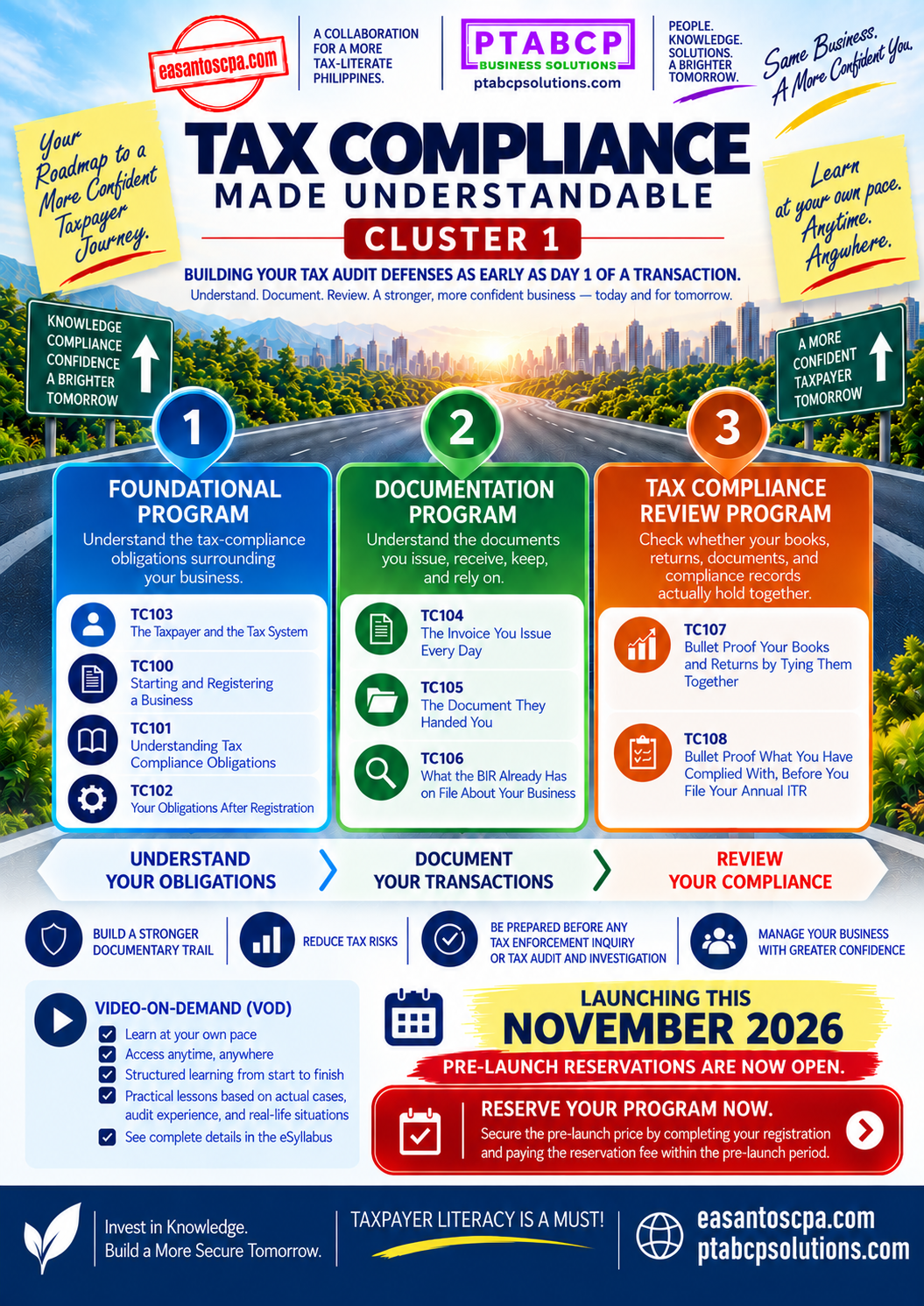
The Tax Compliance Foundational Program brings together four courses designed to help you build that understanding:
TC103 — What to Know in Your Tax Types and Taxable Year
TC100 — The Choice You Made Before You Understood It
TC101 — You Are the One Who Signs It
TC102 — The Obligations Nobody Explained When You Registered
Together, these courses introduce the foundational questions behind your tax compliance:
What applies to me? What did I choose? What am I responsible for? And what do I need to know about my tax obligations?
The program is part of
… Tax Compliance Made Understandable — Cluster 1: Building Your Tax Audit Defenses as Early as Day 1 of a Transaction.
2. WHO IS THIS PROGRAM FOR?
This program is particularly relevant to:
Business owners
Sole proprietors
Professionals in business
Corporations
Finance and accounting personnel
Bookkeepers
Tax compliance personnel
Business administrators
Taxpayers responsible for their business’s tax compliance
It may be especially relevant if you have ever thought:
“Registered naman kami.”
“May accountant naman kami.”
“Nag-file naman kami.”
“Nagbayad naman kami.”
Those may be important parts of compliance. But they do not automatically mean you understand the full set of obligations connected with your business.
This program is designed for taxpayers who want to understand their own tax compliance—not merely depend on someone else to explain it when a question arises.
3. WHAT MAKES THE FOUNDATIONAL PROGRAM DIFFERENT?
This is not simply a collection of tax definitions, rates, and deadlines.
The program is organized around the taxpayer’s own position and responsibilities.
It begins with the figures and rules that apply to the taxable year, then moves into the choices made during registration, the responsibility attached to signing and submitting documents, and the obligations that follow registration.
The goal is to help learners develop a clearer understanding of the tax compliance responsibilities connected with their business.
A structured learning path
KNOW THE TAX YEAR
TC103 — What to Know in Your Tax Types and Taxable Year
UNDERSTAND THE CHOICE
TC100 — The Choice You Made Before You Understood It
RECOGNIZE YOUR RESPONSIBILITY
TC101 — You Are the One Who Signs It
UNDERSTAND YOUR OBLIGATIONS
TC102 — The Obligations Nobody Explained When You Registered
The recommended order is TC103, followed by TC100, TC101, and TC102. TC103 serves as a reference course for figures used throughout the catalog.
4. THE FOUR COURSES
FOUR COURSES. FOUR DIFFERENT TAXPAYER QUESTIONS.
You registered a business. You started making transactions. You hired help. You filed returns. You paid taxes.
But somewhere along the way, you may have missed the questions that connect all those activities.
Which tax rules apply to you?
What choices did you make?
Who remains responsible?
What obligations did your registration create?
The Foundational Program takes you through four perspectives:
TC103 — What to Know in Your Tax Types and Taxable Year
TC100 — The Choice You Made Before You Understood It
TC101 — You Are the One Who Signs It
TC102 — The Obligations Nobody Explained When You Registered
Each course addresses a different part of the taxpayer’s situation. The complete explanations, applicable rules, and learning process are inside the courses.
COURSE 1 — TC103
What to Know in Your Tax Types and Taxable Year
The Figures You Need to Understand Your Tax Position
You may know that your business has taxes to pay.
But do you know which figures actually apply to your business?
A threshold may determine which tax regime you fall under. A rate may depend on what kind of taxpayer you are. A deadline may depend on the type of return or obligation involved.
And the figure you remember from last year may not necessarily be the figure that applies to the year you are dealing with now.
That is where uncertainty begins.
You hear a number from someone. You see another number in a post. You remember a figure from a seminar. But which one applies to your situation—and which rule fixes it?
TC103 is the reference course for the figures used throughout the Cluster 1 catalog. It gathers the relevant rates, thresholds, deadlines, durations, and amounts so you can look up the figures connected with the tax rules being discussed.
MODULE 1 — WHERE YOU STAND THIS YEAR
You may be operating under a tax classification you have never really examined.
Your sales, taxpayer category, and registration can affect where you stand. But do you know which line applies to you? Do you know what counts toward it? Have you checked whether the figures or conditions have changed?
This module takes you into the figures that help establish your current tax position—and the questions you need to ask about where your business stands.
The figures and the rules that fix them are inside TC103.
MODULE 2 — WHAT IT COSTS THIS YEAR
You know you have taxes to pay. But do you know which rates and amounts actually reach you?
Different taxes may use different bases. Rates may depend on the type of taxpayer, the transaction, or the person being paid. Penalties may also depend on conditions that are easy to overlook.
The problem is not simply remembering a percentage. It is knowing when that percentage applies—and when it does not.
This module brings together the figures connected with tax costs, ceilings, and penalties, along with the conditions that determine who they reach.
The figures are inside TC103.
MODULE 3 — WHAT IS DUE, AND WHEN
You may know that you have deadlines. But do you know the calendar of duties behind your registration?
Some obligations recur monthly. Others are quarterly or annual. Filing and paying may be separate responsibilities, and the records behind those duties may need to be kept beyond the filing date.
A missed date can create another problem. But a date remembered incorrectly can also lead you in the wrong direction.
This module brings the relevant dates and periods into one reference point, helping you identify which timing rules belong to the obligations being discussed.
The dates, durations, and applicable rules are inside TC103.
MODULE 4 — WHAT IS NEW, AND WHAT IS COMING
You learned a rule before. But does it still apply the same way today?
Tax rules and administrative requirements can change. Some provisions are already in force. Others may have implementation dates or developments that taxpayers need to distinguish from what is currently applicable.
That creates a familiar problem: relying on something you learned before without checking whether the relevant rule has changed.
This module brings attention to new and developing provisions, including the dates that matter when determining what applies and when.
The figures and effective dates are inside TC103.
WHY TC103 MATTERS
TC103 is not designed to teach every tax concept or show you how to prepare a return. It serves as the figures reference for the Cluster 1 courses.
When another course points to a rate, threshold, deadline, duration, or amount, TC103 is where you can look for the figure and the provision that fixes it.
Because knowing that a rule exists is one thing. Knowing which figure applies to your situation is another.
COURSE 2 — TC100
THE CHOICE YOU MADE BEFORE YOU UNDERSTOOD IT
The Decisions You Made Once—and Have Been Living With Since
When you started your business, you had decisions to make.
What form would it take? Which tax regime would apply? Which income tax option would you use? What accounting period and method would govern your records?
Maybe you understood every choice. Maybe someone helped you complete the forms. Maybe you chose what seemed easiest at the time.
But after registration, the consequences of those decisions did not simply disappear.
Your business grew. Your transactions changed. Your circumstances may have changed. Yet the settings chosen at the beginning may still be affecting how your business is treated.
What exactly did you choose—and what does that choice mean for you today?
TC100 takes you back to those decisions and examines what they commit you to, what they affect, and which choices may still be changed
MODULE 1 — WHAT YOU ARE ABOUT TO BECOME
You chose a business structure once. But have you ever examined what that structure means for you now?
The name on your signboard may not tell the whole story. The way you operate may feel personal, but the legal and tax treatment of the business may depend on the form you chose.
A registration form may have been completed in one afternoon. Its consequences can remain long after the person who helped you register has moved on.
This module takes you into the business form you selected, the identity attached to it, and the responsibilities and costs that may follow from that choice.
The distinctions behind your business structure are inside TC100.
MODULE 2 — THE BUSINESS TAX YOU ARE ABOUT TO CHOOSE
You may have a preference for how your business is taxed. But does the law give you that choice?
Your sales, registration, and applicable tax rules may determine which business tax regime applies. Some choices may be available only under particular conditions, and a choice made once may remain in place for a period of time.
That can become uncomfortable when the regime you are using no longer feels suited to your business—or when you discover you never fully understood the difference.
This module examines the business tax regimes, the conditions behind them, and the consequences that may follow from the choice.
The rules behind the available lanes are inside TC100.
MODULE 3 — THE INCOME TAX LANE YOU ARE ABOUT TO PICK
You may think your business tax choice and income tax choice are one decision. They are not necessarily the same.
A taxpayer may be dealing with more than one tax decision. The rules for one do not automatically answer the questions for another.
You may have heard about different income tax options. But who may use them? How is the choice made? How long does it last? And what happens if you assumed the option was available without checking the conditions?
This module separates the income tax decision from the business tax decision and examines the choices that may be available to the taxpayer.
The distinctions and conditions are inside TC100.
MODULE 4 — WHAT YOU CANNOT UNDO
Some decisions can be changed. Others may be difficult to reverse—or may require a particular process.
A business owner may discover that an old choice no longer fits the business. But the question is not simply whether a change sounds desirable.
What can still be changed? What conditions apply? When does a change take effect? What happens to the obligations that existed before the change?
This module takes you into the choices that may be revisited, the limits that matter, and the consequences of changing—or failing to change—what was selected.
What may still be changed, and how, is inside TC100.
WHY TC100 MATTERS
The decisions made at registration can continue affecting the business long after the paperwork is finished.
TC100 helps you revisit those decisions, understand the tax settings you are operating under, and recognize where a choice may no longer match your circumstances.
Because the question is not only what you chose then. It is what that choice means for you now.
COURSE 3 — TC101
YOU ARE THE ONE WHO SIGNS IT
You Can Hire Help. But the Return Still Carries Your Name.
You hired a bookkeeper. You engaged an accountant. Someone prepares the return. Someone checks the figures. Someone sends it for filing.
You may reasonably rely on professionals to help you manage your tax responsibilities.
But when the return carries your name, do you understand what you are declaring?
What records were used? What taxes did the transaction create? What does the signature mean? And what remains your responsibility even when someone else performs the work?
“Sabi ng accountant, okay naman.”
That may be reassuring. But it does not answer every question the person signing the return may need to understand.
TC101 takes you into the taxpayer’s role: the records a business produces, the taxes transactions may trigger, the meaning of signing a return, and the responsibilities that cannot simply be handed over.
MODULE 1 — WHAT YOUR BUSINESS ALREADY PRODUCES WITHOUT YOU NOTICING
Your business may already be creating records and obligations you have never personally examined.
Invoices are issued. Transactions are recorded. Documents are received. Returns are prepared. Information accumulates as the business operates.
You may see these as separate tasks handled by different people. But the records are connected to the business—and some of them may become important when the taxpayer is asked to explain what happened.
This module takes you into the records and obligations your business produces, including those that may exist even when nobody has organized them into one picture.
What your business is already producing—and why it matters—is inside TC101.
MODULE 2 — THE TAXES ONE DEAL SWITCHES ON
One transaction may involve more than one tax responsibility.
You make a sale. You pay a supplier. You hire a service provider. You enter into an agreement.
You may think first about the amount of the transaction. But different tax responsibilities may arise depending on what happened, who was involved, and what the transaction was.
If you recognize only one tax, what other responsibilities might you overlook?
This module examines the taxes that may be triggered by different transactions and why the taxpayer needs to recognize them before focusing only on computation.
The tax responsibilities connected with the transaction are inside TC101.
MODULE 3 — THE NAME ON THE RETURN IS YOURS
Someone else may prepare the return. But whose name appears on it?
You may not have prepared the figures yourself. You may not have encoded the information. You may not have personally submitted the return.
But what does it mean when the return is made and filed under your name?
What are you declaring? What is the role of the person who prepared it? What responsibilities remain with the taxpayer? And what happens when the return contains information that the signer never examined?
This module takes you into the significance of the return, the declaration it carries, and the responsibility attached to the person whose name appears on it.
What the signature means—and what it does not transfer—is inside TC101.
MODULE 4 — WHAT YOU CANNOT HAND TO ANYONE ELSE
You can delegate the work. But can you delegate every responsibility?
A business owner may depend on a bookkeeper, accountant, or tax professional. That support can be valuable. Yet the taxpayer may still need to understand the business, recognize the obligations, and know what is being signed or submitted.
What should you understand even if you never prepare the return yourself? What questions should you be able to ask? What records should remain available? And what happens when nobody in the business can explain what was filed?
This module examines the responsibilities that remain with the taxpayer, even when other people perform the work.
The responsibilities that stay with you are inside TC101.
WHY TC101 MATTERS
Tax compliance often involves several people—but the taxpayer still has a role.
TC101 helps you understand the records your business produces, recognize the tax responsibilities transactions may trigger, and examine what it means to sign and submit a return.
Because relying on help and understanding your own responsibilities are not mutually exclusive.
COURSE 4 — TC102
THE OBLIGATIONS NOBODY EXPLAINED WHEN YOU REGISTERED
Your Certificate Is Not Just a Piece of Paper
You registered your business. You received your Certificate of Registration. You placed it somewhere visible—or saved a copy in your files.
And then you got busy.
You started selling, buying, paying, recording, and filing. Maybe someone told you which returns to submit. Maybe you followed a routine. Maybe you assumed the certificate was simply proof that the business had registered.
But have you ever read it line by line?
What obligations did it create? Which books are you required to keep? What documents must you be able to produce? What happens when your business changes but the registration remains the same?
Your certificate may be one sheet of paper. The responsibilities connected with it can extend much further.
TC102 takes you into the obligations that follow from registration—and the records and updates that may be required as your business continues operating.
MODULE 1 — WHAT YOUR CERTIFICATE OF REGISTRATION ACTUALLY COMMITS YOU TO
You may have received your certificate years ago. But do you know what every line on it means today?
The certificate is not simply proof that registration happened. It identifies tax types and other registration details connected with the business.
Each line may point to a responsibility. And if you have never examined those lines closely, you may not have a clear picture of what your business is expected to do.
This module takes you back to the certificate and the obligations it reflects, including the duties that may continue even when business activity slows down.
What your certificate commits you to is inside TC102.
MODULE 2 — THE BOOKS YOU ARE REQUIRED TO KEEP
You may have books. But do you know whether they are the books your business is required to keep?
A taxpayer may rely on a bookkeeper to maintain records. The books may be stored in an office, an accounting system, or somewhere the owner rarely checks.
But what books are required? How must they be maintained? Where should they be kept? And does the responsibility disappear because someone else is doing the bookkeeping?
This module examines the books connected with the taxpayer’s obligations and the responsibility to maintain them.
The requirements behind your books are inside TC102.
MODULE 3 — WHAT YOU MUST BE ABLE TO PRODUCE, AND FOR HOW LONG
Keeping a document is one thing. Being able to find and produce it when needed is another.
A transaction may have happened years ago. The person who handled it may have left. The file may have been moved. The supporting document may be difficult to locate—or nobody may remember where it was kept.
What records should still be available? What must they support? How long do they need to remain accessible? And what happens when someone asks for a document that the business can no longer find?
This module takes you into the records a taxpayer may need to produce and the importance of retaining and locating them.
What must be producible—and for how long—is inside TC102.
MODULE 4 — WHEN YOUR BUSINESS CHANGES AND YOUR REGISTRATION DOES NOT
Your business changes. But did your registration change with it?
You may have added a branch, changed activities, stopped doing something, or shifted the way the business operates.
The change may feel ordinary to you. But does your registration still describe the business you are actually running?
A registration that no longer reflects the business can create questions about the obligations connected with it.
This module examines the relationship between changes in the business and the registration details that may need to be updated.
What changes may need to be reported—and why—is inside TC102.
WHY TC102 MATTERS
Registration is not simply an event that happened at the beginning of the business.
The certificate, books, supporting records, and reporting obligations continue to matter as the business operates and changes.
TC102 helps you understand what your registration commits you to, what records you are expected to maintain, and why the business must keep its registration aligned with its circumstances.
Because the obligations did not end when you received the certificate.
5. HERE’S THE UNCOMFORTABLE PART
You may have registered your business, filed your tax returns, and paid your taxes.
But can you explain why those taxes apply to you, what your registration requires, and what responsibilities remain yours—even when someone else prepares your returns?
You may have been following instructions without fully understanding the obligations behind them.
You may know what to file, but not why a particular tax applies. You may have a Certificate of Registration, but not fully understand what it commits you to do. You may rely on a bookkeeper or tax preparer, while your name remains on the return.
And when your business changes, your tax obligations may change with it.
The uncomfortable question is not simply whether you filed. It is whether you understand the tax responsibilities attached to your business.
That is where the Foundational Program begins.
It helps you build your understanding of your tax types, registration choices, responsibilities, and compliance obligations—before you move deeper into the records and documents that support your transactions.
6. TC-FOUNDATIONAL IS NOT GOING TO GIVE YOU THE WHOLE ANSWER HERE.
The Foundational Program is the UNDERSTAND stage of your Tax Compliance roadmap.
It helps you understand the tax obligations and responsibilities that come with your business.
But understanding the rules is only one part of tax compliance.
Knowing what your obligations are does not automatically mean that every invoice, document, bookkeeping entry, or filed return properly reflects the transactions of your business.
You may understand what should happen—and still need to examine whether your records actually show it.
That is why the roadmap continues:
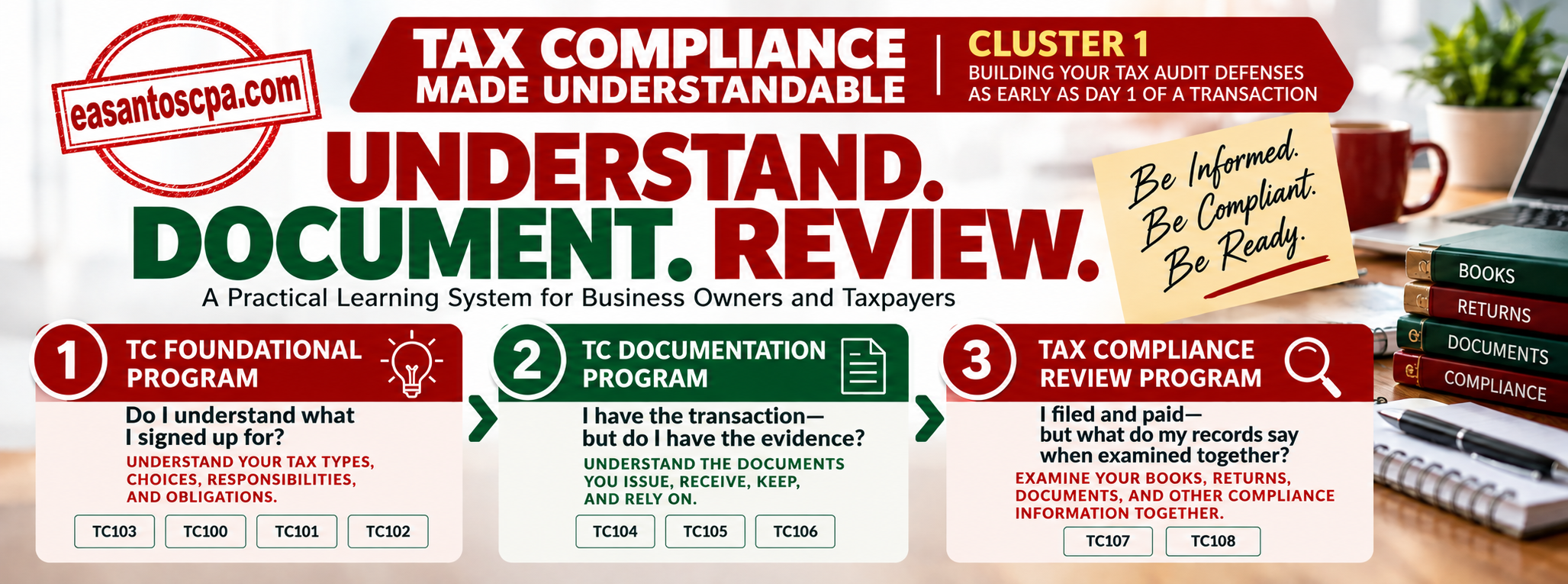
UNDERSTAND → DOCUMENT → REVIEW
UNDERSTAND: Know your tax types, choices, responsibilities, and obligations.
DOCUMENT: Learn to examine the invoices and other documents connected with your transactions.
REVIEW: Examine your books, returns, and compliance records together before filing your Annual ITR.
The Foundational Program gives you the starting point. The next stages address different questions that cannot be answered by foundational knowledge alone.
7. THE FOUR QUESTIONS THE FOUNDATIONAL PROGRAM BRINGS TOGETHER
By the time you have explored these four courses, the questions become more connected:
TC103 — What figures apply to my tax position and taxable year?
TC100 — What choices did I make, and what do they mean for my business now?
TC101 — What responsibilities remain with me, especially when I sign and file?
TC102 — What obligations did my registration create, and what records must I maintain?
The Foundational Program is designed to help you understand these questions before moving deeper into documentation and review.
It does not promise that you will never receive a BIR notice, audit, or assessment. It is an educational program intended to help you better understand your tax responsibilities and the records connected with them.
UNDERSTAND → DOCUMENT → REVIEW
First, understand the tax rules, choices, responsibilities, and obligations that apply to you.
Then explore the documents that support your transactions.
Then learn to examine how your books, returns, and other records relate to one another.
Your Tax Compliance Has a Roadmap.
The Foundational Program is where that understanding begins.
8. WHAT TC-FOUNDATIONAL IS NOT
The Foundational Program is not a shortcut to knowing everything about your tax compliance.
It will not examine every invoice you issue or receive. It will not determine whether each document properly supports your bookkeeping entries. And it will not review your books and tax returns as one complete picture.
Those are different stages of the Tax Compliance roadmap.
TC-Foundational is not a substitute for your bookkeeper, accountant, or tax professional. Its purpose is to help you understand the tax obligations and responsibilities behind the work they perform—and the decisions you make as a business owner or taxpayer.
It is also not a promise that you will never receive a BIR inquiry, tax audit, or assessment. Learning the rules does not remove the possibility of an audit or guarantee a particular tax outcome.
What it does is give you a starting point: a clearer understanding of your tax types, registration choices, responsibilities, and compliance obligations.
Because before you can properly document your transactions or review your books and returns, you need to understand what you are dealing with.
TC-FOUNDATIONAL helps you understand. TC-DOCUMENTATION helps you examine the evidence. TC-REVIEW helps you look at the bigger picture.
That is the roadmap:
UNDERSTAND → DOCUMENT → REVIEW
9. PROGRAM STRUCTURE
SELF-PACED VIDEO-ON-DEMAND
Learn at your own pace during your selected access period.
No need to wait for a scheduled seminar.
4 Comprehensive Courses
TC103, TC100, TC101, and TC102.
16 MODULES
550+ LESSONS
A structured learning path through foundational tax compliance topics.
Recommended Order of Study
TC103 → TC100 → TC101 → TC102.
The Foundational Program is part of a larger learning roadmap*:
UNDERSTAND → DOCUMENT → REVIEW
After building foundational understanding, learners may proceed to the Tax Compliance Documentation Program and then the Tax Compliance Review Program.
===Your Roadmap to a More Confident Taxpayer Journey
*TAX COMPLIANCE MADE UNDERSTANDABLE
Cluster 1: Building Your Tax Audit Defenses As Early As Day 1 of A Transaction.
10. YOUR INSTRUCTOR / RESOURCE SPEAKER
Evangeline A. Santos, CPA, CMA
- Tax Audit & Investigation Specialist
- UP-Certificated Paralegal
- Tax & Legal Researcher
- Resource Speaker / Lecturer
- Author
Developed from actual Philippine tax practice, research, and professional experience involving tax compliance, documentation, tax review, tax assessments, and tax audit matters.
For E.A. Santos Profile and Testimonials, read here –>
11. NEED PROFESSIONAL ASSISTANCE?
TC-Foundational helps you understand your tax obligations and responsibilities.
If your business needs assistance setting up its bookkeeping system and receiving tax guidance, a separate professional engagement may be appropriate.
Bookkeeping Set-up with Tax Guidance Support Services start at ₱250,000, net of taxes per engagement.
The scope, deliverables, timeline, and final professional fee will depend on your business’s circumstances and the agreed engagement.
This professional service is separate from the TC-Foundational educational program and is not included in the course fee.
12. ACCESS OPTIONS
30-DAY ACCESS
Focused access to the complete program
Three courses.
16 modules.
550+ lessons.
Regular Price: ₱12,000
Pre-Launch Price: ₱8,000
TC100 and TC101 are FREE in this TC-Foundational Program
60-DAY ACCESS
More time to access
Regular Price: ₱20,000
Pre-Launch Price: ₱11,000
TC100 and TC101 are FREE in this TC-Foundational Program
How to Secure the Pre-Launch Price
Complete your registration and pay the required reservation fee within the pre-launch period to secure the applicable pre-launch price.
THIS IS NOT A ONE-DAY SEMINAR.
This is a self-paced VOD program
This is not a one-day seminar. It is a multi-course learning program delivered through recorded lessons.
Access is limited
Access is for the selected 30-day or 60-day period. It is not lifetime access. The applicable access period and activation details will be provided during enrollment.
Educational program only
The Foundational Program is intended to help taxpayers understand tax compliance concepts and responsibilities. It is not a BIR audit, tax assessment, legal advice, or professional representation.
The program does not guarantee that a taxpayer will never receive a BIR notice, audit, or assessment, or that a taxpayer has no tax exposure.
Course coverage
The program focuses on foundational tax compliance topics. It does not include every aspect of tax return preparation, bookkeeping, audit response, or representation. Other topics may be addressed in separate programs or professional engagements.
TAXPAYER LITERACY IS A MUST.
Start with the foundation.
You do not have to understand every tax rule in one sitting.
But you can begin by understanding the foundation: your tax position, the choices connected with your registration, your responsibility for the documents you sign, and the obligations that follow.
Start with the foundation.
TAX COMPLIANCE FOUNDATIONAL PROGRAM
TC103 + TC100 + TC101 + TC102
4 Courses | 550+ Lessons | Self-Paced VOD
[ REGISTER ]
Launching This October 2026
Pre-launch reservations are now open.
REGISTER / RESERVE YOUR PROGRAM
Disclaimer
The Tax Compliance Foundational Program is an educational VOD program. It does not constitute a BIR audit, tax assessment, legal advice, or professional representation.
LEARN • STRENGTHEN • COMPLY
Trainings, Seminars & Webinars
Practical learning for business owners, professionals and teams.


- services@easantoscpa.com
- +63 916 587 1528
- Topaz Building, Kamias Road, Quezon City
- Office visit: By Appointment only.
- Strictly NO Walk-In
- Affiliate: ptabcpsolutions.com
Disclaimer: Posts are provided for educational and conceptual purposes only. They do not constitute professional advice. You are advised to consult a qualified professional regarding your specific circumstances.