
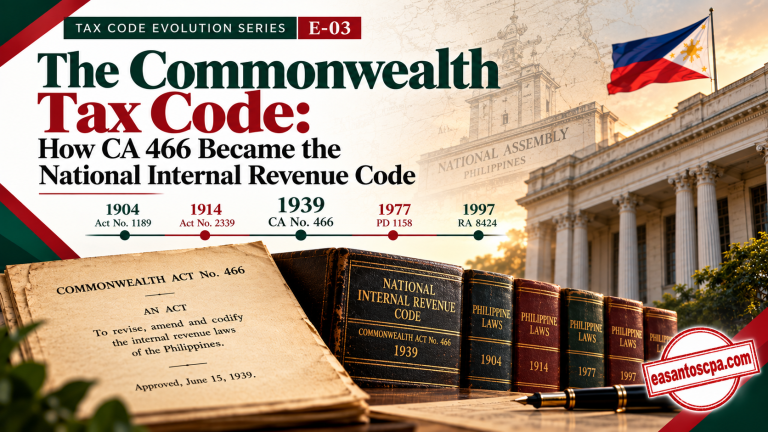
THE COMMONWEALTH TAX CODE: HOW CA 466 BECAME THE NATIONAL INTERNAL REVENUE CODE
Tax Code Evolution Series
If Act No. 1189 was an important beginning and Act No. 2339 represented an early revision and consolidation, what came next?
The answer is Commonwealth Act No. 466.
And this is where the phrase “National Internal Revenue Code” formally enters the story.
From Many Internal Revenue Laws to One Code
By the late 1930s, Philippine internal revenue law had accumulated decades of amendments and additional legislation.
The problem was becoming familiar:
Too many laws → too many amendments → increasingly complex tax administration.
The response was another major consolidation.
On June 15, 1939, the National Assembly enacted Commonwealth Act No. 466, entitled:
“An Act to Revise, Amend and Codify the Internal Revenue Laws of the Philippines.”
Section 1 expressly provided:
“This Act shall be known as the National Internal Revenue Code.”
This was a major milestone.
The country now had a statute expressly organized and identified as a National Internal Revenue Code.
1. CA 466 Was the First Codification of the Internal Revenue Laws
This point is worth emphasizing.
In Tolentino v. Secretary of Finance, G.R. Nos. 115455, et al., August 25, 1994, the Supreme Court described Commonwealth Act No. 466 as the first codification of the country’s internal revenue laws.
The Court noted that CA 466 was approved on June 15, 1939 and generally took effect on July 1, 1939, while its income-tax provisions applied retroactively to income beginning January 1, 1939. Lawphil
That gives us an important distinction:
Act No. 2339 was a revision and consolidation.
CA 466 was the first codification of the country’s internal revenue laws.
The two concepts are related—but they are not exactly the same.
2. What Does “Codification” Actually Mean?
In simple terms, codification means bringing a body of laws into an organized statutory code.
Instead of requiring taxpayers, government officials and lawyers to piece together numerous separate laws and amendments, the rules are organized into a more coherent statutory structure.
CA 466 did precisely that.
It was divided into Titles, Chapters and Sections, creating a structure that looks surprisingly familiar to anyone who works with the modern NIRC.
The Code contained provisions dealing with:
- organization of the Bureau of Internal Revenue;
- income tax;
- estate, inheritance and gift taxes;
- specific taxes;
- privilege and license taxes;
- documentary stamp taxes;
- mining taxes;
- administrative provisions;
- national internal-revenue allotments;
- repealing provisions; and
- final provisions.
The important point is this:
The Tax Code was becoming a system—not merely a collection of individual taxes.
3. The BIR Was Already Part of the Code
CA 466 did not treat tax administration as something separate from taxation.
It began with Title I — Organization of Bureau.
Section 2 identified the chief officials of the Bureau:
- the Collector of Internal Revenue; and
- the Deputy Collector of Internal Revenue.
Section 3 described the powers and duties of the Bureau, including the collection of national internal-revenue taxes, fees and charges and the enforcement of forfeitures, penalties and fines connected with them.
This is an important historical point.
From the beginning, Philippine internal-revenue law involved two connected dimensions:
TAXATION
What is taxable?
How much?
When?
Who pays?
ADMINISTRATION
Who assesses?
Who collects?
Who enforces?
What records are required?
What happens when there is noncompliance?
That combination continues in today’s NIRC.
4. Tax Administration Was Already Built Into the Code
Look at the detail in CA 466.
Section 4 authorized regulations dealing with matters such as:
- taxpayer records;
- books;
- invoices;
- revenue stamps;
- reporting;
- collection and payment;
- income-tax returns;
- evidence of payment;
- enforcement procedures; and
- records maintained by persons subject to tax.
Section 5 likewise required the Collector to prescribe and provide forms, certificates, bonds, records, invoice books, instruments and other materials used in administering the internal-revenue laws.
For today’s taxpayer, this should sound familiar.
Tax compliance has never been simply:
“Compute the tax and pay it.”
It has always involved an administrative system around the tax.
5. The Code Already Covered Different Kinds of Taxes
CA 466’s Section 18 identified national internal-revenue taxes, fees and charges including:
- income tax;
- estate, inheritance and gift taxes;
- specific taxes;
- privilege taxes on business or occupation;
- documentary stamp taxes;
- mining taxes; and
- miscellaneous taxes, fees and charges involving areas such as banks, insurance companies, franchises, amusements, forest products and other regulated activities.
This is significant because the modern NIRC’s broad architecture did not appear out of nowhere.
The Tax Code was already designed to accommodate different tax bases and different types of economic activity.
6. Income Tax Already Had Its Own Detailed Structure
One of the most striking features of CA 466 is Title II — Income Tax.
It was divided into chapters covering:
- introductory provisions;
- individuals;
- corporations;
- computation of net income;
- accounting periods and methods of accounting;
- returns and payment;
- estates and trusts;
- personal holding companies;
- administrative provisions; and
- definitions. Lawphil
Read that list again.
Even in 1939, the Code recognized that income taxation required more than simply stating a tax rate.
It needed rules concerning:
income → computation → accounting → returns → payment → administration → definitions.
That is a foundational concept that remains relevant to tax research today.
7. Accounting Was Already Connected to Tax Law
CA 466 expressly included a chapter on:
Accounting Periods and Methods of Accounting
That matters.
It demonstrates that the relationship between accounting records and taxation is not a modern development.
The law already recognized that determining taxable income requires rules concerning:
- accounting periods;
- accounting methods;
- recognition of income;
- deductions; and
- supporting records.
This historical development helps explain why tax compliance cannot be separated entirely from bookkeeping and accounting.
A taxpayer may have a tax obligation.
But the taxpayer also needs a legally acceptable way of measuring and supporting that obligation.
8. Tax Returns and Payment Were Also Codified
CA 466’s Title II included a dedicated chapter for:
Returns and Payment of Tax
That means the Code was already connecting three distinct things:
Tax liability
Tax reporting
Tax payment
This is an important distinction for today’s taxpayer.
A taxpayer can have:
- a tax liability but fail to file;
- a filed return but an incorrect tax computation;
- a correct return but unpaid tax;
- payment but inadequate documentation; or
- apparent compliance in one area but noncompliance in another.
The Code’s structure itself recognized that these are related—but distinct—components of tax compliance.
9. CA 466 Also Contained Administrative Powers
CA 466 gave revenue officials various administrative powers.
For example, revenue officers were required to enforce the internal-revenue laws and help prevent, detect and punish frauds and delinquencies.
The Code also authorized designated revenue officials to administer oaths and take testimony in official matters or investigations within the Bureau’s jurisdiction.
Again, this is historically important.
The BIR was not conceived merely as a cashier collecting taxes.
It was an administrative and enforcement institution.
10. The Code Was Not Frozen in 1939
Here is another important lesson.
The enactment of CA 466 did not mean that Philippine tax law had finally become complete.
Quite the opposite.
CA 466 became the new statutory foundation upon which later amendments would operate.
Its provisions were subsequently modified by numerous laws.
Eventually, after decades of amendments, another major consolidation would occur:
Presidential Decree No. 1158 in 1977.
That would become the National Internal Revenue Code of 1977.
And decades later, another major restructuring would come through:
Republic Act No. 8424 — Tax Reform Act of 1997.
So the historical pattern continues:
Codify → amend → amend again → accumulate changes → consolidate/restructure → amend again.
11. Jurisprudence Also Shows How the 1939 Code Continued to Operate
The Supreme Court’s decision in Manila Electric Company v. Vera, G.R. No. L-29987, October 22, 1975, illustrates how provisions of CA 466 continued to matter decades after its enactment.
The case involved a compensating-tax provision under Section 190 of the National Internal Revenue Code (Commonwealth Act No. 466, as amended).
Notice the wording:
CA 466, as amended
That phrase is important.
It tells us that by 1975, the legal question could not necessarily be answered by looking at the 1939 version alone.
The Code had already been modified.
This is exactly why tax research must pay attention to amendment history.
12. A Section Number Is Not the Whole Story
This is one of the most important lessons from the Tax Code’s evolution.
Suppose you encounter a provision today and find an old case referring to a different section number.
Should you immediately conclude that the case is irrelevant?
Not necessarily.
A provision may have:
- been renumbered;
- been recodified;
- been amended;
- been transferred to another part of the Code; or
- retained substantially similar language under a new section number.
The Supreme Court’s treatment of tax-law history demonstrates why the legislative lineage of a provision can matter.
That is one reason historical tax research is not merely academic.
It can help explain what a present provision actually developed from.
13. CA 466 Was a Major Step Toward the Tax Code We Recognize Today
Look at the progression:
1904
Act No. 1189
Early statutory framework for internal revenue administration
↓
1914
Act No. 2339
Revision and consolidation of internal-revenue laws
↓
1939
Commonwealth Act No. 466
First codification of the country’s internal revenue laws
↓
1977
PD 1158
Further consolidation and codification
↓
1997
RA 8424
Tax Reform Act of 1997
↓
2017 onward
TRAIN, CREATE, EOPT, Digital Services VAT, CREATE MORE, CMEPA and other amendments
The modern NIRC is therefore not an isolated creation.
It is the latest major expression of a tax-law system that has been repeatedly built, revised, consolidated and amended.
Why This Matters to Today’s Taxpayer
When you read the current NIRC, remember:
The section you are reading has a history.
A current provision may have originated decades ago.
It may have been:
- introduced by an earlier statute;
- revised by another law;
- recodified;
- implemented through regulations;
- clarified by BIR issuances;
- interpreted by the courts; and
- amended again.
That is why simply searching:
“What does the Tax Code say?”
may not always be enough.
A better tax-research question is:
“What is the current operative version of this rule, and how did it get here?”
A Simple Taxpayer Lesson
Think of the Tax Code like a building.
Act No. 1189 helped establish the early foundation.
Act No. 2339 expanded and consolidated the structure.
CA 466 organized the accumulated internal-revenue laws into a formal National Internal Revenue Code.
Later laws renovated, expanded, replaced and reorganized portions of that structure.
And the building is still being modified today.
So when someone gives you an old tax rule and says:
“Ganyan na ‘yan noon pa.”
That statement alone is not enough.
The next question should be:
“Pero ano na ang batas ngayon?”
LEGAL BASIS
Commonwealth Act No. 466 — National Internal Revenue Code of 1939
Approved June 15, 1939.
Section 1 formally named the statute the National Internal Revenue Code.
Section 3 defined the broad powers and duties of the Bureau of Internal Revenue.
Sections 4–5 addressed regulations, forms, records, invoice books and other administrative requirements.
Section 18 identified national internal-revenue taxes, fees and charges.
Title II contained the income-tax provisions, including accounting methods, returns and payment.
Jurisprudence
Tolentino v. Secretary of Finance
G.R. Nos. 115455, 115525, 115543, 115544, 115754, 115781, 115852, 115873 & 115931, August 25, 1994
The Supreme Court expressly described CA 466 as the first codification of the country’s internal revenue laws, noting its approval on June 15, 1939 and general effectivity on July 1, 1939.
Manila Electric Company v. Vera
G.R. No. L-29987, October 22, 1975
The case demonstrates the continued operation of CA 466 provisions, as amended, decades after the Code’s enactment.
TAXPAYER TAKEAWAY
The National Internal Revenue Code did not appear overnight.
It was the product of decades of Philippine tax-law development.
CA 466 was the first codification of the country’s internal revenue laws—but it was not the end of tax-law evolution.
It became another major foundation upon which later Tax Codes and tax reforms were built.
And that leads us to the next stage.
Related Philippine Tax Code Evolution Articles
E-01 — Before the NIRC: Where Did Philippine Tax Law Begin?
E-02 — From Act No. 1189 to Act No. 2339: How Philippine Internal Revenue Law Started to Evolve
E-03 — The Commonwealth Tax Code: How CA 466 Became the National Internal Revenue Code
E-04 — From CA 466 to PD 1158: Why The 1977 NIRC Was Another Major Recodification
Taxpayer Literacy is a Must!
Editorial Note
Current as of October 5, 2026.
This article is part of the Tax Code Evolution Series of easantoscpa.com Articles & Insights.
The purpose of this series is to help taxpayers understand where Philippine tax rules came from, how they evolved, and why today’s tax rules must be read together with their amendments, implementing issuances and jurisprudence.
Taxpayer Literacy is a Must!
Need Help With a Tax or Compliance Concern?
Understanding your obligations is the first step. Building the right compliance system is the next.
If your business needs professional guidance regarding BIR compliance, bookkeeping, documentation, tax concerns, or compliance review, you may discuss your specific circumstances with us.
BOOK A CONSULTATION →
Disclaimer
This article is provided for educational and conceptual purposes only and does not constitute tax, legal, accounting, or other professional advice. Tax rules and administrative requirements may change, and their application depends on the taxpayer’s particular facts and circumstances. Consult a qualified professional regarding your specific situation.
LEARN • STRENGTHEN • COMPLY
Trainings, Seminars & Webinars
Practical learning for business owners, professionals and teams.


- services@easantoscpa.com
- +63 916 587 1528
- Topaz Building, Kamias Road, Quezon City
- Office visit: By Appointment only.
- Strictly NO Walk-In
- Affiliate: ptabcpsolutions.com
Disclaimer: Posts are provided for educational and conceptual purposes only. They do not constitute professional advice. You are advised to consult a qualified professional regarding your specific circumstances.