
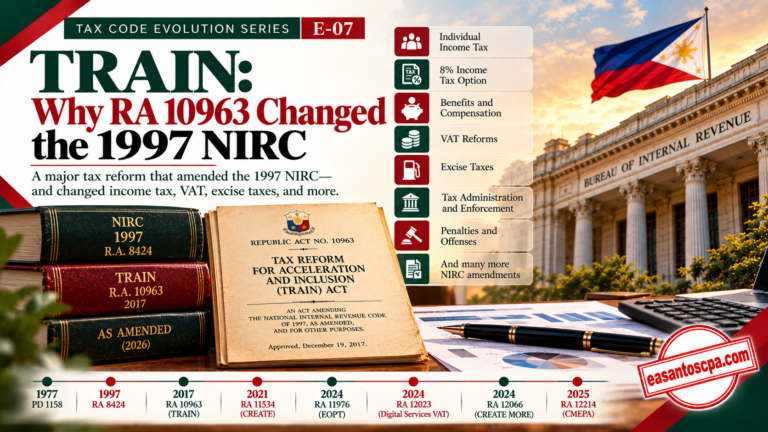
[E-07] TRAIN: WHY RA 10963 CHANGED THE 1997 NIRC
Tax Code Evolution Series No. 7
The 1997 NIRC was not replaced by TRAIN. It was amended by TRAIN—and that distinction matters.
When taxpayers hear “TRAIN Law,” many immediately think of income-tax brackets, the 8% tax option, excise taxes, or the increase in the tax on certain transactions.
But TRAIN was much bigger than any one tax rate.
Republic Act No. 10963, or the Tax Reform for Acceleration and Inclusion (TRAIN) Act, fundamentally changed numerous provisions of the 1997 National Internal Revenue Code (NIRC). It amended dozens of existing sections, created new provisions, repealed others, and introduced a new direction for Philippine tax policy.
And because the NIRC continued to be amended after TRAIN, there is an important lesson for anyone researching Philippine tax law:
A tax rule’s origin is not necessarily its current form.
Where did TRAIN come from?
The story begins with Republic Act No. 8424, the NIRC of 1997.
As discussed in the previous article, RA 8424 was itself an amendment and restructuring of the Philippine internal revenue system. It became effective in 1998 and subsequently underwent numerous amendments.
By 2017, the government pursued another major tax reform program.
This resulted in RA 10963, approved on December 19, 2017.
The law expressly declared its policy objectives, including:
- enhancing the progressivity of the tax system;
- rationalizing the internal revenue tax system;
- providing equitable relief to taxpayers and their families;
- increasing disposable income and economic activity; and
- generating resources for government programs and services.
TRAIN therefore was not simply an adjustment of tax rates.
It was a major amendment package to the existing NIRC.
TRAIN did not create a new Tax Code
This is one of the most important points in understanding Philippine tax-law evolution.
RA 10963 itself describes what it was doing:
it amended numerous sections of RA 8424, otherwise known as the National Internal Revenue Code of 1997, as amended.
TRAIN amended provisions covering areas such as:
- income taxation;
- withholding taxes;
- estate and donor’s taxes;
- VAT;
- percentage taxes;
- excise taxes;
- documentary stamp taxes;
- tax administration;
- tax penalties;
- tax offenses; and
- disposition of incremental revenues.
It also created new sections and repealed certain existing sections of the NIRC.
So the better way to visualize the evolution is:
PD 1158 / 1977 NIRC
↓
RA 8424 / 1997 NIRC
↓
RA 10963 / TRAIN
↓
RA 11534 / CREATE
↓
RA 11976 / EOPT
↓
RA 12023 / Digital Services VAT
↓
RA 12066 / CREATE MORE
↓
RA 12214 / CMEPA
↓
Current NIRC, as amended
This is why simply saying “under TRAIN” is not always enough when researching a tax issue today.
The most visible TRAIN change: individual income tax
Perhaps the most recognizable TRAIN reform was the restructuring of individual income-tax rates.
Before TRAIN, individual taxpayers were generally subject to the older graduated income-tax structure.
TRAIN introduced a substantially different schedule.
For January 1, 2018 to December 31, 2022, the rates included:
| Taxable Income | Tax |
|---|---|
| Not over ₱250,000 | 0% |
| Over ₱250,000–₱400,000 | 20% of excess over ₱250,000 |
| Over ₱400,000–₱800,000 | ₱30,000 + 25% of excess over ₱400,000 |
| Over ₱800,000–₱2M | ₱130,000 + 30% of excess over ₱800,000 |
| Over ₱2M–₱8M | ₱490,000 + 32% of excess over ₱2M |
| Over ₱8M | ₱2.41M + 35% of excess over ₱8M |
TRAIN also contained a second-stage rate schedule beginning January 1, 2023, reducing several of the rates applicable to lower and middle income brackets while retaining a 35% top rate.
This was implemented by the BIR through Revenue Regulations No. 8-2018.
Why this matters
The important research lesson is that the rate you see in the law must be read together with its effective date.
A taxpayer asking:
“What is the individual income-tax rate?”
cannot always be answered correctly without first asking:
For what taxable year?
That principle will repeatedly appear throughout Philippine tax-law research.
TRAIN removed the old personal and additional exemptions
Another significant change was the repeal of the old personal and additional exemptions under Section 35 of the NIRC.
TRAIN repealed Section 35 and effectively replaced the previous exemption mechanism with the first ₱250,000 of taxable income being subject to a zero rate under the new graduated-rate structure.
This illustrates an important point:
Tax relief does not always appear in the Tax Code as an “exemption.”
It can instead be achieved through:
- a zero tax bracket;
- a deduction;
- a credit;
- an exclusion;
- an exemption; or
- a preferential rate.
The legal mechanism matters.
TRAIN introduced the famous 8% income-tax option
For qualified individuals earning income from self-employment and/or practice of profession, TRAIN introduced an important option.
Subject to the statutory requirements, qualified taxpayers whose gross sales/receipts and other non-operating income did not exceed the applicable VAT threshold could choose the 8% income-tax option instead of the graduated income-tax rates and percentage tax, subject to the conditions of the law.
The BIR subsequently issued rules implementing the option, including Revenue Memorandum Order No. 23-2018.
Revenue Regulations No. 8-2018 likewise implemented the individual income-tax provisions, including the 8% option.
This became particularly significant for:
- professionals;
- freelancers;
- consultants;
- sole proprietors; and
- other qualified self-employed individuals.
But there is a crucial taxpayer lesson:
The 8% option is not simply “8% tax for small businesses.”
Eligibility, election, taxpayer classification, income composition, VAT status, registration, and the applicable rules all matter.
That is precisely why a taxpayer should not reduce a statutory rule to a slogan.
TRAIN also changed benefits and compensation taxation
TRAIN increased the tax-exempt ceiling for 13th-month pay and other benefits from the previous ₱82,000 to ₱90,000.
It also made significant changes to the treatment of certain compensation-related items.
The BIR subsequently issued implementing and clarificatory regulations and circulars, including RR No. 8-2018, RR No. 11-2018, and RMC No. 50-2018.
This demonstrates another feature of Philippine tax law:
One statute may require several layers of administrative implementation.
The taxpayer therefore needs to distinguish:
Statute → Revenue Regulation → Revenue Memorandum Circular → actual compliance
rather than treating all issuances as if they have the same legal status.
TRAIN was also a VAT reform
TRAIN did not focus only on income tax.
It substantially amended the VAT provisions of the NIRC.
Among other changes, TRAIN increased the statutory VAT threshold to ₱3 million under the relevant provision and modified the treatment of several transactions.
It also introduced changes concerning:
- VAT exemptions;
- export transactions;
- VAT refund administration;
- zero-rated transactions; and
- the transition toward an enhanced VAT refund system.
The original TRAIN law even linked certain changes in export-sale treatment to the establishment and implementation of an enhanced VAT refund system.
Why this is important today
A taxpayer researching VAT in 2026 should not stop at TRAIN.
Later legislation—including the Ease of Paying Taxes Act (RA 11976) and subsequent amendments—further changed VAT, invoicing, filing, payment and administrative provisions of the NIRC.
So:
“TRAIN increased the VAT threshold to ₱3 million” is a historical statement.
It is not automatically a complete answer to:
“What is the current VAT threshold and how does it apply to me?”
That is the difference between studying tax-law evolution and merely memorizing isolated tax rules.
TRAIN changed estate and donor’s taxes
TRAIN also substantially changed transfer taxation.
The law modified provisions involving:
- estate tax;
- donor’s tax; and
- related filing and payment requirements.
Among the most notable reforms was the adoption of a 6% estate tax rate under the amended framework.
Donor’s tax was likewise substantially restructured.
These changes simplified certain aspects of the previous system while simultaneously changing the tax consequences of transfers of property.
Again, however, the correct research approach is:
What did TRAIN change?
followed by:
Did a later law change that TRAIN provision?
TRAIN introduced and increased several excise taxes
Another major component of TRAIN was its excise-tax reform.
The law changed excise-tax treatment involving products and activities such as:
- petroleum products;
- automobiles;
- tobacco;
- sugar-sweetened beverages;
- certain cosmetic procedures; and
- other excisable products.
Some of these provisions were designed not only to raise revenue but also to influence taxpayer or consumer behavior.
This illustrates an important constitutional and public-policy principle:
Taxation is not used solely to raise money.
Tax legislation may also pursue economic, social, health, environmental, or developmental objectives.
TRAIN also changed tax administration and enforcement
This part is often overlooked.
TRAIN amended provisions dealing with the BIR’s administration and enforcement powers.
For example, it amended Section 6 of the NIRC, dealing with the Commissioner’s authority concerning examinations, assessments and additional requirements for tax administration and enforcement.
TRAIN also introduced new provisions, including:
- Section 237-A on an electronic sales reporting system;
- Sections 264-A and 264-B involving certain tax offenses; and
- Section 265-A involving fuel-marking offenses.
This is significant for taxpayers because tax reform is not merely about:
How much tax do I pay?
It is also about:
How does the government administer, verify, monitor and enforce the tax system?
That distinction becomes increasingly important as we move toward later articles on audit, assessment, enforcement and collection.
TRAIN itself became the subject of a constitutional challenge
TRAIN was not merely a tax-policy discussion.
Its constitutionality was challenged before the Supreme Court.
In ACT Teachers Representative Antonio Tinio, et al. v. President Rodrigo Roa Duterte, G.R. Nos. 236118 & 236295, January 24, 2023, the Supreme Court addressed challenges to RA 10963.
The petitioners questioned, among other things:
- the legislative process;
- the alleged lack of quorum;
- the constitutionality of the tax measures; and
- the argument that certain provisions were inconsistent with the constitutional requirement to evolve a progressive system of taxation.
The Supreme Court ultimately declared RA 10963 constitutional and dismissed the consolidated petitions.
What did the Supreme Court say about “progressive taxation”?
This is an especially important jurisprudential lesson.
Article VI, Section 28(1) of the 1987 Constitution provides:
“The rule of taxation shall be uniform and equitable. The Congress shall evolve a progressive system of taxation.”
The challenge to TRAIN argued, among other things, that certain indirect taxes were regressive.
The Supreme Court explained that the Constitution does not simply prohibit every regressive tax.
The Court relied on earlier jurisprudence, including Tolentino v. Secretary of Finance, explaining that indirect taxes such as VAT can have regressive characteristics while Congress is constitutionally directed to evolve a progressive tax system.
The Court therefore concluded that the TRAIN Act could not be invalidated merely on the argument of regressivity.
This is an excellent example of why jurisprudence belongs in tax research.
The statutory text tells us what Congress enacted.
The Supreme Court helps explain how the Constitution applies to that tax legislation.
But TRAIN is no longer the final word
This is perhaps the most important lesson of this entire article.
If someone says:
“TRAIN says this…”
the next question should be:
“Was that provision later amended?”
Because it may have been.
After TRAIN came major tax legislation such as:
CREATE — RA 11534
This substantially changed the taxation of corporations and introduced major reforms to the corporate tax and incentives framework.
EOPT — RA 11976
The Ease of Paying Taxes Act amended numerous administrative, filing, payment, invoicing, VAT, refund and taxpayer-rights provisions of the NIRC.
Digital Services VAT — RA 12023
This introduced major changes concerning VAT on digital services.
CREATE MORE — RA 12066
RA 12066 subsequently amended numerous provisions of the NIRC again, including provisions relating to corporate taxation, VAT, invoicing and other matters.
CMEPA — RA 12214
The Capital Markets Efficiency Promotion Act introduced another layer of amendments to the tax framework.
So the current NIRC is better understood as a continuously amended living statute.
The taxpayer lesson: don’t research tax law by “law name” alone
This is where the evolution of the Tax Code becomes practical.
Suppose someone asks:
“What does TRAIN say about invoicing?”
That may be the wrong starting question.
The better questions are:
What provision of the NIRC governs the transaction?
↓
What law currently amends that provision?
↓
What BIR regulations implement it?
↓
What RMCs/RMOs clarify its application?
↓
Is there jurisprudence interpreting the provision?
↓
What was the applicable rule on the date of the transaction?
That is the difference between reading a tax law and researching a tax issue.
A simple example
Imagine a taxpayer says:
“I read online that TRAIN made the VAT threshold ₱3 million, so I’m not VATable.”
That conclusion may be incomplete.
Why?
Because the researcher must determine:
- the taxpayer’s actual gross sales/receipts;
- the nature of the transactions;
- whether the taxpayer is already VAT-registered;
- the applicable statutory provision;
- later amendments to that provision;
- the relevant BIR regulations;
- the effective date; and
- whether other rules affect the transaction.
The ₱3 million figure may be part of the historical evolution, but the taxpayer’s actual 2026 compliance position requires research of the current amended NIRC and current implementing rules.
The bigger picture: TRAIN changed how we should read the NIRC
Before TRAIN, taxpayers were already dealing with an amended NIRC.
TRAIN made the evolutionary nature of the Code even more obvious.
It demonstrated that:
A tax code is not frozen in the year appearing in its title.
The words “NIRC of 1997” do not mean that the taxpayer should apply only the law that existed in 1997.
The same Code has been repeatedly amended.
Thus:
RA 8424 is the 1997 NIRC.
RA 10963 is one major amendment to it.
RA 10963 is not the current Tax Code by itself.
That distinction should be part of every taxpayer’s basic tax literacy.
LEGAL BASIS
Constitutional basis
1987 Philippine Constitution
- Article VI, Section 28(1) — uniform and equitable taxation; Congress shall evolve a progressive system of taxation.
- Article VI, Section 26 — requirements concerning legislative enactment.
- Article VI, Section 27 — presidential action on bills.
- Article III, Section 1 — due process and equal protection.
The Supreme Court specifically considered these constitutional principles in reviewing TRAIN.
Statutory basis
Republic Act No. 10963 — TRAIN Act
Approved: December 19, 2017
Effectivity: January 1, 2018.
It amended numerous provisions of RA 8424, the NIRC of 1997, created new provisions and repealed others.
Important implementing issuances
- RR No. 8-2018 — implementation of TRAIN income-tax provisions.
- RR No. 21-2018 — implementation of amended Section 249 on interest.
- RMO No. 23-2018 — 8% income-tax option procedures.
- RMC No. 50-2018 — clarifications on TRAIN income and withholding tax provisions.
Jurisprudence
ACT Teachers Representative Antonio Tinio, et al. v. President Rodrigo Roa Duterte, G.R. Nos. 236118 & 236295, January 24, 2023
The Supreme Court declared RA 10963 constitutional, rejecting the constitutional challenges raised against TRAIN.
The decision also discussed the constitutional concept of progressive taxation and relied on earlier jurisprudence, including Tolentino v. Secretary of Finance.
What should taxpayers remember?
If there are only five things to remember from this article:
1. TRAIN did not replace the NIRC.
It amended RA 8424, the 1997 NIRC.
2. TRAIN was much broader than income tax.
It changed income tax, VAT, excise taxes, estate and donor’s taxes, DST, penalties, administration and enforcement, among others.
3. TRAIN provisions have dates.
The applicable rule can depend on the taxable year, transaction date, effectivity date and transitional provisions.
4. TRAIN is not necessarily the current rule.
Later laws—including CREATE, EOPT, Digital Services VAT legislation, CREATE MORE and CMEPA—further amended the NIRC.
5. Tax research requires evolution.
Mother law → amendment → implementing rules → later amendment → jurisprudence → current operative rule.
That is the real lesson of the TRAIN era.
What comes next in the Tax Code Evolution Series?
TRAIN was only the beginning of the major tax reforms that reshaped the post-1997 NIRC.
The next major chapter is CREATE.
And CREATE is particularly important because it changed something TRAIN did not fundamentally accomplish:
the architecture of Philippine corporate income taxation and tax incentives.
Next Article — E-08
CREATE: How RA 11534 Reshaped Corporate Taxation and Tax Incentives
Related Philippine Tax Code Evolution Articles
[E-01] Before the NIRC: Where Did Philippine Tax Law Begin?
[E-02] From Act No. 1189 to Act No. 2339: How Philippine Internal Revenue Law Started To Evolve
[E-03] The Commonwealth Tax Code: How CA 466 Became the National Internal Revenue Code
[E-04] From CA 466 To PD 1158: Why the 1977 NIRC Was Another Recodification
[E-05] From The 1980s-1990s Tax Reforms To RA 8424: How the Modern NIRC Emerged
[E-06] The 1997 NIRC: How the Modern Philippine Tax Code Is Structured
[E-07] Train: Why Ra 10963 Changed The 1997 NIRC
Editorial Note
Current as of October 31, 2026.
This article is part of the Tax Code Evolution Series of easantoscpa.com Articles & Insights.
The purpose of this series is to help taxpayers understand where Philippine tax rules came from, how they evolved, and why today’s tax rules must be read together with their amendments, implementing issuances and jurisprudence.
Taxpayer Literacy is a Must!
Need Help With a Tax or Compliance Concern?
Understanding your obligations is the first step. Building the right compliance system is the next.
If your business needs professional guidance regarding BIR compliance, bookkeeping, documentation, tax concerns, or compliance review, you may discuss your specific circumstances with us.
BOOK A CONSULTATION →
Disclaimer
This article is provided for educational and conceptual purposes only and does not constitute tax, legal, accounting, or other professional advice. Tax rules and administrative requirements may change, and their application depends on the taxpayer’s particular facts and circumstances. Consult a qualified professional regarding your specific situation.
LEARN • STRENGTHEN • COMPLY
Trainings, Seminars & Webinars
Practical learning for business owners, professionals and teams.


- services@easantoscpa.com
- +63 916 587 1528
- Topaz Building, Kamias Road, Quezon City
- Office visit: By Appointment only.
- Strictly NO Walk-In
- Affiliate: ptabcpsolutions.com
Disclaimer: Posts are provided for educational and conceptual purposes only. They do not constitute professional advice. You are advised to consult a qualified professional regarding your specific circumstances.