
What Every Business Owner Should Know About BIR Compliance
Tax & BIR
BIR compliance is more than filing tax returns and paying taxes. It involves a continuing system of registration, invoicing, bookkeeping, documentation, filing, payment, and recordkeeping throughout the life of the business.
For many business owners, tax compliance is something they think about only when a filing deadline approaches.
But compliance does not begin when the tax return is prepared.
It begins much earlier — when a business registers, starts issuing invoices, records transactions, maintains books of accounts, pays employees and suppliers, enters into contracts, and keeps the documents supporting its transactions.
Understanding this distinction can help business owners build better compliance systems and avoid problems that may only become visible later.
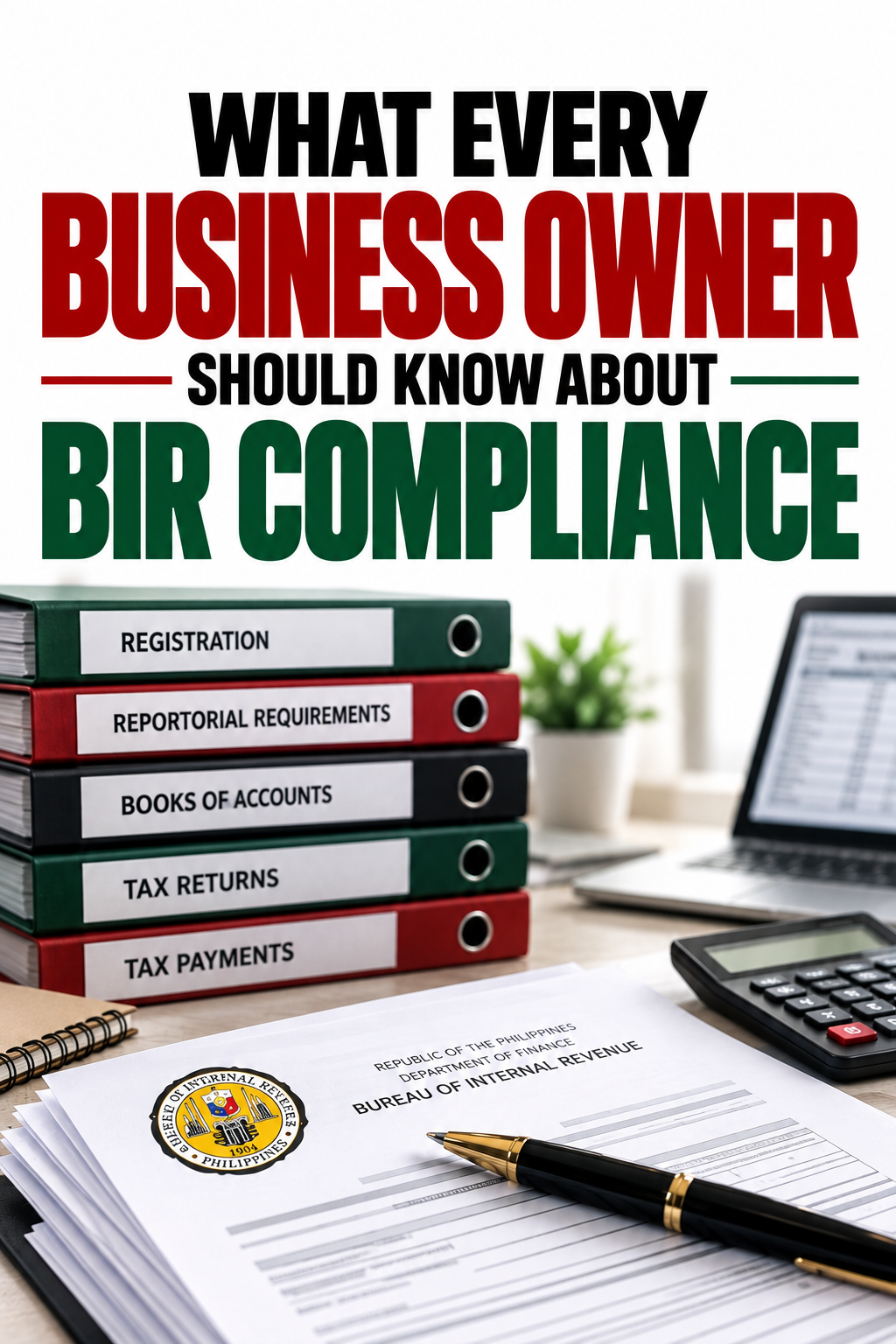
BIR Compliance Is a Continuing Business Responsibility
Registering a business with the Bureau of Internal Revenue is only the beginning.
A registered business may have continuing obligations involving its books of accounts, invoicing system, tax types, filing and payment requirements, withholding obligations, and supporting records, depending on the nature and circumstances of the business.
Current BIR registration requirements separately recognize matters such as registration of books of accounts, authority to print invoices, computerized or loose-leaf accounting systems, and POS or cash-register systems.
This means business owners should not look at BIR compliance as a single activity.
It is better understood as a process that runs alongside the business itself.
1. Know What Your Business Is Registered For
One of the first things every business owner should understand is the business’s own BIR registration.
Do not simply assume that your accountant or bookkeeper knows everything and therefore you do not need to understand it.
At a minimum, management should know:
- the registered taxpayer name and TIN;
- the registered business address and branches, if any;
- the Revenue District Office having jurisdiction over the business;
- the tax types applicable to the business;
- the invoicing system being used;
- the books of accounts being maintained; and
- the filing and payment requirements applicable to the business.
Different taxpayers can have different obligations.
A corporation, sole proprietor, professional, VAT-registered taxpayer, non-VAT taxpayer, employer, withholding agent, or business with branches may not have exactly the same compliance requirements.
Your compliance system should therefore be based on your actual registration and transactions — not simply on what another business is doing.
2. Understand Your Filing and Payment Obligations
Business owners should know what tax returns and other submissions their businesses are required to file and when they are due.
Depending on the taxpayer, these may involve income tax, VAT or percentage tax, withholding taxes, compensation-related withholding, and other applicable taxes or information returns.
BIR deadlines differ according to the particular return, tax type, taxpayer classification, filing method, and sometimes subsequent BIR issuances. The BIR’s own electronic filing guidance, for example, provides different deadlines for different returns.
This is why a business should maintain a tax compliance calendar.
A good compliance calendar should identify:
WHAT must be filed
WHEN it must be filed
WHO is responsible
WHAT documents are needed
WHEN payment must be made
HOW filing and payment will be verified
The goal is not merely to remember deadlines.
The goal is to create a system where compliance does not depend on somebody remembering at the last minute.
3. Invoices Are Part of Your Tax Compliance System
Invoices should not be treated merely as pieces of paper given to customers.
They form part of the documentary trail of the business.
The Ease of Paying Taxes Act changed Philippine invoicing rules, and the BIR’s implementing regulations under Revenue Regulations No. 7-2024 established updated registration and invoicing requirements.
Among other things, current BIR rules address manual invoices, loose-leaf invoices, computerized accounting systems, Authority to Print requirements, and the information required in invoices.
The transition was especially important for businesses accustomed to treating Official Receipts as the primary sales document for services. Under the EOPT implementing rules, the invoice became the primary document evidencing sales of goods and services, subject to the applicable requirements and transitional rules.
For business owners, the practical lesson is simple:
Do not assume that the invoicing procedure you used several years ago remains correct today.
Your invoicing practices should be reviewed whenever tax rules change.
4. Your Books of Accounts Matter
Another common mistake is treating bookkeeping as something done only to prepare tax returns.
Good bookkeeping serves a much larger purpose.
Your books should help establish what happened in the business:
What did you sell?
What did you buy?
What expenses did you incur?
What did customers owe you?
What did you owe suppliers?
What taxes were withheld?
What assets and liabilities did the business have?
BIR rules recognize different forms of books of accounts. In 2025, the BIR clarified that new business taxpayers may register manual books, loose-leaf books, or computerized books, subject to the applicable requirements for the method selected.
But merely having registered books is not enough.
The records must actually reflect the transactions of the business.
5. Keep the Documents Behind the Numbers
Suppose your books show an expense of ₱500,000.
Where did that number come from?
What transaction created it?
Who was the supplier?
What was purchased?
Was there an invoice?
Was there a contract?
Was payment made?
Was withholding tax applicable?
Can the business establish the business purpose and nature of the transaction?
This is where documentation becomes critical.
A number appearing in the books or tax return does not exist in isolation. It should ordinarily be traceable to the records and documents supporting the underlying transaction.
Depending on the transaction, the supporting documentation may include invoices, contracts, purchase orders, delivery documents, proof of payment, withholding tax certificates, payroll records, bank records, schedules, correspondence, and other relevant records.
This is one reason businesses should develop a documentation system, not merely a filing cabinet.
6. Your Books, Returns and Supporting Documents Should Tell a Consistent Story
Consider three different sources of information:
BOOKS OF ACCOUNTS
What was recorded?
TAX RETURNS
What was reported?
SUPPORTING DOCUMENTS
What can be substantiated?
Ideally, these should be capable of being reconciled.
Problems may arise when one set of records tells a different story from another.
For example:
Sales recorded in the books may need to reconcile with amounts reported in tax returns.
Expenses claimed may need supporting documents.
Taxes withheld may need to reconcile with withholding tax returns and certificates.
Payroll records may need to agree with compensation-related reporting.
Financial statements should be traceable to the underlying accounting records.
This is why tax compliance should not be viewed as simply “Did we file?”
A better question is:
“Can we explain and support what we filed?”
7. Filing on Time Does Not Automatically Mean Everything Is Correct
A return can be filed on time and still contain problems.
For example, a business may have:
- incorrect classifications;
- incomplete transactions;
- unsupported expenses;
- reconciliation differences;
- incorrect withholding treatment;
- invoicing issues;
- bookkeeping errors; or
- inconsistencies between accounting records and tax returns.
Therefore, there are at least two separate questions management should ask:
Was the return filed on time?
and
Was the return prepared from complete, accurate, and supportable information?
Both matter.
8. Do Not Wait for a BIR Inquiry Before Organizing Your Records
One of the most important habits a business can develop is maintaining its records as transactions occur.
Trying to reconstruct documentation months or years later can be difficult.
People leave the company.
Emails disappear.
Files are misplaced.
Suppliers close.
Employees forget what happened.
Contracts cannot be located.
The person who handled the transaction may no longer remember why something was done.
That is why good tax compliance is largely preventive.
The best time to establish the documentary trail of a transaction is when the transaction happens — not when somebody later asks for proof.
9. Late or Incorrect Compliance Can Have Financial Consequences
Missing a filing or payment obligation can result in additional costs.
Depending on the applicable provision and circumstances, tax consequences can include surcharge, interest, and compromise penalties.
The applicable surcharge is not necessarily identical for every taxpayer or every situation. For example, current BIR instructions for the annual income tax return for taxpayers classified as micro or small reflect the EOPT reduced 10% surcharge for specified violations, while other BIR forms and circumstances may be subject to different statutory consequences.
That is another reason business owners should avoid relying on generic statements such as:
“The penalty is always ___%.”
The correct treatment depends on the taxpayer, violation, tax period, and applicable law or issuance.
10. Compliance Should Not Depend on Only One Person
Many businesses have a dangerous system:
“Our bookkeeper handles everything.”
Your bookkeeper or accountant may indeed handle much of the work.
But management still needs visibility.
At minimum, somebody in management should know:
What returns are required?
Were they filed?
Were the taxes paid?
Where is the proof of filing and payment?
Are the books updated?
Are invoices being issued properly?
Where are the supporting documents stored?
Who reviews unusual transactions?
A strong compliance process has accountability, documentation, and review.
It should not collapse simply because one employee resigns or one external service provider becomes unavailable.
A Simple Compliance Framework for Business Owners
Instead of thinking about BIR compliance only in terms of tax returns, think of it as a chain:
REGISTER
Know what your business is registered for.
↓
TRANSACT
Understand the tax consequences of your business transactions.
↓
DOCUMENT
Create and preserve the appropriate invoices, contracts, and supporting records.
↓
RECORD
Enter transactions accurately and timely in your accounting records.
↓
RECONCILE
Check whether the books, supporting documents, tax returns, and other reports agree.
↓
FILE & PAY
Meet the applicable filing and payment requirements.
↓
REVIEW
Periodically identify errors, gaps, and inconsistencies before they become larger problems.
That is a much stronger approach than simply waiting for the next tax deadline.
Questions Every Business Owner Should Be Able to Answer
You do not have to personally prepare every tax return.
But as a business owner or responsible officer, you should be able to answer questions such as:
What taxes is our business registered for?
What returns do we regularly file?
Who prepares them and who reviews them?
Are our books updated?
Are we issuing the proper invoices?
Can our sales and purchases be traced to supporting documents?
Do our books reconcile with our tax returns?
Where do we keep proof of filing and payment?
How long and how systematically are we preserving our records?
If the BIR asks us to explain a transaction today, can we retrieve the supporting documents?
If the answer to several of these questions is “I don’t know,” that may be a sign that the business needs to review its compliance system.
Compliance Is Easier When It Is Built Into the Business
Tax compliance should not be something businesses try to repair at the end of the year.
And it should not begin only after receiving a BIR notice.
A stronger approach is to build compliance into everyday business processes:
when you sell,
when you purchase,
when you pay,
when you hire,
when you enter into contracts,
when you issue invoices,
when you record transactions,
and when you prepare reports.
When these processes are properly designed, tax compliance becomes part of running the business rather than a recurring emergency.
The Bottom Line
BIR compliance is not just about filing tax returns.
It is about whether your business has a system that can consistently:
document transactions,
maintain reliable records,
meet tax obligations,
reconcile information,
and support what has been reported.
A business may have filed every return on time — but management should still ask:
Are our books, returns, invoices, and supporting documents telling the same story?
That question can reveal far more about the quality of a business’s tax compliance than simply asking whether a return was filed.
Need Help With a Tax or Compliance Concern?
Understanding your obligations is the first step. Building the right compliance system is the next.
If your business needs professional guidance regarding BIR compliance, bookkeeping, documentation, tax concerns, or compliance review, you may discuss your specific circumstances with us.
BOOK A CONSULTATION →
Disclaimer
This article is provided for educational and conceptual purposes only and does not constitute tax, legal, accounting, or other professional advice. Tax rules and administrative requirements may change, and their application depends on the taxpayer’s particular facts and circumstances. Consult a qualified professional regarding your specific situation.
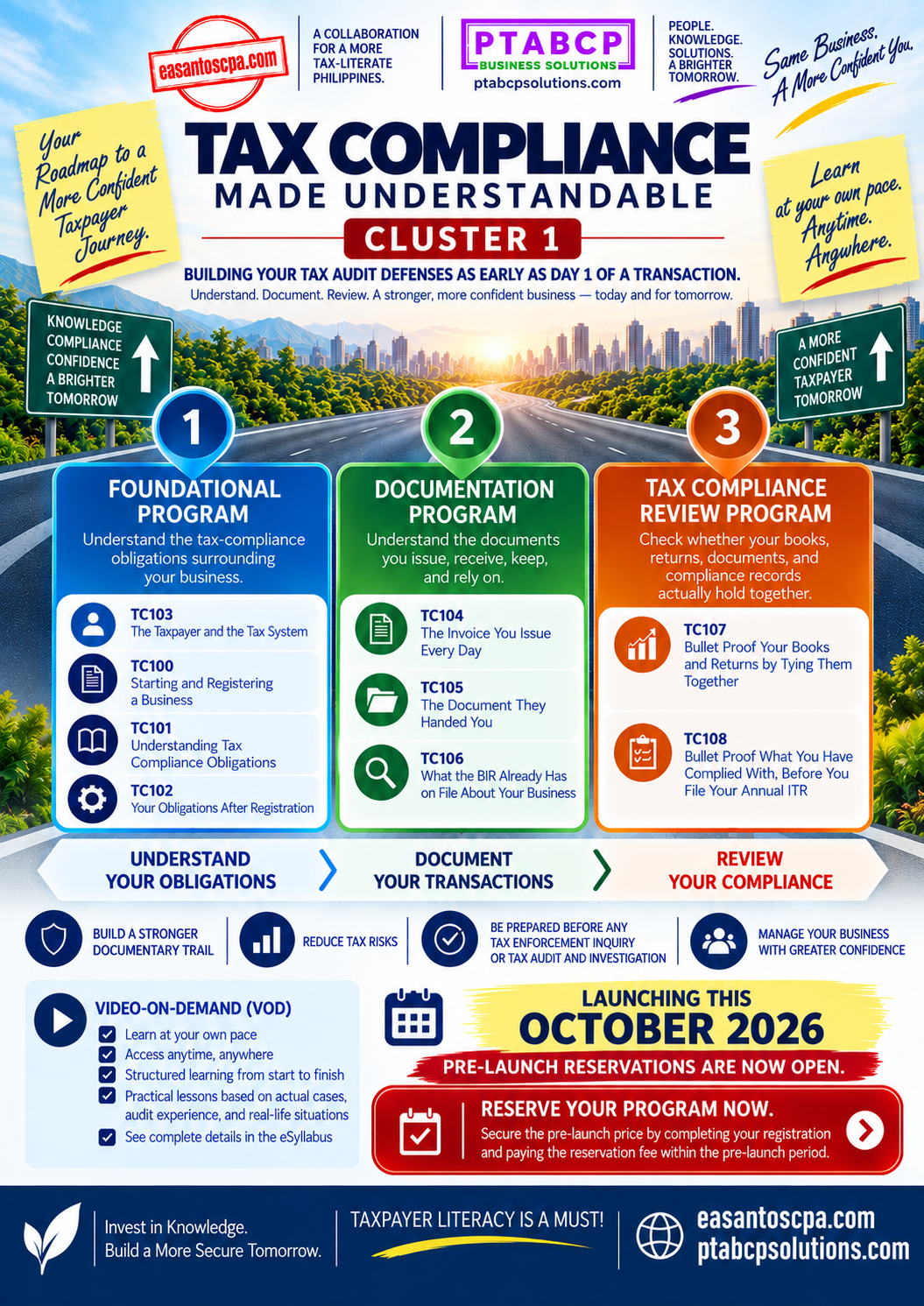
LEARN • STRENGTHEN • COMPLY
Trainings, Seminars & Webinars
Practical learning for business owners, professionals and teams.


- services@easantoscpa.com
- +63 916 587 1528
- Topaz Building, Kamias Road, Quezon City
- Office visit: By Appointment only.
- Strictly NO Walk-In
- Affiliate: ptabcpsolutions.com
Disclaimer: Posts are provided for educational and conceptual purposes only. They do not constitute professional advice. You are advised to consult a qualified professional regarding your specific circumstances.