
[E-09] EOPT: WHY RA 11976 CHANGED HOW TAXPAYERS COMPLY
Tax Code Evolution Series No. 9
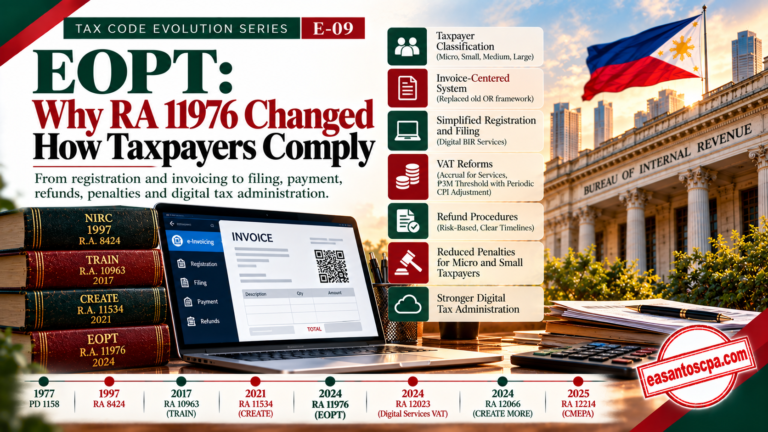
The Ease of Paying Taxes Act did not simply make taxes “easier.” It changed the legal architecture of taxpayer compliance—from registration and invoicing to filing, payment, refunds, records, penalties and digital BIR services.
For many taxpayers, the phrase “Ease of Paying Taxes” sounds like a promise of simpler tax compliance.
But Republic Act No. 11976, or the Ease of Paying Taxes (EOPT) Act, is more than a convenience law.
It amended numerous provisions of the 1997 National Internal Revenue Code, introduced taxpayer classification, changed invoicing rules, modernized registration and filing, revised refund procedures, reduced certain penalties for smaller taxpayers, and mandated a broader digitalization strategy for the BIR.
And one of its most visible changes fundamentally altered something businesses had been doing for decades:
The tax document that many taxpayers used to call an Official Receipt became part of a new invoice-centered system.
That is why EOPT belongs in the Tax Code Evolution Series.
Where does EOPT fit in the evolution of the NIRC?
The evolution now looks like this:
PD 1158 — 1977 NIRC
↓
RA 8424 — 1997 NIRC
↓
RA 10963 — TRAIN
↓
RA 11534 — CREATE
↓
RA 11976 — EOPT
↓
RA 12023 — Digital Services VAT
↓
RA 12066 — CREATE MORE
↓
RA 12214 — CMEPA
↓
Current NIRC, as amended
EOPT therefore did not replace the NIRC.
It amended the NIRC of 1997, as amended.
The law itself amended a long list of provisions, including Sections 21, 22, 51, 56–58, 76, 77, 81, 90, 91, 103, 106, 108–120, 128, 200, 204, 229, 235–238, 241–245, 248, 269 and others.
So the correct description is:
EOPT is another major layer of amendments to the living NIRC.
Why was EOPT enacted?
RA 11976 expressly declared several policy objectives.
Among them were:
- protecting taxpayer rights and welfare;
- ensuring fair treatment of taxpayers;
- modernizing tax administration;
- improving efficiency and effectiveness;
- encouraging proper and easier compliance;
- reducing the cost and resources required for compliance;
- updating the taxation system;
- adopting best practices; and
- developing procedures appropriate to different types of taxpayers.
This last point is particularly important.
For the first time, the NIRC expressly introduced a statutory framework for classification of taxpayers according to size.
That changed the philosophy of administration.
Instead of treating every taxpayer as if they had the same compliance capacity, EOPT moved toward:
different taxpayers → different compliance considerations.
EOPT introduced taxpayer classification
Under Section 21(b), as amended by EOPT, business taxpayers are classified according to gross sales.
The implementing Revenue Regulations No. 8-2024 provides the following classifications:
| Classification | Gross Sales |
|---|---|
| Micro | Less than ₱3 million |
| Small | ₱3 million to less than ₱20 million |
| Medium | ₱20 million to less than ₱1 billion |
| Large | ₱1 billion and above |
For classification purposes, gross sales generally refer to total sales revenue, net of VAT where applicable, without other deductions, and the regulations specify what income is included or excluded.
The BIR subsequently issued RMO No. 37-2024 prescribing the operational policies and procedures for taxpayer classification.
Why does taxpayer classification matter?
Because under EOPT, classification is not merely a label.
It can affect the taxpayer’s compliance treatment.
For example, EOPT provides special concessions for micro and small taxpayers, including:
- a maximum two-page income tax return;
- a reduced civil penalty rate;
- a 50% reduction in the interest rate under Section 249;
- a reduced ₱500 penalty for certain information-return violations; and
- at least a 50% reduction in compromise penalties for specified invoicing and registration-related violations.
This represents an important policy shift.
The law recognizes that:
A micro taxpayer and a large corporation do not necessarily have the same capacity to comply with a complex tax-administration system.
That concept is now built into the NIRC.
But “micro” does not mean “tax-exempt”
This is a common misunderstanding.
Being classified as a micro taxpayer does not mean:
- no tax;
- no bookkeeping;
- no invoicing;
- no registration;
- no returns;
- no BIR obligations.
Rather, the classification can determine certain compliance concessions and treatment under the law and implementing rules.
This distinction is important:
Ease of compliance is not exemption from compliance.
One of EOPT’s biggest changes: INVOICE replaced the old OR-centered framework
This is arguably the change that most directly affected everyday business transactions.
Before EOPT, businesses commonly distinguished between:
- Sales Invoice; and
- Official Receipt.
The statutory framework changed.
Under the amended NIRC, a VAT-registered person must issue a VAT Invoice for every sale, barter, exchange or lease of goods or properties and for every sale or exchange of services.
The implementing RR No. 7-2024 defines an invoice as the written account evidencing the sale of goods and/or services and recognizes different forms such as sales, commercial, cash, charge/credit, service and miscellaneous invoices.
The same regulation distinguishes:
- VAT Invoice, and
- Non-VAT Invoice.
Why did EOPT change the document?
Because EOPT also changed the tax treatment of services.
Historically, Philippine VAT rules distinguished between the recognition of sales of goods and services in ways that were linked to concepts such as receipts and collection.
EOPT moved toward an accrual-based recognition framework for sales of services.
RR No. 3-2024 explains that EOPT adopted the accrual basis of recognizing sales for both goods and services and replaced references to “gross receipts” with “gross sales” in the relevant VAT and percentage-tax provisions.
That change had an obvious consequence:
The document evidencing the transaction needed to be aligned with the recognition of the sale.
Thus came the invoice-centered system.
The ₱500 invoice threshold is not the whole story
Under amended Section 237, taxpayers generally must issue registered sales/commercial invoices at the point of sale or transfer for transactions valued at ₱500 or more, subject to the statutory rules.
But the same provision says that:
when the buyer requires an invoice, the seller must issue one regardless of the amount.
VAT-registered persons are also required to issue duly registered invoices regardless of the amount of the sale or service rendered.
Therefore, a taxpayer should not reduce the rule to:
“Below ₱500 = no invoice.”
That is incomplete.
What happened to the Official Receipt?
This was one of the most confusing parts of the transition.
The EOPT framework shifted the tax document serving as evidence of the sale from the old Sales Invoice/Official Receipt distinction toward the invoice as the principal document.
BIR issued RMC No. 77-2024 specifically to clarify the transition.
The Circular explained that an invoice is now required for both sales of goods and services and provided guidance on the use and printing of sales invoices and sample formats.
This is an excellent example of why reading only the statute is not enough.
The statute tells you the new legal framework.
The BIR issuance explains how taxpayers were expected to transition into it.
EOPT changed VAT accounting in another important way
EOPT introduced a significant change for VAT on services.
Under amended Section 108, gross sales for services generally refer to the amount representing the contract price, compensation, service fee, rental or royalty for services already rendered or properties already supplied, subject to the statutory exclusions and rules.
This is important because:
“I haven’t collected the money yet” is no longer automatically equivalent to “there is no sale yet.”
The tax treatment depends on the applicable recognition rules.
For long-term contracts of at least one year, the law also provides a specific invoicing rule tied to when the service or use/lease is rendered or supplied.
EOPT also addressed uncollected receivables
Another significant reform is the treatment of output VAT on uncollected receivables.
The amended Section 110 allows a seller of goods or services, subject to the statutory conditions, to deduct output VAT attributable to uncollected receivables from output VAT in the succeeding quarter after the agreed payment period has lapsed.
If the receivable is subsequently recovered, the corresponding output VAT is added back.
This is an important practical recognition:
Tax administration has to deal with the difference between a sale being legally recognized and the taxpayer actually receiving cash.
But the statutory conditions must be followed.
EOPT also changed the VAT threshold mechanism
EOPT retained the ₱3 million statutory amount for the VAT-exempt threshold but introduced an important mechanism:
the threshold is to be adjusted every three years using the Consumer Price Index (CPI) published by the Philippine Statistics Authority.
This is a major conceptual change.
Previously, taxpayers could treat the statutory threshold as a fixed amount until Congress changed the law.
EOPT created a mechanism for periodic adjustment.
Therefore, even where an article mentions “₱3 million,” current-law research should ask:
Has the statutory adjustment mechanism produced a different operative threshold for the relevant period?
That is the proper tax-research approach.
EOPT simplified registration
EOPT also amended Section 236 concerning taxpayer registration.
The amended framework provides for registration once, either electronically or manually, with the appropriate Revenue District Office, subject to the statutory registration triggers.
The law also directed the Commissioner to simplify business-registration and tax-compliance requirements for self-employed individuals and professionals.
This was part of the broader policy:
Tax registration should not become an unnecessarily repetitive administrative burden.
EOPT also changed business closure
The amended Section 236 provides that, as a general rule, registration may be cancelled upon the filing of the appropriate registration-update application.
But there is an important qualification:
Cancellation does not prevent the BIR from conducting an audit to determine tax liability.
That distinction is critical.
A taxpayer may be able to complete the registration cancellation process, but that does not mean:
“The taxpayer can no longer be examined for past tax liabilities.”
Registration closure and tax liability are separate concepts.
This distinction becomes especially important when we later discuss open cases, tax audit and collection.
EOPT changed record retention
The amended Section 235 provides for preservation of books of accounts and other accounting records for five years, reckoned according to the statutory rule tied to the filing deadline or actual filing of the return for the taxable year in which the last entry was made.
That is more than an administrative housekeeping rule.
Records are evidence.
A taxpayer may need them to establish:
- income;
- deductions;
- purchases;
- VAT;
- withholding;
- transactions;
- payments;
- tax credits;
- refunds; and
- compliance.
Therefore:
The end of the filing season is not necessarily the end of the record-keeping obligation.
EOPT changed the VAT refund system
This is one of the most important reforms for taxpayers with substantial input VAT.
Under the amended Section 112, VAT refund claims are subject to a risk-based classification.
Claims are classified into:
- low-risk;
- medium-risk; and
- high-risk.
Medium- and high-risk claims may undergo audit or verification under the BIR’s national audit program.
The law also established a 90-day period for the Commissioner to act on a proper VAT refund claim from submission of the invoices and other supporting documents, subject to the statutory framework.
If the claim is denied, the BIR must state the legal and factual basis for the denial. If the Commissioner fails to act within the prescribed period, the taxpayer may appeal to the CTA within the statutory period.
This is a significant move toward:
risk-based tax administration instead of treating every refund claim identically.
EOPT also changed other tax-refund claims
EOPT amended Section 204 and related provisions concerning tax refunds and credits.
For refund claims under Section 204(C), the amended law provides that the Commissioner shall process and decide the claim within 180 days from submission of complete supporting documents. A denial must state the legal and/or factual basis.
Section 229 was also amended to provide the related judicial pathway after denial or failure to act within the applicable period.
This matters because taxpayers must distinguish between:
VAT refund claims
which have their own statutory framework under Section 112,
and
Other refund/credit claims
which may fall under Sections 204 and 229.
Again:
“Tax refund” is not one single legal procedure.
Why the refund changes are important in light of jurisprudence
Before EOPT, the Supreme Court’s jurisprudence concerning VAT refunds placed substantial emphasis on statutory deadlines.
In CIR v. Aichi Forging Company of Asia, Inc., G.R. No. 193625, August 30, 2017, the Court reiterated the mandatory nature of the then-applicable 120-day and 30-day periods governing administrative action and judicial appeal for VAT refund claims.
Earlier jurisprudence such as CIR v. Aichi Forging Company of Asia, Inc. and San Roque Power Corporation v. CIR became central to Philippine VAT-refund litigation.
EOPT subsequently changed the statutory framework itself, including the period for BIR action and the risk-based processing system.
This illustrates a fundamental lesson:
Jurisprudence explains the law that existed at a particular time. When Congress later changes the statute, the researcher must determine which version of the statute governs the claim.
A taxpayer cannot automatically apply an old judicial rule to a new statutory regime.
EOPT also reduced certain penalties for micro and small taxpayers
This is one of the law’s most taxpayer-friendly features.
For qualifying micro and small taxpayers, EOPT provides:
- 10% civil penalty instead of the general 25% rate in specified circumstances;
- 50% reduction in interest;
- ₱500 fine for certain information-return violations; and
- at least 50% reduction in compromise penalties for specified invoicing/registration violations.
The BIR implemented the reduced interest and penalty rates through RR No. 6-2024.
But there is an important qualification:
These concessions depend on taxpayer classification and statutory conditions.
They are not a universal reduction for every taxpayer.
EOPT also changed the filing and payment environment
EOPT expressly recognizes electronic and manual filing/payment in various provisions.
But its broader policy direction is toward digital tax administration.
Section 43 of RA 11976 directs the BIR to adopt an integrated digitalization strategy covering services such as:
- registration;
- TIN issuance and validation;
- filing of returns;
- submission of attachments;
- payment of taxes;
- payment of fines, surcharges and penalties;
- data exchange; and
- online services.
Section 44 further requires the BIR to develop an Ease of Paying Taxes and Digitalization Roadmap.
So EOPT was not simply about reducing paperwork.
It was a statutory mandate to transform tax administration digitally.
And that digitalization is now visible in everyday tax compliance
The EOPT framework has been followed by increasingly digital BIR systems and requirements.
For example, RR No. 11-2025 implemented the electronic-invoice and electronic-sales-reporting provisions of the NIRC, as amended by CREATE MORE, covering specified categories such as:
- e-commerce/internet transactions;
- taxpayers under the Large Taxpayers Service;
- taxpayers classified as Large under EOPT;
- taxpayers using computerized accounting and invoicing systems; and
- other categories once the BIR system is capable of receiving the required data.
Then, in 2026, the BIR issued RMC No. 98-2026 prescribing policies and guidelines on the issuance of electronic invoices under the relevant BIR regulations.
This is exactly how tax-law evolution works:
EOPT creates the administrative framework
↓
later laws refine the NIRC
↓
BIR regulations operationalize it
↓
later circulars clarify implementation
↓
taxpayer compliance changes in practice
EOPT also affects withholding
EOPT amended Section 57 and introduced a review mechanism concerning creditable withholding tax regulations.
The Department of Finance is directed to review the regulations and processes for creditable withholding tax at least every three years and direct the BIR to amend them when existing rules materially and adversely affect taxpayers.
The law also provides that micro taxpayers are not required to withhold taxes under the specified subsection of Section 57(b).
This is another example of taxpayer classification having practical consequences.
EOPT did not eliminate tax compliance complexity
This may sound contradictory.
The law is called:
Ease of Paying Taxes.
Yet the transition itself generated numerous BIR regulations and circulars.
Why?
Because simplification of a tax system often requires new rules to implement the simplified system.
For example:
RA 11976
↓
RR 3-2024 — VAT and percentage-tax implementation
↓
RR 4-2024 — filing/payment implementation
↓
RR 6-2024 — reduced penalties/interest
↓
RR 7-2024 — registration and invoicing
↓
RR 8-2024 — taxpayer classification
↓
RMO 37-2024 — classification procedures
↓
RMCs — clarifications and transition
The existence of these layers does not necessarily mean the statute failed.
It demonstrates something more fundamental:
Tax administration requires operational rules.
The taxpayer lesson: “I filed” is not the same as “I complied”
EOPT makes this distinction even more important.
A taxpayer may have:
- a TIN;
- a registration certificate;
- books;
- invoices;
- tax returns;
- payments; and
- electronic submissions.
But compliance requires that these elements work together.
For example:
Invoice
should agree with
sale
which should agree with
books
which should agree with
VAT/percentage-tax returns
which should agree with
income-tax reporting
which should agree with
withholding records
which should agree with
supporting documents.
That is why EOPT is not simply a “filing” reform.
It is a tax-administration reform.
A simple real-life example
Imagine a professional services business.
The business says:
“We issued an Official Receipt when the client paid us, so we’re compliant.”
Under the EOPT framework, that may no longer be the right way to analyze the transaction.
The taxpayer needs to ask:
- Was the transaction a sale of service?
- When was the service rendered?
- When should the sale be recognized?
- What invoice was required?
- Was the taxpayer VAT-registered?
- What information must appear on the invoice?
- How should the transaction be recorded in the books?
- When should the output VAT or percentage tax be recognized?
- What return reports the transaction?
- Does the invoice, book entry and tax return tell the same story?
The focus therefore moves from:
“Did I issue a receipt?”
to:
“Did I properly document and report the transaction under the current tax rules?”
That is a much more sophisticated concept of tax compliance.
The deeper significance of EOPT
TRAIN changed many tax rates and tax bases.
CREATE changed much of corporate taxation and tax incentives.
EOPT changed something different:
the taxpayer’s interaction with the tax administration itself.
It touched:
- registration;
- taxpayer classification;
- invoicing;
- VAT recognition;
- books and records;
- filing;
- payment;
- refunds;
- penalties;
- interest;
- digitalization;
- BIR service delivery.
In other words:
EOPT changed the mechanics of compliance.
But EOPT itself is not the final chapter
This is perhaps the most important Tax Code Evolution lesson.
RA 11976 was approved in January 2024.
But the NIRC continued to evolve after EOPT.
Among the later major developments are:
RA 12023 — Digital Services VAT
A major amendment concerning VAT on digital services.
RA 12066 — CREATE MORE
Further amendments to corporate taxation, incentives and invoicing-related provisions.
RA 12214 — CMEPA
Another major tax-law amendment affecting capital markets and related tax rules.
And administrative implementation has continued into 2026.
The BIR’s 2026 issuances, for example, include further developments involving electronic invoicing, refunds, filing systems and other digital tax administration matters.
Therefore:
EOPT is the origin of some current compliance rules—but not necessarily their final form.
LEGAL BASIS
Constitutional basis
The EOPT framework is consistent with constitutional principles involving:
- Article III, Section 1 — due process and equal protection;
- Article VI, Section 28(1) — uniform and equitable taxation;
- the broader constitutional responsibility of government to administer public revenue within law.
Principal statute
Republic Act No. 11976 — Ease of Paying Taxes Act
Approved: January 5, 2024
The law amended numerous provisions of RA 8424, the NIRC of 1997, as amended.
The law’s declared policy specifically emphasizes taxpayer rights and welfare, fair treatment, modernization of tax administration and procedures appropriate to different taxpayer types.
Important implementing issuances
Among the significant EOPT implementation issuances are:
- RR No. 3-2024 — VAT and percentage-tax amendments;
- RR No. 6-2024 — reduced interest and penalty rates for micro and small taxpayers;
- RR No. 7-2024 — registration and invoicing requirements;
- RR No. 8-2024 — taxpayer classification;
- RMO No. 37-2024 — procedures for taxpayer classification;
- RMC No. 77-2024 — clarification of invoicing requirements;
- RMC No. 87-2024 — filing and payment clarifications.
Jurisprudence: why the history still matters
EOPT changed several statutory rules that had previously been interpreted by the Supreme Court.
A particularly important example is the jurisprudence on VAT refunds.
CIR v. Aichi Forging Company of Asia, Inc.
G.R. No. 193625, August 30, 2017
The Supreme Court emphasized the mandatory nature of the then-applicable 120-day administrative period and 30-day judicial period for VAT refund claims.
San Roque Power Corporation v. CIR
The Supreme Court likewise dealt extensively with the statutory timing requirements for VAT refund claims.
These cases remain important historically and doctrinally, but the researcher must always check whether Congress subsequently amended the statutory provision involved.
That is precisely what happened under EOPT.
The most important EOPT lesson
The EOPT Act teaches us something larger than:
“Use an invoice instead of an Official Receipt.”
The deeper lesson is:
Tax compliance is a system.
Registration affects taxpayer classification.
Taxpayer classification can affect compliance treatment.
The transaction determines the invoice.
The invoice supports the books.
The books support the tax return.
The return determines the tax liability.
The payment satisfies the liability.
The records support the taxpayer if questioned.
And the entire system increasingly operates through digital BIR infrastructure.
That is the direction of modern Philippine tax administration.
What should taxpayers remember?
If you remember only seven things about EOPT:
1. EOPT amended the NIRC; it did not replace it.
RA 11976 is another major amendment to the living Tax Code.
2. Taxpayers are now classified by size.
Micro, small, medium and large classifications can have practical compliance consequences.
3. Invoice is now the central sales document.
The old invoice/Official Receipt distinction changed significantly under EOPT.
4. Services moved toward an accrual-based sales-recognition framework.
This affects invoicing, VAT and bookkeeping.
5. Refund procedures became more structured and risk-based.
VAT refunds and other refund claims have distinct statutory procedures and timelines.
6. Micro and small taxpayers receive certain concessions.
But concessions are not the same as exemption from tax compliance.
7. EOPT is part of a continuing digital transformation.
Electronic invoicing, digital filing, digital registration and electronic BIR services continue to evolve after RA 11976.
The Tax Code Evolution Lesson
We can now see the progression more clearly:
RA 8424 — NIRC 1997
Established the modern statutory framework.
RA 10963 — TRAIN
Changed major tax rates, bases and tax-policy rules.
RA 11534 — CREATE
Reshaped corporate taxation and tax incentives.
RA 11976 — EOPT
Reshaped the mechanics of taxpayer compliance and tax administration.
And that last phrase is important.
Because modern tax compliance is increasingly about:
data + invoices + books + returns + digital systems + supporting documents.
The taxpayer is no longer interacting with the BIR only through paper forms and tax payments.
The taxpayer is increasingly interacting with the tax system through digital records and electronically transmitted information.
Which brings us naturally to the next stage of Philippine tax evolution:
When the taxpayer’s business becomes digital, the tax system must eventually follow.
Related Philippine Tax Code Evolution Articles
[E-01] Before the NIRC: Where Did Philippine Tax Law Begin?
[E-02] From Act No. 1189 to Act No. 2339: How Philippine Internal Revenue Law Started To Evolve
[E-03] The Commonwealth Tax Code: How CA 466 Became the National Internal Revenue Code
[E-04] From CA 466 To PD 1158: Why the 1977 NIRC Was Another Recodification
[E-05] From The 1980s-1990s Tax Reforms To RA 8424: How the Modern NIRC Emerged
[E-06] The 1997 NIRC: How the Modern Philippine Tax Code Is Structured
[E-07] Train: Why RA 10963 Changed The 1997 NIRC
[E-08] Create: How RA 11534 Reshaped Corporate Taxation And Tax Incentives
[E-09] EOPT: Why RA 11976 Changed How Taxpayers Comply
[E-10] Digital Services VAT: How RA 12023 Brought Digital Services Into The Philippine Vat System
[E-11] Create More: Why RA 12066 Rewrote Parts Of The Create Framework
[E-12] CMEPA: How Ra 12214 Changed The Taxation Of Capital Markets And Financial Transactions
[E-13] The Current NIRC: How To Read The National Internal Revenue Code As Amended In 2026
[E-14] How A Philippine Tax Rule Is Born: From Legislation To Implementation
[E-15] How To Research Philippine Tax Law: Finding The Original Rule, Its Amendments, And The Current Legal Basis
Next:
[E-10]
DIGITAL SERVICES VAT: HOW RA 12023 BROUGHT DIGITAL SERVICES INTO THE PHILIPPINE VAT SYSTEM
The next article will examine how the Philippine tax system responded to:
- streaming;
- online platforms;
- digital subscriptions;
- cloud services;
- online advertising;
- digital content; and
- foreign digital service providers.
The question is no longer simply:
“Where is the seller located?”
It becomes:
“How does a tax system impose and collect VAT when the transaction happens digitally and the supplier may be outside the Philippines?”
Taxpayer Literacy is a Must!
Editorial Note
Current as of October 31, 2026.
This article is part of the Tax Code Evolution Series of easantoscpa.com Articles & Insights.
The purpose of this series is to help taxpayers understand where Philippine tax rules came from, how they evolved, and why today’s tax rules must be read together with their amendments, implementing issuances and jurisprudence.
Taxpayer Literacy is a Must!
Need Help With a Tax or Compliance Concern?
Understanding your obligations is the first step. Building the right compliance system is the next.
If your business needs professional guidance regarding BIR compliance, bookkeeping, documentation, tax concerns, or compliance review, you may discuss your specific circumstances with us.
BOOK A CONSULTATION →
Disclaimer
This article is provided for educational and conceptual purposes only and does not constitute tax, legal, accounting, or other professional advice. Tax rules and administrative requirements may change, and their application depends on the taxpayer’s particular facts and circumstances. Consult a qualified professional regarding your specific situation.
LEARN • STRENGTHEN • COMPLY
Trainings, Seminars & Webinars
Practical learning for business owners, professionals and teams.


- services@easantoscpa.com
- +63 916 587 1528
- Topaz Building, Kamias Road, Quezon City
- Office visit: By Appointment only.
- Strictly NO Walk-In
- Affiliate: ptabcpsolutions.com
Disclaimer: Posts are provided for educational and conceptual purposes only. They do not constitute professional advice. You are advised to consult a qualified professional regarding your specific circumstances.