
[E-15] How To Research Philippine Tax Law: Finding The Original Rule, Its Amendments, And The Current Legal Basis

[E-15] HOW TO RESEARCH PHILIPPINE TAX LAW: FINDING THE ORIGINAL RULE, ITS AMENDMENTS, AND THE CURRENT LEGAL BASIS Tax Code Evolution Series No. 15 Why Finding the Latest BIR Issuance Is Not Always Enough to Understand the Applicable Tax Rule Part I — Tax Code Evolution | easantoscpa.comLast reviewed: October 31, 2026 You found a […]
[E-14] How A Philippine Tax Rule Is Born: From Legislation To Implementation
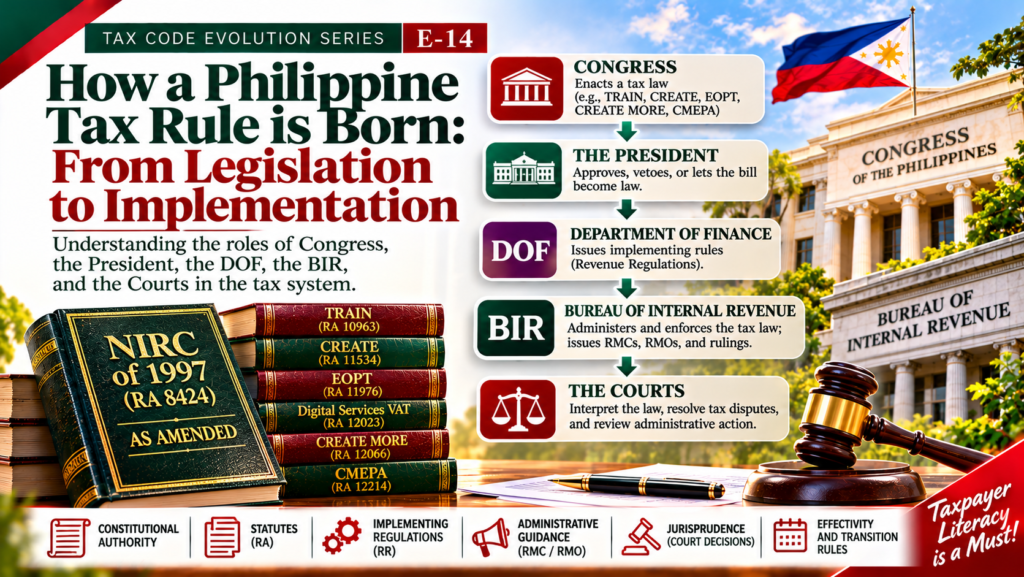
[E-14] HOW A PHILIPPINE TAX RULE IS BORN: FROM LEGISLATION TO IMPLEMENTATION Tax Code Evolution Series No. 14 Understanding the Roles of Congress, the President, the Department of Finance, the BIR, and the Courts Part I — Tax Code Evolution | easantoscpa.comLast reviewed: October 31, 2026 When the BIR announces a new tax rule, who […]
[E-13] The Current NIRC: How To Read The National Internal Revenue Code As Amended In 2026
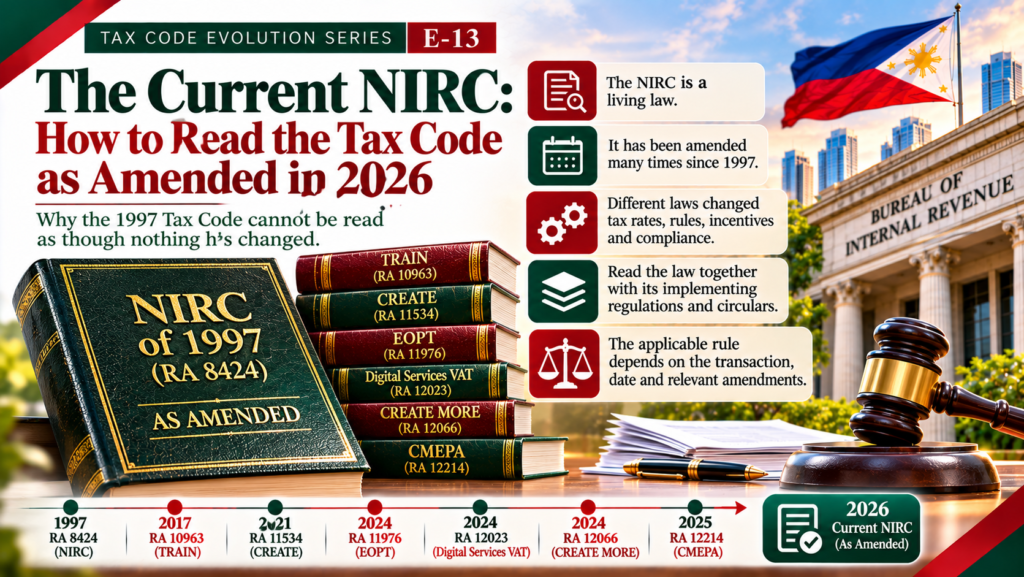
[E-13] THE CURRENT NIRC: HOW TO READ THE NATIONAL INTERNAL REVENUE CODE AS AMENDED IN 2026 Tax Code Evolution Series No. 13 Why the 1997 Tax Code Cannot Be Read as Though Nothing Has Changed Part I — Tax Code Evolution | easantoscpa.comReview date: October 31, 2026 The Tax Code still says “1997.” Does that […]
[E-12] CMEPA: How Ra 12214 Changed The Taxation Of Capital Markets And Financial Transactions
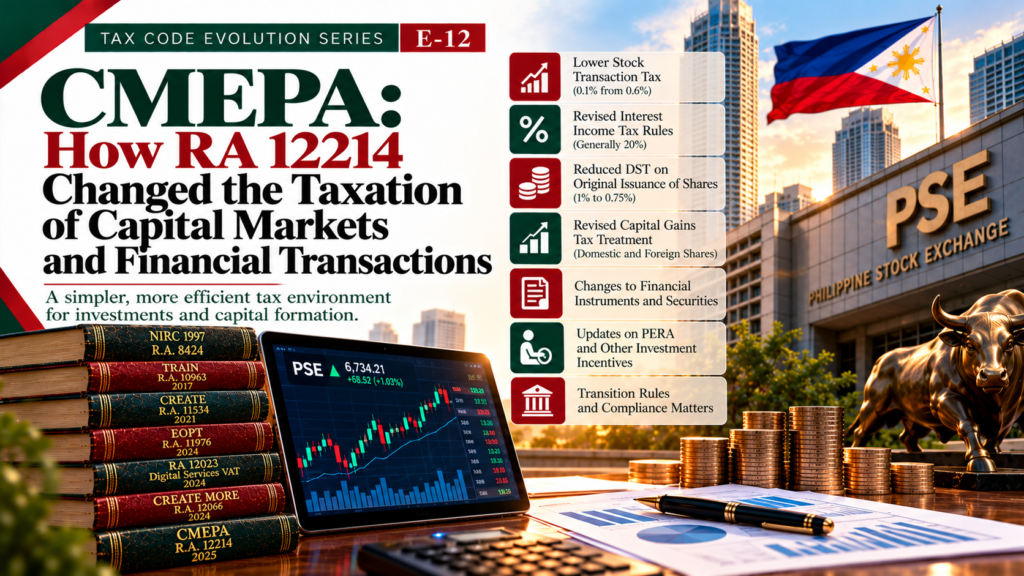
[E-12] CMEPA: HOW RA 12214 CHANGED THE TAXATION OF CAPITAL MARKETS AND FINANCIAL TRANSACTIONS Tax Code Evolution Series No. 12 Capital Markets Efficiency Promotion Act (CMEPA)Last reviewed: October 30, 2026 Part I — Tax Code Evolution | easantoscpa.com A tax reform that goes beyond ordinary business taxation When Philippine taxpayers hear about tax reform, they […]
[E-11] Create More: Why RA 12066 Rewrote Parts Of The Create Framework

[E-11] CREATE MORE: WHY RA 12066 REWROTE PARTS OF THE CREATE FRAMEWORK Tax Code Evolution Series No. 11 CREATE was supposed to reform corporate taxation and tax incentives. CREATE MORE came soon after and changed important parts of that framework—including incentives, VAT treatment, local sales, compliance, and the administration of registered business enterprises. If TRAIN […]
[E-10] Digital Services VAT: How RA 12023 Brought Digital Services Into The Philippine Vat System
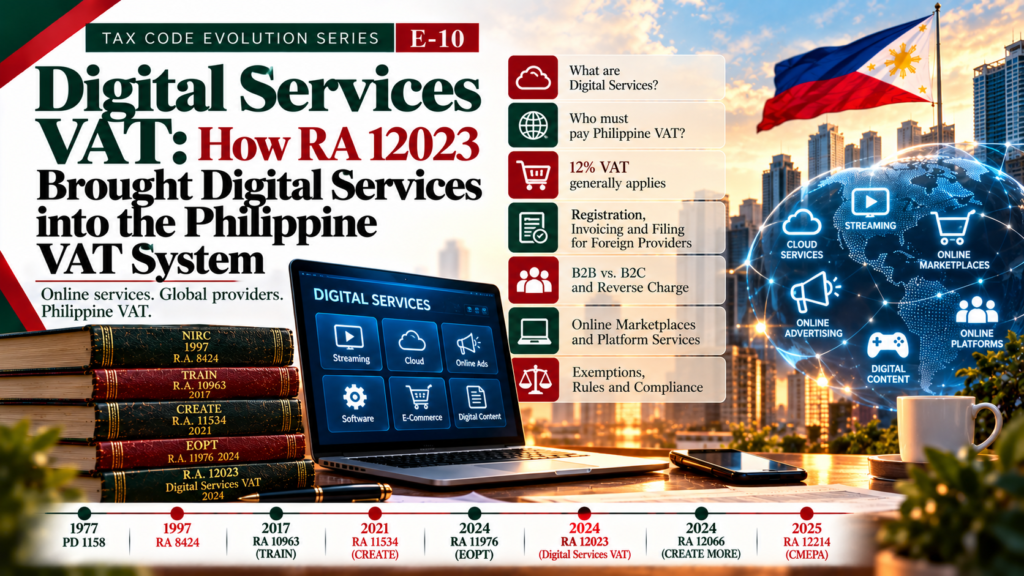
[E-10] DIGITAL SERVICES VAT: HOW RA 12023 BROUGHT DIGITAL SERVICES INTO THE PHILIPPINE VAT SYSTEM Tax Code Evolution Series No. 10 You may never see the foreign digital company that provides your service. But if you consume that digital service in the Philippines, Philippine VAT may still follow the transaction. A few years ago, the […]
[E-09] EOPT: Why RA 11976 Changed How Taxpayers Comply
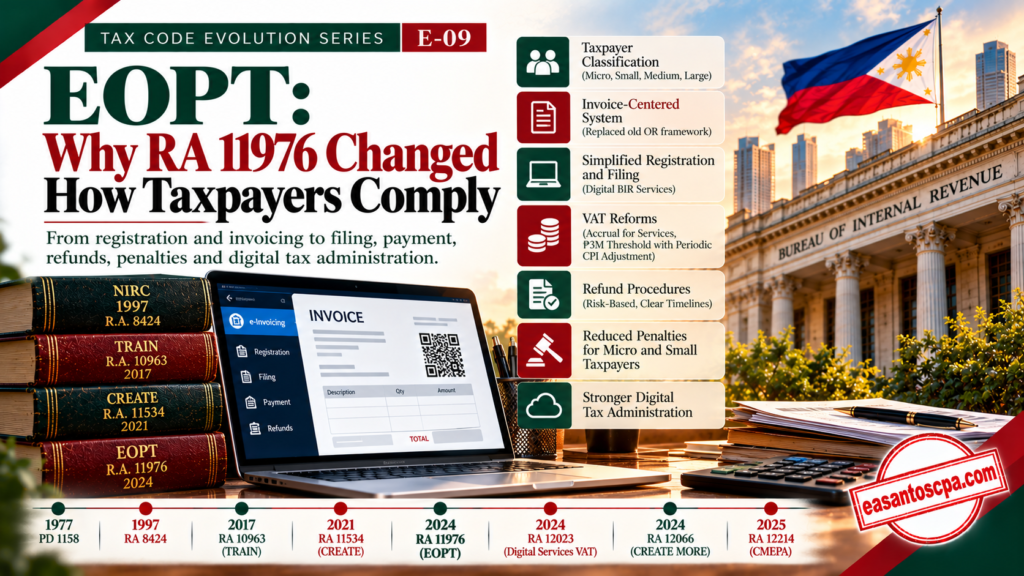
[E-09] EOPT: WHY RA 11976 CHANGED HOW TAXPAYERS COMPLY Tax Code Evolution Series No. 9 The Ease of Paying Taxes Act did not simply make taxes “easier.” It changed the legal architecture of taxpayer compliance—from registration and invoicing to filing, payment, refunds, records, penalties and digital BIR services. For many taxpayers, the phrase “Ease of […]
[E-08] Create: How RA 11534 Reshaped Corporate Taxation And Tax Incentives

[E-08] CREATE: HOW RA 11534 RESHAPED CORPORATE TAXATION AND TAX INCENTIVES Tax Code Evolution Series No. 8 CREATE did more than lower corporate income tax. It changed the architecture of corporate taxation and tax incentives in the Philippines. When TRAIN became law in 2017, it significantly changed the individual-tax side of the Philippine tax system. […]
[E-07] Train: Why RA 10963 Changed The 1997 NIRC
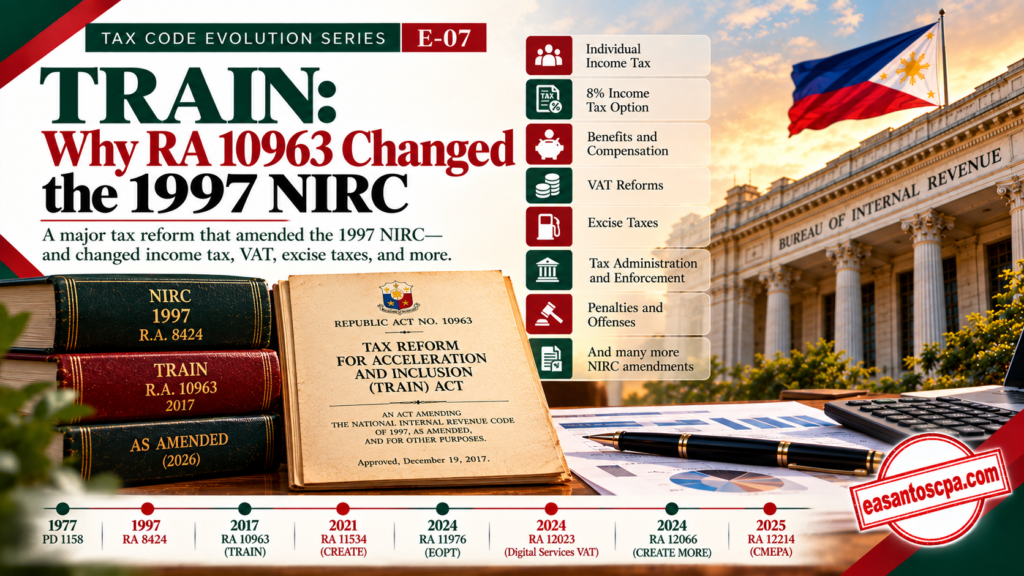
[E-07] TRAIN: WHY RA 10963 CHANGED THE 1997 NIRC Tax Code Evolution Series No. 7 The 1997 NIRC was not replaced by TRAIN. It was amended by TRAIN—and that distinction matters. When taxpayers hear “TRAIN Law,” many immediately think of income-tax brackets, the 8% tax option, excise taxes, or the increase in the tax on […]
[E-06] The 1997 NIRC: How the Modern Tax Code Is Structured
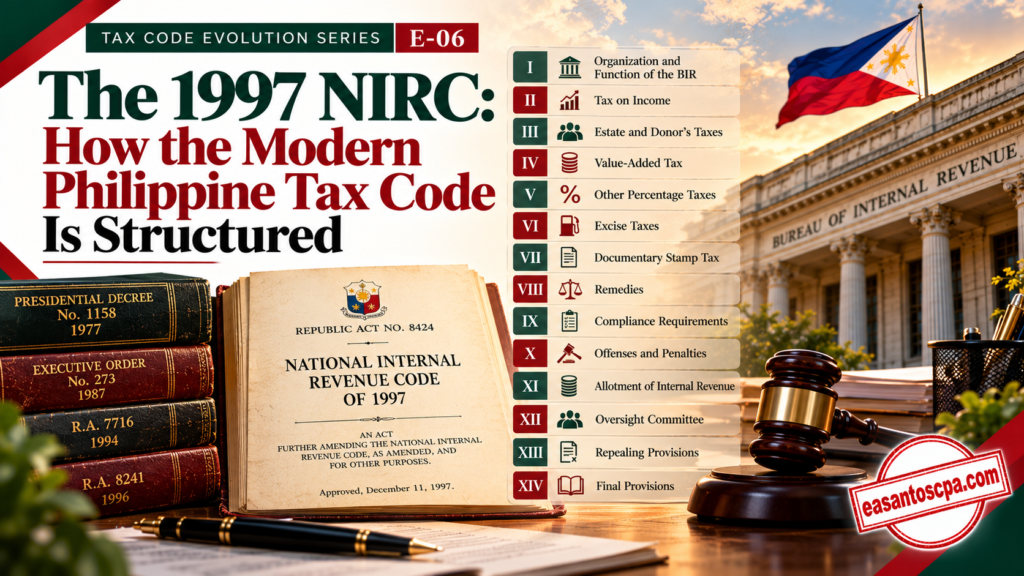
[E-06] THE 1997 NIRC: HOW THE MODERN PHILIPPINE TAX CODE IS STRUCTURED Tax Code Evolution Series No. 6 We have now followed the evolution of Philippine internal revenue law from: Act No. 1189 (1904)→ Act No. 2339 (1914)→ CA 466 (1939)→ PD 1158 (1977)→ EO 273 and the 1980s–1990s tax reforms→ RA 8424 (1997) But […]